
The family of 81-year-old Amrikan Prasad Dubey of Khalla Jhadgadiya in Rapti Sonari Rural Municipality–7, Banke, has been living along the bank of the Rapti River for more than a century. Once owning 10 bighas of land, Dubey was known in the village as a landlord. When he had enough land, he even donated two kattha to a nearby community school.
As the Rapti River, which flowed north of his house, gradually shifted southwards, the size of his land kept shrinking.
“Now, only about four to five bighas remain. The fruit orchard and paddy fields have all been cut away,” says Dubey to Onlinekhabar. “I have the land ownership certificate, and I still pay taxes, but the river is flowing over my land.”
As the river continued moving south, Dubey kept relocating his house further and further away. Over time, he has now reached near the school built on the land he once donated, just about 50 meters away.
“I don’t feel like leaving the place my father chose,” he says emotionally.
His current one-storey house is now separated from the Rapti River by a six-foot-high concrete embankment built after devastating floods in 2014.
That year, the Rapti River caused massive destruction. According to records from the Rapti Sonari Rural Municipality’s disaster and climate resilience plan (2078 BS) and Banke District Administration Office’s rapid assessment report (2079 BS), around 700 houses were inundated. Of these, 180 were fully damaged and 1,574 partially damaged.
Two people, including a child, died in the floods, and losses worth around Rs 56 million were recorded in food and household goods. About 735 bighas of farmland were eroded.
“After the flood entered the village, only water could be seen everywhere,” Dubey recalls. “It looked like an ocean, and we had to use boats to rescue people to safer places.”
He says it took three days before they could even get drinking water and somehow survive.
“Productive rice fields were buried under sand and gravel. Later, we had to load them into tractors and dump them elsewhere,” he remembers.
High-risk area
Rapti Sonari Rural Municipality lies in a high flood-risk zone. According to data from the Kusum flood measuring station, the area has crossed warning levels 15 times in the last 20 years.
After the devastating 2014 flood, then-President Ram Baran Yadav visited the affected area. The government then decided to construct a concrete embankment along the Rapti River. For a few years after its construction, locals felt relieved.
But nature proved otherwise. In 2022, the same embankment was destroyed by floods. According to rural municipality records, the flood fully damaged 65 houses and partially damaged 230. Around 798 households were displaced. Food supplies of 1,250 households and crops over 1,650 hectares were destroyed.
Since then, every monsoon has brought repeated suffering to Rapti-side villages. Locals repeatedly appealed to rebuild the broken embankment. They visited offices, met leaders and lawmakers, but their demands were ignored.
“We went everywhere but only returned disappointed,” says Khusi Ram Dubey of Khalla Jhadgadiya–7. “They kept saying stones cannot be extracted, so how can an embankment be built?”
Although there was budget support from the Asian Development Bank under the People’s Embankment Program, legal hurdles in extracting river materials delayed reconstruction, leaving riverside residents to suffer.
Arrival of a new chief
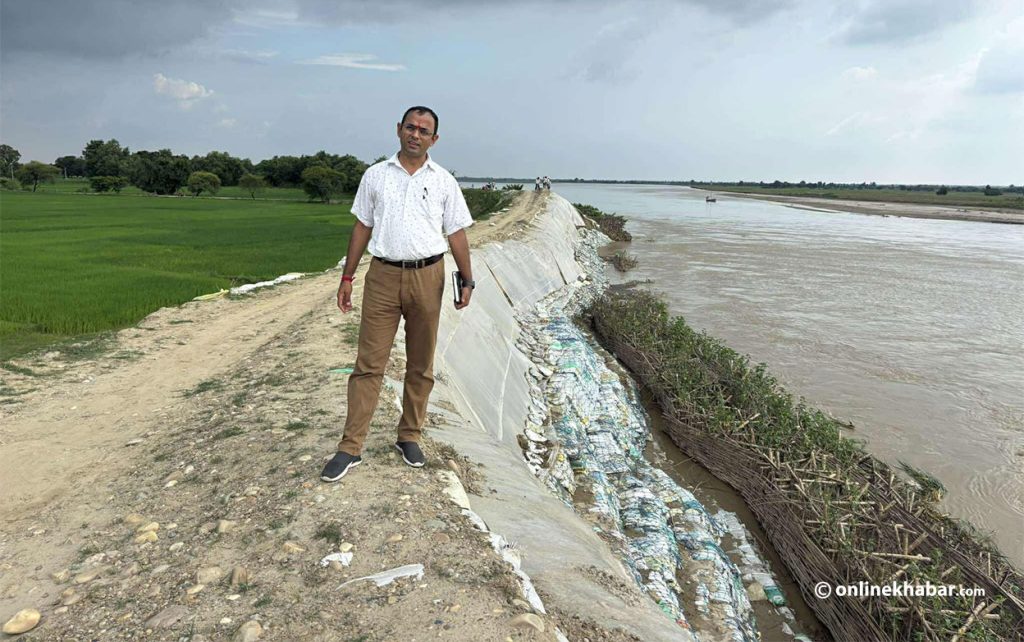
The People’s Embankment Program’s Lamahi field office was responsible for constructing embankments in eight high-risk sites, six in Dang and two in Banke, including Khalla Jhadgadiya. While some work progressed in Dang through contracts, no work had started in Khalla.
Meanwhile, the Ministry of Energy, Water Resources and Irrigation transferred the office head. On February 12, 2025, senior divisional engineer Narayan Prasad Subedi took charge.
“When I arrived, progress was very disappointing. The project was almost in flight mode and ADB pressure was increasing,” he says.
With the monsoon approaching, there was an urgency to build the embankment.
Since a permanent structure was not possible in a short time, Subedi devised an emergency solution.
“We had to protect the people of Rapti Sonari at any cost. So we decided to build an emergency embankment using local resources,” he says.
During the busy rice plantation season, finding workers was difficult. Officials went door to door in fields to gather labourers. “We convinced people from even Narainapur rural municipality, saying let’s first build the embankment and then continue farming,” says Ward Chair Ram Lakhan Tharu. Workers were paid daily wages.
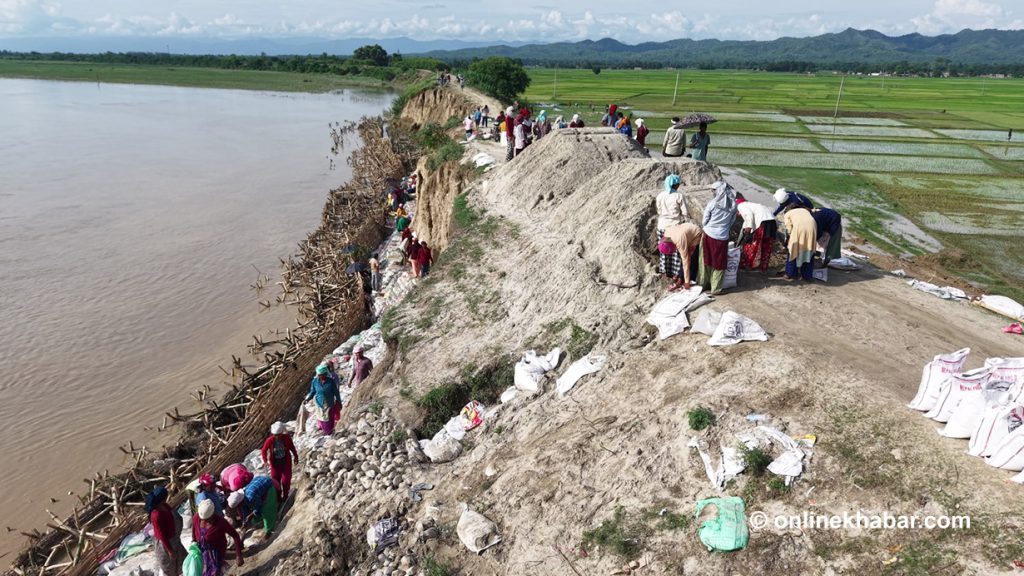
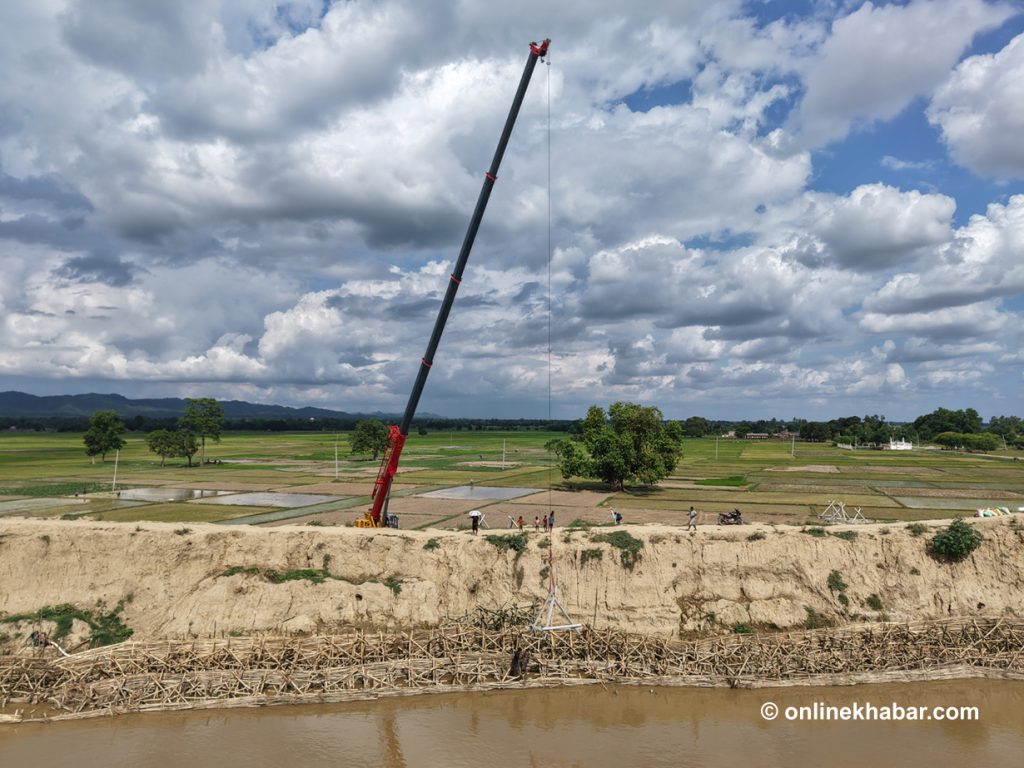
About 100 workers built a 400-meter temporary embankment using bamboo, bamboo strips, sand-filled sacks, cement poles and iron rods.
Since then, locals say the structure has withstood more than a dozen floods since 2024. “This year alone, seven major floods came, but this embankment held,” says local Durga Pandey.
Residents say they are relieved. “We kept pleading for repairs for three years, but no one listened. This initiative saved our lives,” says Pandey.
How the temporary embankment worked
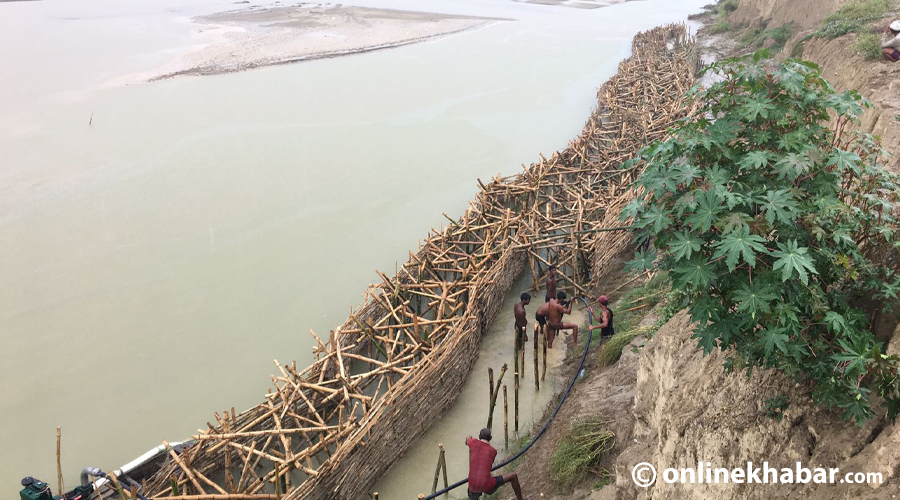
According to engineer Subedi, cement poles and bamboo-based structures were used in a triangular formation, placed underwater and supported with geotextile, sandbags and plastic netting. Bamboo poles were deeply anchored, and protective layers were added to prevent erosion.
Village chair Tapt Poudel says around 30,000 people have been partially protected. Officials say a permanent embankment contract has already been signed.
Continued annual damage
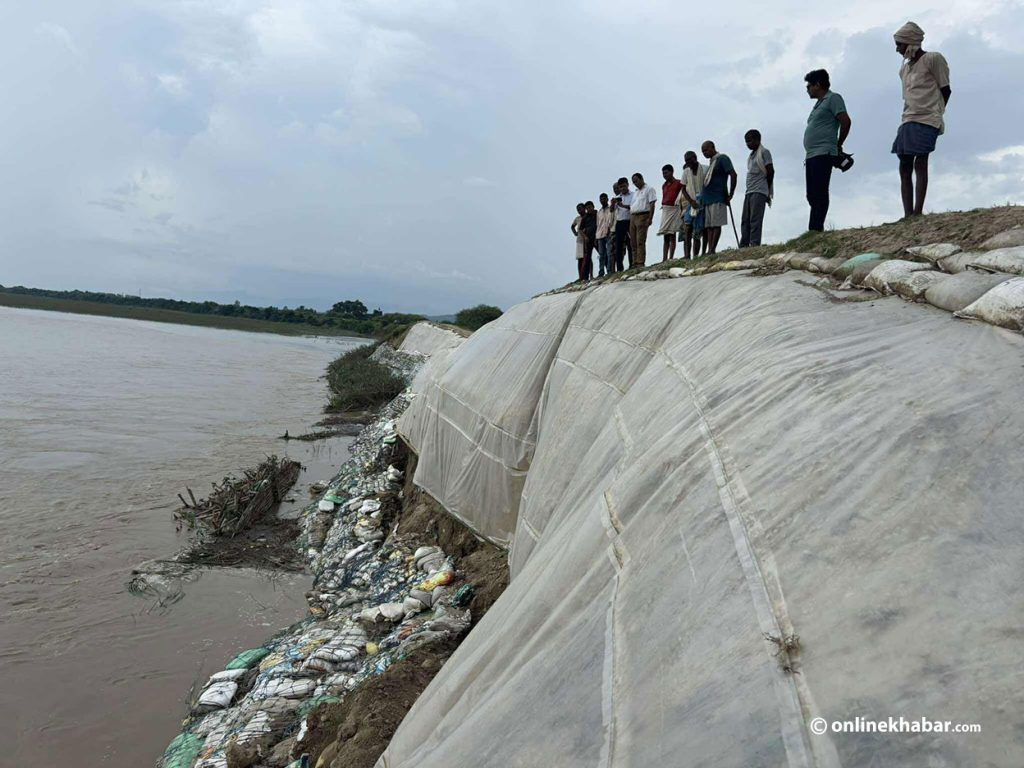
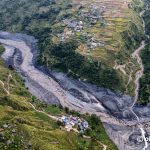
The Rapti Sonari area continues to suffer yearly floods and erosion. Since the construction of India’s Laxmanpur dam (1985) and Kalakalwa embankment (2000) nearby, local settlements have repeatedly been inundated, residents say.
Over the years, floods have caused repeated deaths, displacement, and large-scale destruction of homes, crops and livestock, as recorded in government reports.
Locals continue to demand a permanent embankment to solve the crisis.
Walking 165 km to study the river
Under the Asian Development Bank-supported project, embankment work covering 11 km is ongoing in different sections. Progress has reached about 79 percent.
Officials say prior to construction, a 165-kilometer on-foot survey along the Rapti River from Dang to Banke was conducted over 11 days to understand river behavior and identify stone sources.
Engineer Subedi says the survey team included engineers, sub-engineers and staff who walked along riverbanks in extreme heat to study conditions and coordinate materials.
After the embankment construction, both sides of the Rapti River have become safer, allowing farmers to cultivate crops and earn income again.
Local farmers say they are now able to grow peanuts, cucumbers and vegetables on previously vulnerable land and are relieved by the reduced risk of flooding.