
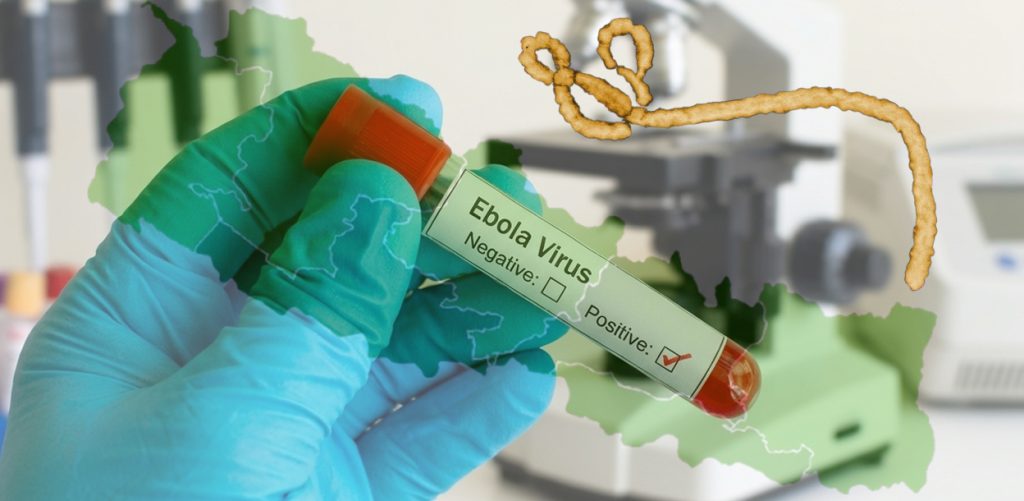
The Bundibugyo Ebola virus is currently spreading rapidly in the African nation of Congo. The virus has also reached Uganda, a neighbouring country. Seeing the risk that its extraordinary and rapid spread could affect other countries, the World Health Organisation (WHO) has declared a public health emergency.
With this declaration, fear of Ebola has once again risen around the world. The Ebola epidemic that spread in West Africa in 2014–15 claimed the lives of thousands of people. The Bundibugyo strain now emerging is being viewed with equal seriousness.
According to experts, although this virus is extremely dangerous, it does not spread through the air like COVID-19. However, because it can spread quickly through contact with the bodily fluids of an infected person, extreme caution is necessary.
Experts say that while there is no immediate high risk in Nepal at this time, the country cannot be considered fully safe due to global travel and movement.
Understanding Bundibugyo Ebola virus
According to infectious disease specialist Dr Sher Bahadur Pun, the Bundibugyo Ebola virus is one of the main strains of Ebola. Although its outbreaks have not been seen many times in the past, it is considered extremely dangerous.
He says past studies have shown its fatality rate to be around 40% on average, while the overall Ebola fatality rate can reach approximately 50%.
Symptoms
According to Dr Pun, the early symptoms of this virus resemble those of ordinary fever, typhoid, or malaria fever, body aches, extreme fatigue, sore throat, and increasing weakness.
In later stages, serious bleeding-related complications can also appear.
How Does It Spread?
He says the most dangerous aspect of Ebola infection is its high transmissibility, although it does not spread through the air. Infection occurs through direct or indirect contact with the bodily fluids of an infected person; blood, vomit, urine, faeces, saliva, sweat, or semen can all transmit the virus easily. It can also spread through materials used by an infected person. Dr Pun notes the belief that the virus can pass from infected animals, especially bats, to humans.
Importantly, an infected person can only transmit the virus to others after symptoms appear. Therefore, if identification and isolation can happen in time, controlling the infection is possible.
Risk to Nepal
Dr Pun says that while the direct risk to Nepal is currently low, it cannot be said to be zero. Travel between African countries and Nepal is increasing, and tourist numbers are also rising. In such a situation, the possibility of infection reaching Nepal at any time remains.
“We have the example of monkeypox reaching Nepal from Africa,” he says. “So Ebola cannot be taken lightly either. Since sanitation, surveillance, and health preparedness in our country are still weak, long-term preparation is necessary.”
Dr Sameer Kumar Adhikari, Deputy Spokesperson of the Ministry of Health and Population, says Nepal is not currently at high risk, as direct travel between Nepal and the affected African regions is limited.
“It is mainly Nepali security personnel going on peace missions who travel to those areas,” he says, “but the world has now become a global village. Any country’s infection can reach another country in no time.”
Government preparedness
According to Dr Adhikari, the government has already started various preparations. The Ministry of Health has activated a central-level surveillance mechanism, and laboratories have been kept on standby for testing.
Fever screening and health checks have been set up at Tribhuvan International Airport, and a system to immediately isolate those showing symptoms has been put in place.
“Rapid response teams are on standby,” he says to Onlinekhabar. “Coordination with other countries is ongoing in line with the WHO and the International Health Regulations. Strict health protocols have been enforced for security personnel returning from Africa.”
He adds that the general public does not need to panic at this point, but caution is necessary.
No approved vaccine or specific treatment
According to infectious disease specialist Dr Anup Subedi, another challenge with the currently circulating Bundibugyo strain is the lack of a fully effective, approved vaccine or specific treatment. He says this is why the WHO is taking the current outbreak very seriously.
“Ebola is an extremely deadly disease,” he says, “but it does not spread through the air like COVID. Infection occurs only through direct contact with the bodily fluids of an infected person. This is why, if timely identification, surveillance, and isolation are possible, it can be controlled.”
Dr Subedi notes that since the major 2014–15 outbreak, small-scale Ebola infections have kept appearing from time to time. The reason it has not yet spread as a global pandemic is the very fact that it does not spread through the air.
He says that although the risk of a major epidemic in Nepal is currently low, the possibility of an infected person arriving in Nepal via other countries remains.
“There may be a period of alertness and anxiety worldwide for a few months,” Subedi says, “but right now, preparedness and awareness are more important than panic.”
What should the public do?
Experts say the general public should adopt basic health precautions at this time. If someone arriving from an affected area shows fever or other symptoms, health authorities should be informed immediately.
Contact with the bodily fluids of infected individuals should be avoided. Their advice: wash hands regularly, maintain personal hygiene, and trust only official information.
Conclusion
According to experts, although Ebola is extremely deadly, it is a disease that can be controlled through timely identification, isolation, and surveillance. Even though Nepal is not currently at high risk, it is extremely necessary to strengthen the health system, surveillance capacity, and public awareness.
Doctors conclude that in the current situation, what is needed more than fear is alertness, preparedness, and accurate information.