
Photos: Milan KC
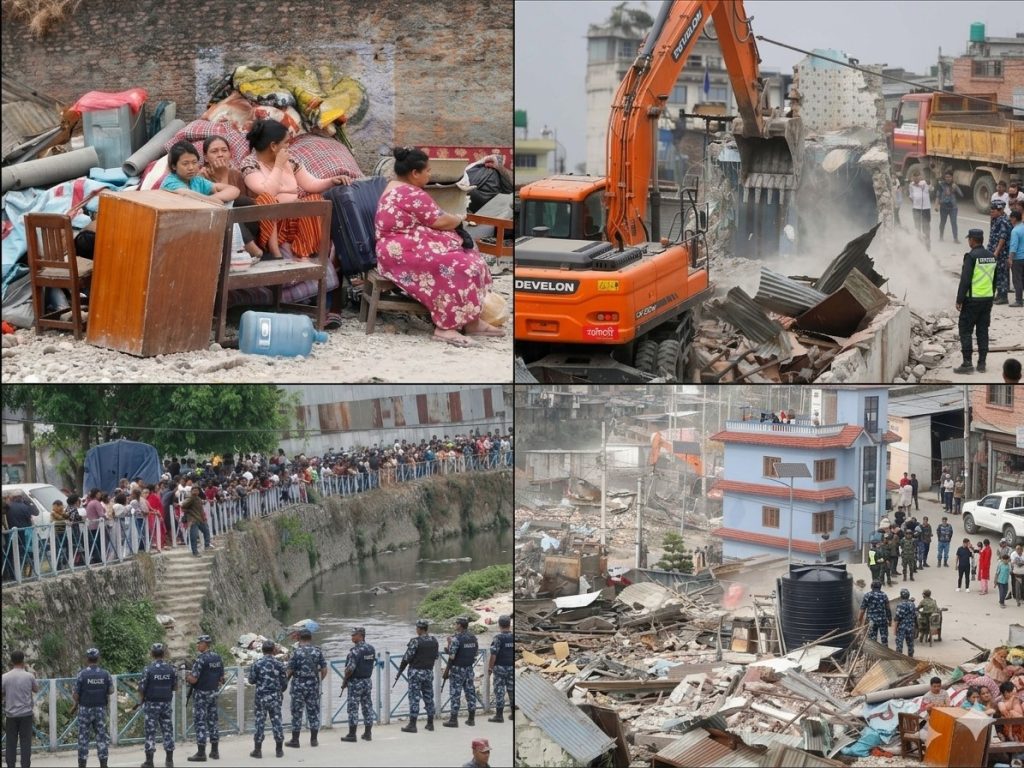
When bulldozers moved into Kathmandu’s riverside settlements in late April 2026, they did what Nepali governments have done for decades: cleared land, displaced people, and called it progress. Over 15,000 residents lost their homes along the Bagmati and its tributaries within weeks. The Supreme Court intervened, demanding rehabilitation plans. Protests erupted. And the cycle demolish, promise, commission, repeat began once more.
Nepal’s political class habitually describes these settlements in terms of illegality—encroachment, unauthorised occupation and disorderly urban growth—these words do real work: they shift responsibility onto the displaced and away from the state that failed them.
However, the persistence of the crisis, growing larger with every passing government, demands a more uncomfortable question. What if Nepal’s squatter problem is not primarily about illegal settlement at all? What if it is instead the cumulative consequence of historical inequality, political manipulation, and institutional failure spanning generations?
A crisis rooted in history, not accident
Landlessness in Nepal did not begin with recent rural migration or riverside settlements. It is woven into the country’s unequal social fabric. Lower-caste communities, bonded labourers, Indigenous populations, and other marginalised groups survived for centuries within systems that denied them secure property rights as a matter of course, not oversight.
The Rana-era abolition of slavery under Prime Minister Chandra Shumsher is frequently cited as a progressive landmark. In practice, it created a profound contradiction that the state was unwilling to resolve. Thousands of freed people gained their liberty without land, assets, or viable livelihoods. Emancipation transformed invisible dependency into visible landlessness. The structural problem did not disappear; it merely became the state’s problem to ignore.
Post-1951 land reforms, including the abolition of birta holdings and cadastral surveys, were designed to weaken elite control over land. In practice, political patronage and bureaucratic weakness meant the benefits were routinely captured by those already connected to power.
The democratic restoration of 1990 and the 2015 Constitution, which formally recognised housing and land rights for landless Dalits and formerly bonded labourers, promised more. Implementation has faltered repeatedly across shifting governments, jurisdictional disputes between federal, provincial, and local administrations, and the chronic absence of political will to follow through.
Commission culture as a political strategy
What has filled this vacuum is what might fairly be called Nepal’s commission culture, the ritualised appointment of bodies to study problems that previous bodies already studied, collect applications that previous bodies already collected, and dissolve before programs mature, leaving the next government to begin again.
By 2026, the National Land Commission had accumulated applications from over 1.21 million families, including nearly 99,000 landless Dalits, 181,000 landless squatters, and over 933,000 informal settlers. Officials themselves estimate that only around 280,000 families are genuinely landless. The gap between those numbers is not simply administrative backlog. It reflects a system in which promises of land have become electoral currency, distributed freely before elections and indefinitely deferred afterwards.
This political economy explains why the crisis persists despite formal constitutional guarantees. Governments found it more useful to keep the issue unresolved than to settle it. In some areas, local political actors actively encouraged occupation of public land in exchange for electoral loyalty. Informal settlements became vote banks.
Land mafias exploited legal ambiguity. And genuinely landless families remained trapped between promises and precarity, unable to improve homes they might lose tomorrow, unable to obtain the documents that civic life requires.
What informal settlement actually cost
Policy discussions rarely reckon honestly with the full cost of inaction. Families in informal settlements lack reliable sanitation, clean water, drainage, and waste collection despite living near rapidly expanding urban centres. Parents avoid investing in their homes because eviction always remains possible.
Children face bureaucratic obstacles in obtaining citizenship documents, since proof of residence and proof of ownership are entangled in contradictory bureaucratic requirements. The result is not merely economic vulnerability but civic invisibility, people living outside the systems that are nominally designed to serve them.
Environmental costs compound the human ones. Many informal settlements occupy riverbanks, floodplains, and unstable hillsides precisely because safer urban land is unaffordable. In the Chure and Bhabar regions, unmanaged settlement contributes to deforestation, erosion, and threats to long-term water security.
Climate change is certain to intensify these pressures, displacing additional rural populations into cities already under strain. The economic logic is clear, even if governments have ignored it: planned, serviced settlements cost less in the long run than repeated disaster relief, unplanned urban sprawl, and perpetual crisis management.
Beyond the eviction-or-redistribution binary
Nepal’s political debate has long been stuck between two inadequate responses: mass eviction, which displaces people without addressing why they are there, and blanket redistribution promises, which generate applications without delivering land. Neither confronts the structural problem. Neither has worked.
International experience offers more nuanced lessons. Brazil’s favela upgrading programs focused on integrating infrastructure and services into existing communities rather than removing them. Thailand experimented with community-led housing cooperatives and collective ownership models.
South Africa’s post-apartheid housing reforms demonstrated both the genuine possibilities and serious limitations of large-scale state-led settlement. What distinguished more successful efforts was not the generosity of promises but the presence of continuity, community involvement, realistic financing, and accountable institutions.
Nepal has the data. It has the satellite technology, GIS mapping capacity, and years of commission reports. What it has lacked is the institutional discipline to act consistently across political cycles. A permanent, depoliticised national settlement authority with multi-party oversight would provide continuity that temporary commissions cannot.
Transparent verification using digital land records, income and asset criteria, and defined cut-off dates could separate genuine landless families from informal settlers or opportunistic claimants, something past efforts have conspicuously avoided because the ambiguity was politically convenient.
Viable settlements require full infrastructure from the outset: water, sanitation, schools, and transport, not years of promises. Financing must be grounded in clear budgets, land-value capture mechanisms, and enforceable anti-corruption safeguards.
Local governments and cooperative housing models should be empowered to give residents genuine agency rather than making them passive recipients of central decisions. And any settlement strategy must be integrated with environmental planning, particularly in ecologically fragile zones where further unmanaged expansion causes irreversible harm.
What the moment demands
The Kathmandu demolitions of 2026 have created a political inflexion point. They have displaced over 15,000 people in weeks, provoked a Supreme Court intervention, and returned the oldest unresolved question in Nepali governance to the centre of public debate. That creates an opportunity that previous governments have wasted.
Nepal’s squatter crisis is not a problem of encroachment. It is the outcome of historical exclusion, failed land reform, political patronage, environmental neglect, and the chronic inability of the state to honour its own commitments. Bulldozers without rehabilitation plans are not governance.
Commissions without authority or continuity are not reform. The people living along Nepal’s rivers and hillsides are not symptoms of disorder to be cleared. They are citizens whose landlessness the state helped create and has spent decades failing to resolve.
Until Nepal’s governments treat this as the structural political problem it is, rather than a recurring administrative inconvenience to be managed until the next election, the cycle of demolitions, protests, commissions, and broken promises will continue. The moment to break it is now.