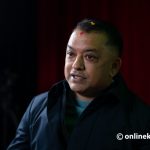

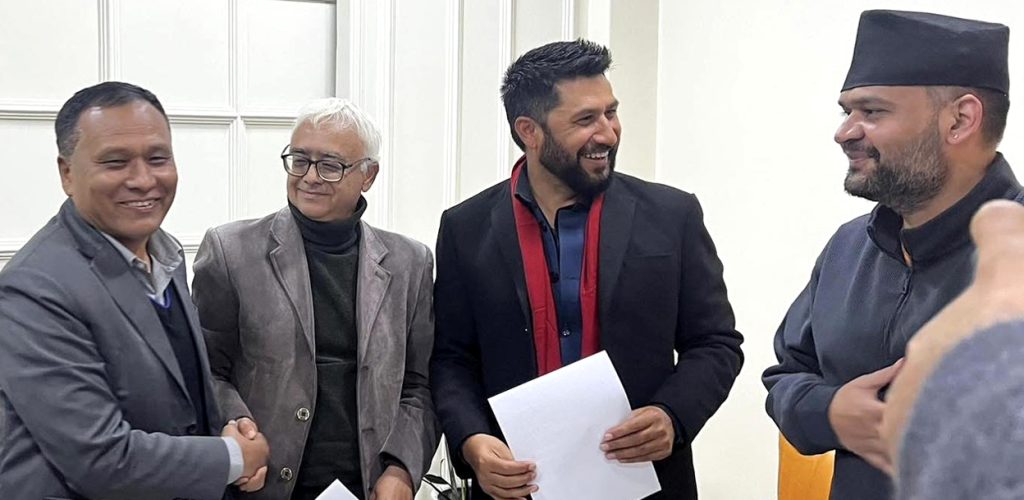
Raising their voices against the poor governance of old political parties, three new political forces have united.
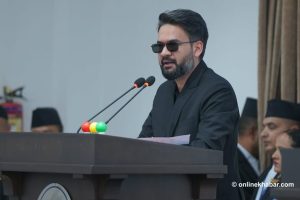
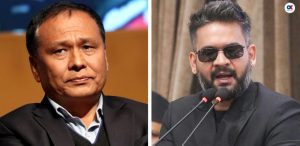
A day after the group led by Kathmandu Mayor Balen Shah united with the Rastriya Swatantra Party (RSP) led by Rabi Lamichhane, the Ujyalo Nepal Party, associated with Kulman Ghising, also joined the unification process on Monday (December 29).
With the unification between the RSP and the Ujyalo Nepal Party as well, the voices raised against the old parties have now been largely organised into a single force. Earlier, the Bibeksheel Sajha Party had already merged into the RSP.
Some leaders of the Gen Z movement had also already entered the RSP.
The political, moral, and material support of those involved in the Gen Z movement appeared to be concentrated in these three groups. Therefore, Gen Z activists had also been mounting pressure on these three forces to unite for elections.
Concluding that it would not be possible to break the dominance of the old parties by contesting elections separately, these three forces came together. However, after the Gen Z movement, other political parties have also emerged in the name of alternative forces.
The unification among these three forces also involved discussions on the distribution of positions within the party structure. Rabi Lamichhane will remain the party chairperson. Balen Shah will be the prime ministerial candidate. Kulman Ghising will hold the position of senior vice-chairperson, the first rank after the chairperson. There is a gentleman’s agreement that 18 names in the proportional representation list will come from the Ujyalo Nepal Party and 40 from Balen Shah’s side.
Their main objective in moving forward by distributing positions to balance internal power is to stand against misgovernance and to establish a merit-based system.
Repeated discussions were held among the three forces to reach this agreement. In the first phase, consensus was reached between the RSP and Balen Shah. In the second phase on Monday, an agreement was reached with Kulman Ghising.
Earlier, although there had been an agreement between Kathmandu Mayor Balen and RSP chair Lamichhane, a consensus could not be reached with Kulman.
After forming his party, Ghising, who had been engaged in discussions with various alternative forces, met Gen Z leaders and other figures. He even publicly shared a photo with Kathmandu Mayor Balen Shah, writing, “We are together in the responsibility of building the nation.”
On the very day Ghising posted that message, the RSP and Bibeksheel Sajha unified. Even then, while signaling that he would move forward almost together with Balen, Ghising continued parallel discussions with the RSP. He even formed a negotiation committee within his party to continue talks on unity and cooperation.
As Ghising moved forward advocating unity with alternative forces, there were also commentaries suggesting that he made the photo with Balen public to increase his bargaining power after the RSP–Bibeksheel merger.
After that too, Ghising remained in continuous dialogue and talked multiple times with Balen and Lamichhane. This continued even after the Lamichhane–Balen agreement. Discussions among these leaders continued until Sunday night.
However, those discussions ended without a conclusion. After that, both parties began preparing their proportional representation lists independently. The Ujyalo Nepal Party even submitted its proportional list to the Election Commission. The RSP also held a central committee meeting to prepare its proportional list.
Even as the Ujyalo Nepal Party was submitting its list to the Election Commission, Ghising again entered into dialogue with the RSP. After discussions with party leaders at Antara Hotel in Boudha, Ghising set out to meet Rabi.
Some central committee members of the Ujyalo Nepal Party were present at Antara Hotel, where an internal meeting was underway. Work was ongoing to prepare the party’s proportional candidate list.

According to a member present at the meeting, while the Ujyalo Nepal Party’s meeting was going on at Antara, RSP chair Lamichhane kept calling repeatedly. But Ghising did not answer. He was reportedly saying to those close to him, “They just keep talking, but they never actually agree.”
“Kulman did not answer Rabi’s calls. We were all almost disappointed, thinking they only talk and never agree. But suddenly Sudhan Gurung and others came and took him away,” a leader close to Ghising told Onlinekhabar.
According to Gen Z sources as well, Gen Z Council leader Sudhan Gurung took Kulman in a car. For the tripartite talks with Balen, Gen Z leaders Sudhan Gurung, James Karki, and Ojaswi Thapa transported Ghising to the negotiation venue.
Just some time before that, Sudhan Gurung had gone to the RSP office itself and pressured them to also bring Kulman along before the central committee meeting began.
One of the Gen Z leaders who took Ghising to the negotiation venue, Ojaswi Thapa, told Onlinekhabar, “They were in Boudha. We went there and requested him. Then we brought him to the negotiation venue in the car. We exerted as much pressure as possible on all sides to make them unite.”
Another Gen Z leader, James Karki, said, “We met all three leaders today and told them, “You must unite no matter what. Otherwise, you yourselves are trying to divide Gen Z. There is no alternative to unity right now. At least do it for us.” After that, the leaders who had already made up their minds to go their separate ways became ready to sit for talks again.”
Earlier too, after the unification between Lamichhane and Balen, there had been repeated efforts to unify with Kulman Ghising. Meanwhile, Ujyalo Nepal had also been holding parallel talks on unity with parties like the Pragatisheel Loktantrik Party. Even after Balen united with the RSP, tripartite dialogues among Lamichhane, Balen, and Ghising took place in phases.
However, consensus could not be reached on the distribution of positions. According to a central member of the Ujyalo Nepal Party, even though they presented themselves very generously for unity with the RSP, the unification failed because RSP chair Lamichhane devalued one force.
Claiming that there had been a form of “political humiliation” from the RSP, the Ujyalo Nepal Party went ahead and prepared its own proportional list and registered it with the Election Commission.
“Rabi showed a cunning and condescending attitude. Initially, he proposed uniting with a 30 percent share, but later said, ‘If you want, come with 15 percent,’” the central member says, citing this as the reason consensus was not reached earlier.
In any case, the effort by these three sides to unite alternative forces did not emerge suddenly. Even before forming the Ujyalo Nepal Party, Ghising had held discussions with RSP vice-chair Swarnim Wagle. At that time, talks failed because Ghising insisted on becoming the party chairperson. Back then, the RSP was ready to move Ghising forward as vice-chair and even as a future prime minister. But because Ghising stuck to his demand for the chairmanship, agreement could not be reached.
Instead, Ghising released photos with Balen to create a favorable environment for himself. He made every possible effort to position himself at the center of alternative forces.
However, after Lamichhane was released from Nakhu prison, dialogue among alternative forces suddenly accelerated. Lamichhane, Balen, and Kulman held separate meetings in various phases.
In the final stage, on Sunday at dawn, an agreement was reached between Balen and Lamichhane. Ghising was left out of that unity because he maintained his demand for an executive role. Ghising’s supporters argued, “One gets the chairmanship, another gets the prime ministership, what do we get?”
The Ujyalo Nepal Party even rejected a proposal that suggested Lamichhane as chairperson, Ghising as senior leader, and Balen as prime minister. Since the party name, election symbol, chairperson, and prime ministerial candidate would all come from the RSP, Ujyalo Nepal Party became dissatisfied.
Ujyalo Nepal maintained that it would not dissolve its own existence to merge into the RSP. Instead, Ghising commented that even Balen, who had already united with Lamichhane, would end up being betrayed.
According to a central member of the party, during a meeting held from 1 pm to 5 pm on Saturday at a hotel in Boudha, Ghising said, “It has to be win–win for everyone. Unity does not mean that someone’s existence is completely erased. There should not be an environment where others are treated as nothing. Once everyone is accepted as a force, they must be treated as such.”
The Ujyalo Nepal Party also concluded that the RSP had devalued them.
“They thought that since the chairperson and future prime minister would be from their side, we would come running anyway. This is a devaluation of our strength,” a Ujyalo Nepal central member told Onlinekhabar.
As Kulman refused to abandon his stance, some central members of the Ujyalo Nepal Party appeared disappointed. On the very night news broke that Ghising had walked out of the negotiation venue after the Lamichhane–Balen unity, a central member told Onlinekhabar, “Who knows who advised him. Leaving Lamichhane and Balen and walking alone at this time, where can one really reach?”
Ultimately, however, Ghising joined the RSP at the last moment. Having earlier rejected an offer of the prime minister from the RSP, he now accepted unity by agreeing to Balen as the prime ministerial candidate from the same party. On the very issues and points that had caused Ghising’s dissatisfaction, he was compelled to unite with the RSP. Finally, with a seven-point agreement, he will now contest the election scheduled for March 5 1 from the RSP itself.