

Nepali cricket has recently made a major leap commercially. The Nepal Premier League (NPL) has added a new attraction to domestic cricket.
The participation of foreign players, the enthusiasm of spectators, sponsorship and franchise investment have also shown the commercial potential of Nepali cricket. But alongside NPL’s glitter, another side of Nepali cricket remains weak: the domestic structure and grassroots cricket.
As the national team competes continuously at the international level, questions are also being raised about how strong the base for producing new players is. In recent tournaments, Nepal were bowled out for 26 against India and 72 against Pakistan, and many see this as one sign of the problem.
These results alone cannot be linked to the state of grassroots cricket to draw a conclusion. But along with the national team’s performance, a debate is needed on player production, training and the regularity of domestic tournaments.
Former cricketers and coaches have also been raising the issue lately. Former national cricketer Amrit Bhattarai has remarked that the base of Nepali domestic cricket is becoming limited to the T20 format.
“We play only 10 50-over matches in domestic cricket throughout the year. T20 has become the base of our domestic cricket. We are also doing well in T20 at the international level. But the domestic cricket system needs to change,” Bhattarai wrote on social media.
Former cricketer and coach Manoj Katuwal has also said that income from NPL should be used to strengthen the domestic cricket structure. He suggests that investment should increase in women’s cricket, grassroots cricket, and U-16 and U-19 tournaments. According to him, a strong domestic structure is needed to build a strong national team.
The calendar that the Cricket Association of Nepal (CAN) publishes every year includes competitions ranging from age-group to women’s cricket. But not all the tournaments in the calendar have been held. Even those that were held have often failed to take place on schedule, a problem that keeps recurring.
The Women’s Prime Minister Cup, which was due to be held in May this year, has been moved to the first week of December. The men’s U-19 national tournament was also listed in the calendar for May, but it is starting tomorrow, about six months behind schedule.
The CAN Youth Cup listed in the calendar could not be held. The National T20 Championship was not held this year either. It was announced last year as well but did not take place.
A proposal to hold a long-format women’s competition did not materialise. The U-16 women’s national championship was also not held.
A lack of tournaments deprives players of regular competition. When age-group players have limited opportunities to prove themselves at the national level, their development and the selection process can also be affected. In women’s cricket, the lack of regular tournaments and long-format opportunities risks narrowing the path of player development.

CAN Secretary Paras Khadka acknowledges the importance of grassroots cricket but says limited resources have prevented CAN from holding all the tournaments in its calendar. According to him, CAN has already held school tournaments at the district level and plans to prioritise school-level cricket next year.
“Grassroots cricket is linked to every competition that CAN organises. Academies, children’s participation and school-level tournaments are an important part of it,” Khadka. “We are trying to hold as many tournaments as possible with limited resources. We have not been able to hold some tournaments because of time constraints and technical reasons.”
According to him, a large share of CAN’s income goes to the men’s national team. He said that about 60 to 70 percent of the money earned from cricket is spent on the men’s national team, while the rest goes to administration and other management. He said that sufficient resources are needed to expand cricket activities from the district to the provincial level.
Khadka also argues that NPL has given new players a platform to get opportunities and show their talent. Saying that the participation of eight franchises and all seven provinces has attracted young players, he placed NPL within a broader definition of grassroots cricket. However, he admitted that more priority should be given to producing players through school- and college-level cricket.
Former cricketer Binod Das also acknowledged that although CAN is organising school-level competitions, they are not reaching the national level. Das, who has also served as CAN’s cricket operations manager, stressed that competitions should move like a chain, from the district to the province and from the province to the national level.
“CAN is organising two-day and three-day matches and 50-over competitions. The National School Championship was completed at the district level a couple of years ago, but CAN has not been able to follow it up. These are in the plans, but implementation is not going well,” Das says. “There was a plan from the beginning to hold a National School Championship, but it has not moved forward.”
Discontinuation of National Cricket Academy
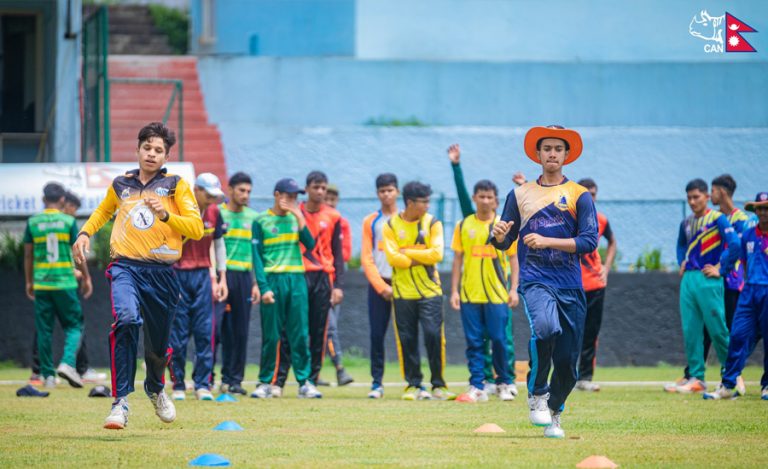
When discussing grassroots and player development, the plan for the National Cricket Academy cannot be forgotten. The National Cricket Academy (NCA) was formally established on January 13, 2013, at the TU Cricket Ground in Kirtipur.
The academy was started on the proposal of then national team coach Pubudu Dassanayake. It aimed to provide continuous training facilities for the national team, Nepal ‘A’, the U-19 team and the women’s national team.
For this purpose, Jagat Tamata and Binod Das were appointed as coaches, and Raman Shivakoti was appointed as data and video analyst. An office and a gym were also set up in a storeroom at the TU ground.
But the plan, put forward 13 years ago, did not get the expected continuity. Former cricketer Binod Das, who was a coach at the time, said it could not be carried forward after CAN was suspended.
“At that time, we had even arranged winter camps for children who had finished their SLC exams. But later, after CAN was suspended, there was a shortage of budget, and we could not carry it forward. We had to shut it down in 2015,” Das told Onlinekhabar.
NPL has opened the door to investment and commercial potential for Nepali cricket. But for its long-term impact to show, the structure for producing new players must be equally strong. Without regular district competitions, school- and college-level cricket, continuity of age-group tournaments, enough opportunities in women’s cricket and systematic training, the base of the national team cannot broaden.
While NPL is making the top tier of Nepali cricket attractive, building the foundation should be an equal priority.
Former cricketer Das also says that CAN should invest the income it earns from NPL in cricket development. He says that income from NPL should be used for the development of cricket as a whole, not for the benefit of any individual or one sector.
He stressed that money from NPL should be spent especially on strengthening grassroots and school-level cricket, and the district and provincial cricket structure. Das said that although NPL has created a strong source of income for CAN, the main challenge now is to use it properly for the development of cricket.
“We needed a cash cow, and it has been created in the form of NPL. The challenge now is to use the money that has come from it properly for the development of cricket,” Das says.