Kathmandu, September 16
Families who have lost hope of finding relatives missing after the Rasuwa floods have begun performing last rites by making symbolic bodies out of kusha grass, following Hindu religious traditions.
They are now approaching ward offices to seek official verification of their missing relatives or register their deaths.
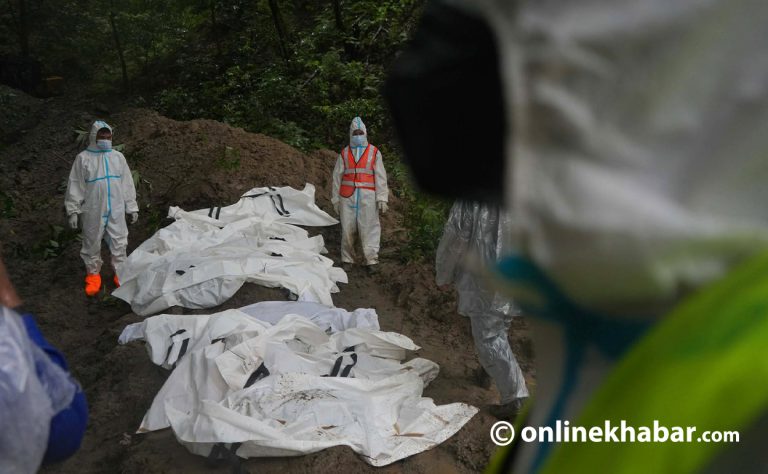
However, local authorities have been unable to certify the deaths of people whose bodies have not been recovered or identified, citing a legal gap in the existing provisions.
Ward offices have asked the government to make a policy decision to address the issue and establish an alternative mechanism for registering such deaths.
The Rasuwa District Disaster Risk Reduction and Management Committee decided last week to write to the Ministry of Home Affairs, saying the lack of clear legal provisions had created difficulties in dealing with people who went missing in the floods.
The committee said the existing process for registering deaths and other vital events involving people who remain missing is cumbersome, creating problems with insurance claims and official confirmation of deaths.
It requested the government to establish an alternative fast-track mechanism for registering such cases.
Rasuwa Assistant Chief District Officer Dipesh Rijal said the Home Ministry had been alerted after local governments across the district faced uncertainty over how to deal with the missing persons.
“Ward offices are currently finding it difficult to register deaths. Families of missing people have performed the last rites after giving up hope of finding them. Some have now come to register their deaths. But what should be recorded as the cause of death? How can we register the death of someone who remains missing?” said Jairam Upreti, chief administrative officer of Uttargaya Rural Municipality in Rasuwa.
“The families have completed the religious rituals even though the bodies have not been identified. But legally, we are in a difficult situation.”
Upreti said the issue had been raised repeatedly in the district disaster management committee.
“Except in cases where the body has been recovered and identified, ward offices are currently in no position to issue any documents for other missing persons,” he said.
Uncertainty extends beyond Rasuwa and Nuwakot
Nuwakot Chief District Officer Shambhu Prasad Regmi said uncertainty over how to deal with missing people was not limited to Rasuwa and Nuwakot.
According to him, another challenge involves verifying people from other districts who went missing in the floods.
“Families whose members have gone missing can only say that their relatives are missing. Until a body is found, there is always hope,” Regmi said.
“They also do not want to declare that their loved one is dead. There has been discussion about providing missing people with facilities similar to those available to deceased persons. The procedure for that also needs to be clarified.”
Regmi said there was no clear provision on whose information should be considered official when an entire family has gone missing or how such information should be recorded.
He said the problem could become wider because residents of more than half of Nepal’s 77 districts were affected by the floods, creating additional difficulties in managing documents for people who went missing away from their home districts.
What does the law say?
Section 40 of the National Civil Code Act, 2017 contains provisions concerning the declaration of death of missing persons.
Under the provision, a person may generally be presumed dead if they have been missing continuously for 12 years or if there has been no evidence of their being alive for 12 years.
The provision was introduced in the context of Nepal’s decade-long conflict, during which many people disappeared and their whereabouts remained unknown.
The law also contains alternative provisions for declaring a person dead when they have gone missing or their body cannot be recovered.
Section 40(4) allows a concerned person to apply to a court for a judicial declaration of death if an individual has gone missing without information or is believed to have died in a disaster or accident.
The court may issue an order declaring the person dead after examining evidence regarding the date, place, cause and basis of the disappearance or presumed death.
However, officials at the district administration offices in Rasuwa and Nuwakot say requiring families affected by the floods to go through a judicial process would be particularly painful.
They argue that the government should instead reach affected families and facilitate the registration process, rather than requiring grieving relatives to go through a legal procedure to have their loved ones declared dead.
Families may have to submit applications detailing the disappearance, establish the identity of the missing person, and collect documents related to requests made to government agencies to search for their relatives.
Local representatives in the flood-affected areas say the process could become even more burdensome because a judicial declaration of death may require witnesses and additional evidence.
Precedents from past disasters
Nepal faced a similar situation following the 2015 earthquake, when around 198 people went missing in landslides in the hills and avalanches in the mountainous areas.
However, officials say the situation was less complicated because houses had collapsed, bodies generally remained at the incident sites and identification was comparatively easier.
A similar case occurred during the Jure landslide in Sindhupalchok on August 2, 2014, when three settlements were buried after being swept into the river.
Of the 145 people reported missing, the bodies of only 33 were eventually recovered. The government later declared the remaining missing people dead.
A senior Home Ministry official said the government may need to make a decision to resolve the current legal difficulties.
“Even then, when there was no clear legal basis, the government declared the missing people dead. There are clearer grounds now compared to that time,” the official said. “The federal government will probably have to make a decision to resolve these difficulties.”