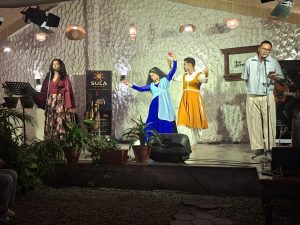

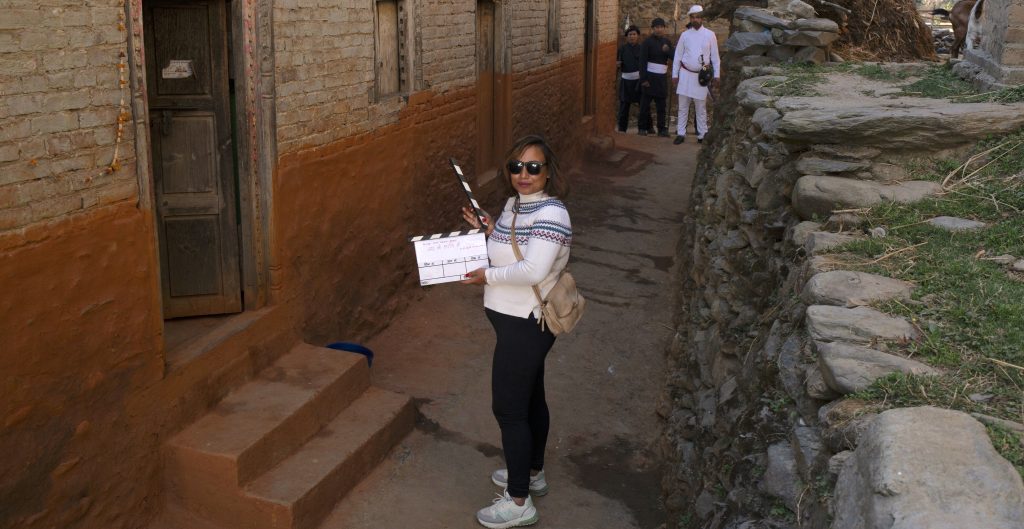
Musician Sarada Dangol first encountered dapha music, a traditional Newa devotional art form based on classical raga and taal systems, during her childhood. Fascinated by the tradition, she tried to learn it after completing grade 10. But conservative norms barred women from practising dapha, forcing her to teach herself in secret.
In 2023, her journey took a pivotal turn when she enrolled in the Maya Art Residency, a programme supporting artists and cultural practitioners. There, she delved deeper into the world of dapha and found a supportive community that encouraged her to pursue her passion. While times have changed and the strict gender barriers of the past have faded, Dangol confronted a new disappointment: many within the Newa community itself remained unaware of dapha. Sensing that a vital piece of her heritage was slipping away, she felt compelled to act.
The art form is believed to be the oldest form of devotional music performed during jatras and special occasions. According to Professor Richard Widdess, in his book Dapha: Sacred Singing in a South Asian City, the music and musical practices of dapha account for their historical origins and later transformations, investigate links with other South Asian traditions, and describe a cultural world in which music is an integral part of everyday social and religious life.
For centuries, dapha has been an important part of Newa religious and social life, bringing communities together through devotional singing accompanied by traditional percussion. Practitioners say the tradition is increasingly at risk as fewer young people take it up.
Determined to help safeguard the tradition, she began exploring cinema as a way to introduce dapha to a wider audience. After a year and a half of dedicated work, she completed her short film, Jaya Shree Harati Maa. The movie recently received official approval from the Central Film Examination Committee.
“The movie tells the story of the goddess Harati Maa, featuring dapha music,” says Dangol to Onlinekhabar.
Through the film, she hopes to rekindle interest in an art form she fears is slowly disappearing.
She is currently in talks with cinema halls and hopes to release the film within the next two months.
Although Dangol has completed her film, the journey was far from easy. As a debut director with no prior experience in filmmaking, she faced steep hurdles at every stage, from initial research and scriptwriting to managing human resources and securing funding.
“The most challenging part was managing the finances,” Dangol reflects. “Most of the budget came directly out of my personal savings.”
When her own earnings proved insufficient, she almost sold her jewellery just to keep the project alive. Fortunately, a timely grant from the Kathmandu Metropolitan City provided some much-needed relief.
Throughout her filmmaking journey, Dangol also discovered a frustrating reality: organisations established to promote culture and heritage were often reluctant to support new projects. She approached multiple organisations for grants, but her pleas went largely unheeded.
“Even an organisation with funds specifically earmarked for the promotion of dapha didn’t want to invest, and they couldn’t provide a proper reason for it,” she says. “Seeing that disheartened me.
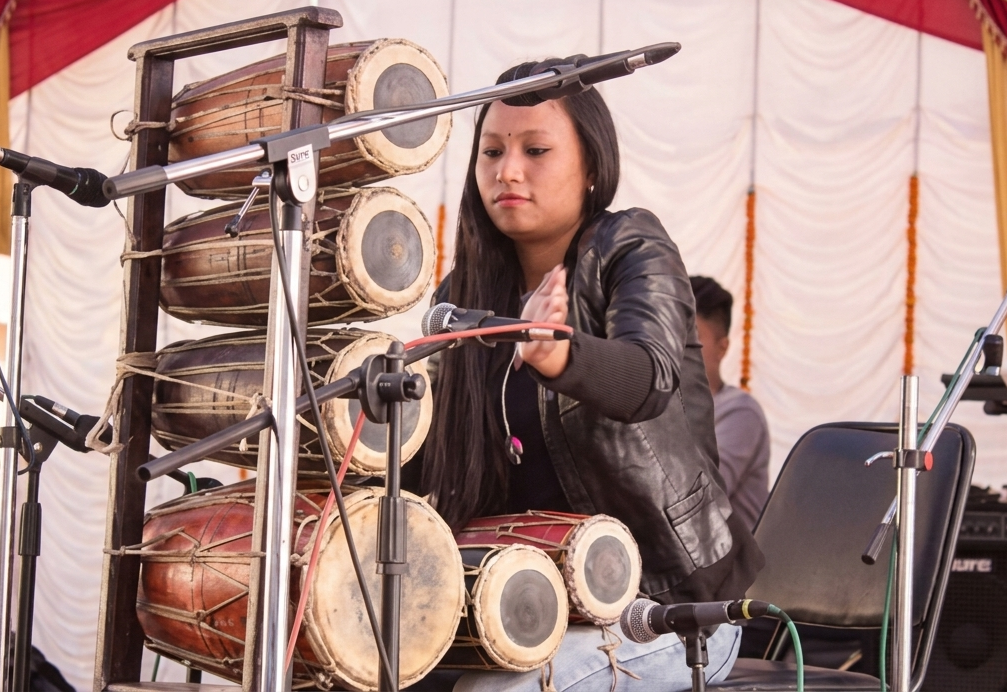
While filmmaking has become her latest passion, music remains at the heart of Dangol’s life. As a multi-instrumentalist, she plays traditional percussion like the dhimey, khi, madal, and dholak. She can play 17 madals at once.
In addition to her performances, she teaches music at several schools in Kathmandu. Likewise, she also runs classes at her home.
Dangol’s interest in music began during her school days, sparked by the sound of boys playing the madal during extracurricular activities.
“The sound fascinated me,” Dangol recalls. “I even gathered a few friends to join the class with me.”
Her family initially opposed her desire for a formal music education, pushing her toward science instead. Yet, in a quiet show of support, they still bought her a madal.
Compromising with her family’s wishes, Dangol earned a Bachelor’s degree in Pharmacy and currently runs her own drugstore alongside her work as a musician. Now a mother to a daughter, a musician, a teacher, and a filmmaker, Dangol credits her supportive husband for her ability to balance all these diverse roles.
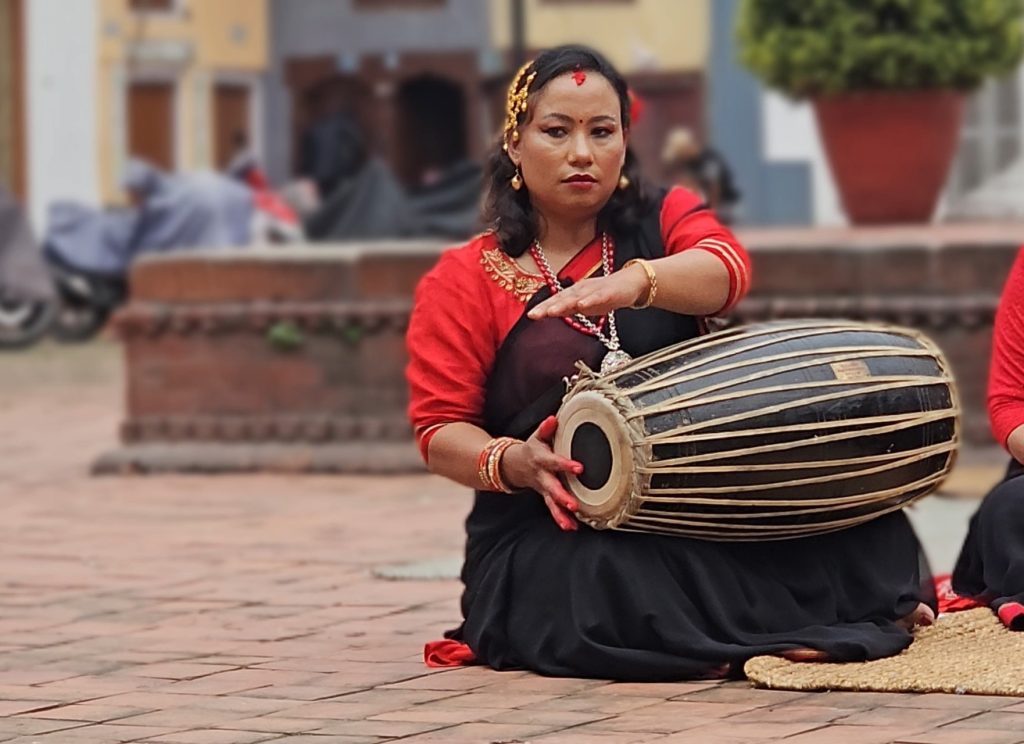
Unlike her own parents, Dangol welcomes the prospect of a formal music education for her eight-year-old daughter. The young girl’s interest in music is already evident, sparked by watching her mother’s students.
“I see a real hunger for music in her,” Dangol says. “She grasps things quickly that took me ages to understand.”
Her journey as a mother brought its own challenges. Pregnancy and early motherhood kept Dangol away from the stage for a long period. This extended gap caused a decline in her confidence and took a toll on her mental well-being. A turning point came during an event where she met poet Ujjwala Maharjan. Maharjan’s encouragement was the catalyst for Dangol’s return to music, a gesture for which she remains deeply grateful. Today, the two are active collaborators on various projects.
Dangol remains deeply concerned about the low representation of women musicians. In her view, family pressures and societal hurdles still prevent talented women from pursuing music freely.
Today, Dangol’s mission extends beyond her own performances and films. She hopes to encourage more women to pursue music while ensuring dapha survives for future generations. For this purpose, she recently registered her new organisation: Dhin Tang Dapha Samaj Nepal.
“We must preserve our culture,” she says. “If not us, then who?”