
Kathmandu, June 8
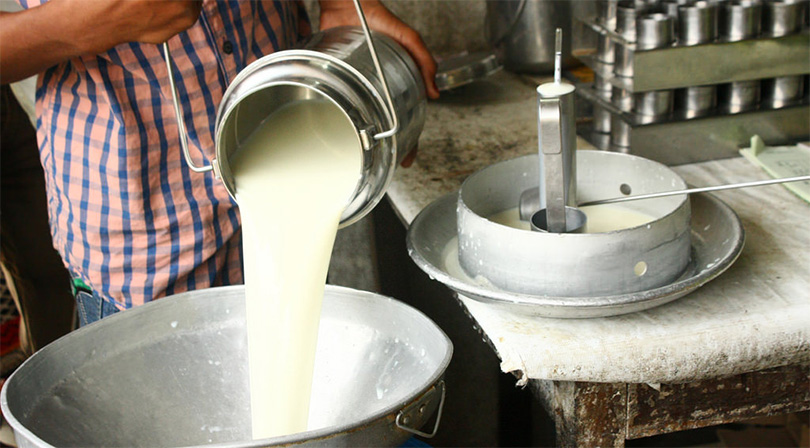
Milk is regarded not only as a food item but also as an unquestionable source of purity, strength, and nutrition. Every day, children and elderly people alike are confidently given a glass of milk, believing it to be a complete and healthy food. Milk is consumed extensively not only in households but also in small tea shops, large cafés, and star-rated hotels. However, recent reports from government agencies and laboratory tests suggest that a “slow poison” may be entering our kitchens through milk.
In an attempt to prolong shelf life and maximise profits, some dairy operators and milk collectors have been committing serious offences against public health. Authorities have discovered that artificial milk is being manufactured and sold in place of natural milk in the Nepali market. On May 14, the Department of Food Technology and Quality Control uncovered such serious irregularities during an inspection of a dairy industry in Bhaktapur.
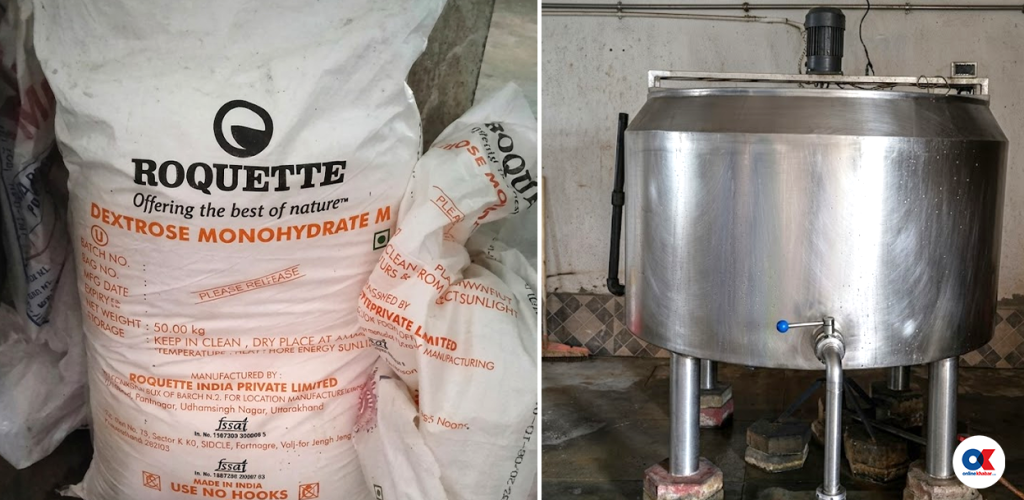
A joint team from the Food Technology and Quality Control Division Office, Kathmandu, and the Jagati Police Circle inspected the Jorpati Dairy Producers Cooperative Ltd., located in Suryabinayak Municipality-9. During the inspection, officials seized 56 kilograms of dextrose monohydrate, 9.86 kilograms of maltodextrin, and 30 kilograms of bakery shortening from the processing unit, all of which were allegedly being used to adulterate milk.
Investigators revealed that the dairy had been producing counterfeit milk using these non-food substances and supplying it both to the state-owned Dairy Development Corporation (DDC) and the open market. The inspection team also found 30 kilograms of a greasy substance resembling bakery shortening prepared for melting in a pasteurizer tank. Samples were collected from milk stored in three chilling vats and from the suspicious fatty substance before being sent to a laboratory for testing.
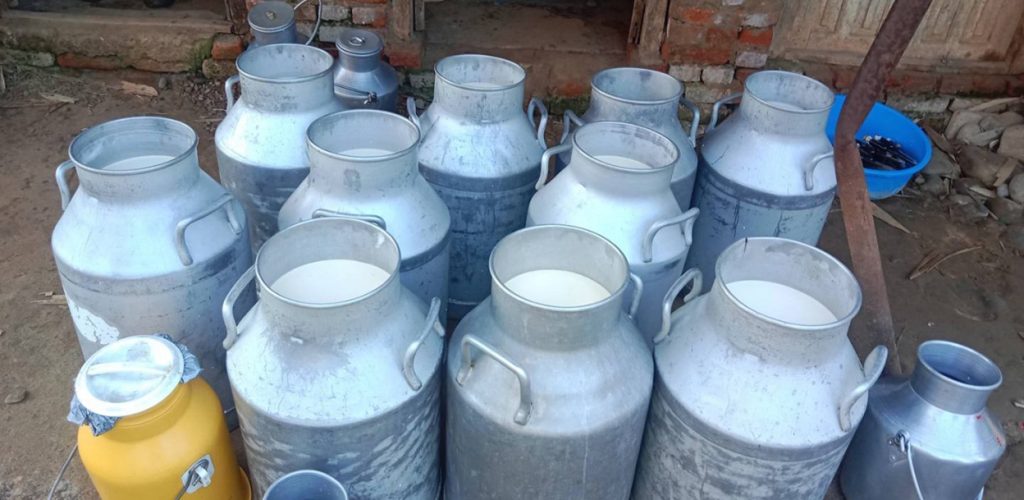
In the first week of June, DDC also detected serious irregularities in milk collected from Kavrepalanchok. The corporation destroyed 3,020 litres of milk supplied through a chilling centre in Panauti after it was found to be unfit for consumption. Laboratory analysis confirmed that sugar had been added to the milk; it emitted an abnormal odour, and it failed to meet minimum quality standards.
Following widespread complaints about poor-quality milk reaching consumers and declining public trust, DDC had intensified monitoring of milk collection, quality control, and distribution. It was during this process that the adulterated milk from Panauti was detected. Authorities also suspected possible collusion by DDC employees in the procurement process.
Similarly, Butwal Sub-Metropolitan City issued a public notice after finding that milk supplied by several vendors in its jurisdiction contained adulterants and failed to meet government quality standards. A joint inspection team from Butwal Sub-Metropolitan City and the Food Technology and Quality Control Office in Bhairahawa found serious issues in milk supplied from Kapilvastu, Nepalgunj, Marchwari Rural Municipality, and Suddhodhan Rural Municipality during inspections conducted on May 21and 22.
Inspectors found that harmful chemicals, including soda, were being added to prevent milk from curdling quickly. Out of 12 suppliers providing milk to dairies in Butwal, 10 were found to be using such chemical adulterants. The tested samples also contained significantly lower levels of fat and solids-not-fat (SNF) than required.
Pile of garbage found at Hetauda Dairy
An inspection of Gayatri Dairy Industries Pvt. Ltd. in Hetauda-2, Makwanpur, found a pile of garbage at the entrance of the facility. During the inspection conducted on June 2, workers were found handling dairy products without masks, hairnets, or aprons, and some were wearing jewellery such as bangles and rings, increasing the risk of contamination.
Inspectors also found plastic ropes, tubes, and other non-food materials scattered around the milk processing area. These are only a few examples. Similar negligence has been found across dairy industries nationwide. Inspections have consistently revealed poor sanitation standards in many dairies and milk-processing facilities.
In previous years, reports had already surfaced showing that hazardous substances such as caustic soda, detergent powder, urea fertiliser, hydrogen peroxide, and sugar were being added to milk at collection centres and dairy industries. Caustic soda, commonly used in laundry soap, is added to neutralise acidity and prevent milk from curdling. Detergent powder is used to make diluted milk appear thicker and foamier.
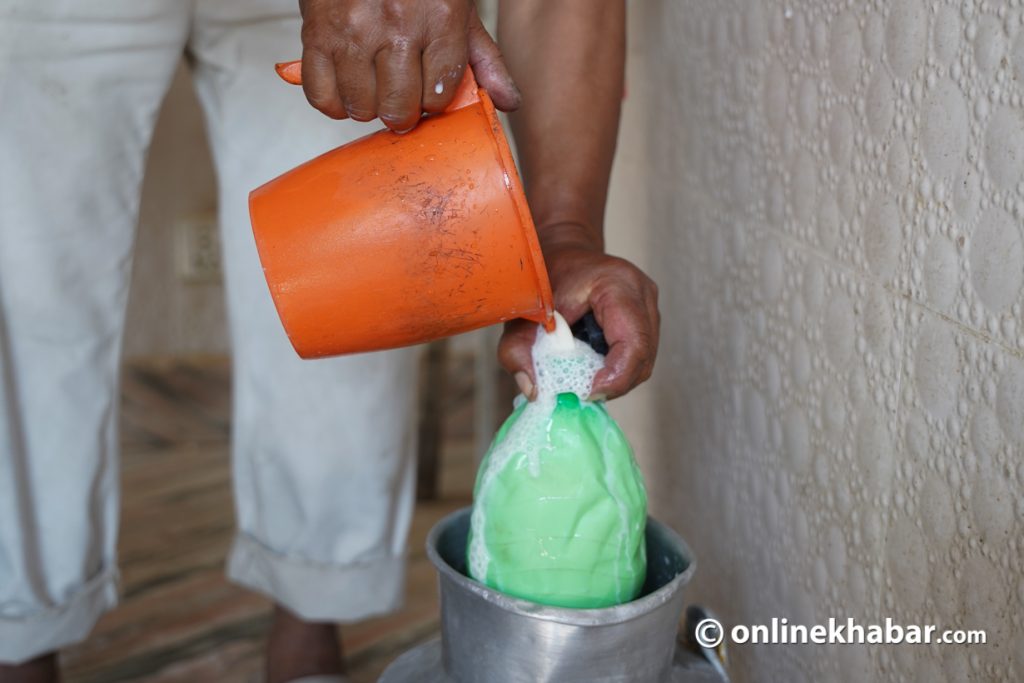
Evidence has also shown that urea fertiliser is added to artificially increase apparent protein levels in milk. Health experts warn that the human body cannot safely process these chemicals and that their long-term consumption can gradually cause serious health problems.
According to Dr Bal Kumari Sharma, spokesperson for the Department of Food Technology and Quality Control and a senior food research officer, poor quality and hazardous chemical adulteration have become major problems in milk available on the market. She said inspections have found poor sanitation practices and failure to meet government standards in many dairy industries.
Although the law requires milk to contain at least 3 per cent fat and 8 per cent SNF, market samples often contain only 2.5 to 2.9 per cent fat and 7.1 to 7.8 per cent SNF.
Beyond quality deficiencies, the use of neutralisers, inedible substances added to prevent milk from spoiling, has emerged as another alarming issue. “We have found milk containing neutralisers such as soda,” Dr Sharma said. “Milk that falls below standards is simply low quality, but milk containing such chemicals is contaminated.” She added that legal action has been intensified against violators.
According to Dr Sharma, authorities have filed 82 cases in the first nine months of the current fiscal year alone after detecting serious irregularities and negligence. Cases involving substandard food products are handled by the respective Chief District Officers, while cases involving contaminated food are referred to district courts. The law provides for penalties of up to six months’ imprisonment, a fine of up to Rs 300,000, or both.
Legal proceedings are currently underway in the case involving the Jorpati dairy in Bhaktapur.
What happens when chemicals are added to milk?
Dr Sharma said milk adulterated with soda and other chemicals directly affects the digestive system. “Our stomach contains hydrochloric acid, which helps digest food and prevents harmful bacteria from growing,” she explained. “When milk containing soda is consumed, the stomach’s pH level rises, and acid levels decrease, leading to indigestion and potentially causing serious gastrointestinal diseases over time.”
Health experts say such adulteration can contribute to cancer, kidney disease, and skin allergies. Children are particularly vulnerable to its effects. Adulterated milk directly damages major organs. Chemicals such as caustic soda and detergent can severely affect the stomach and intestines, causing ulcers and chronic digestive disorders.
Similarly, urea and other preservatives increase the risk of kidney failure and permanent liver damage. Children, for whom milk is considered essential for physical development, face even greater risks from consuming contaminated milk. Doctors warn that long-term consumption of chemically adulterated milk may even contribute to cancer. Consumers who spend money seeking nutrition may instead be exposing themselves to illness and costly medical treatment.
The department says it will strengthen inspections and enforcement efforts to protect public health from substandard and contaminated milk.
Consumer rights activists criticise weak monitoring
Despite the seriousness of the issue, consumer rights advocates argue that regulatory agencies have failed to respond adequately. They claim that while the Department of Food Technology and Quality Control occasionally conducts inspections and collects samples, weak enforcement and the absence of strict punishment have allowed milk adulteration to continue unchecked.
Consumer advocates say that imposing only minor fines on offending industries has emboldened violators. Consumer rights activist Prem Lal Maharjan said substances ranging from palm oil to urea are being used to increase milk fat content and extend shelf life.
“Palm oil is essentially bakery shortening,” he said. “It is used to increase fat content. At the same time, urea fertiliser, gluten, and glucose are also mixed into milk. This is a crime that has continued for years.” Maharjan described milk adulteration not merely as commercial fraud but as a multidimensional deception.
“This is extremely harmful to human health, and it is also a form of fraud,” he said. “Consumers are being cheated in three ways: their health is compromised, their money is wasted, and their trust is betrayed.”
Even greater risks in loose milk
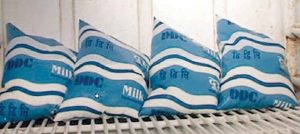
Maharjan alleged that consumers are increasingly being misled into believing that loose or unpackaged milk is purer than packaged milk. “Milk sold loose or tied in plastic pouches is becoming increasingly common,” he said. “People are told that packaged milk is inferior and that loose milk is pure, but in reality, such milk often contains even more harmful substances.”
He accused both the Department of Food Technology and Quality Control and local governments of failing to enforce effective regulations, thereby encouraging milk adulteration networks. According to Maharjan, complaints were filed as early as three years ago, but authorities have shown little urgency in taking action.
“This is a form of negligence by the food authorities, and local governments have also failed to prioritise monitoring,” he said. “Even large industries are involved in such irregular practices. Occasional inspections are not enough; continuous monitoring and strict punishment are necessary.”