
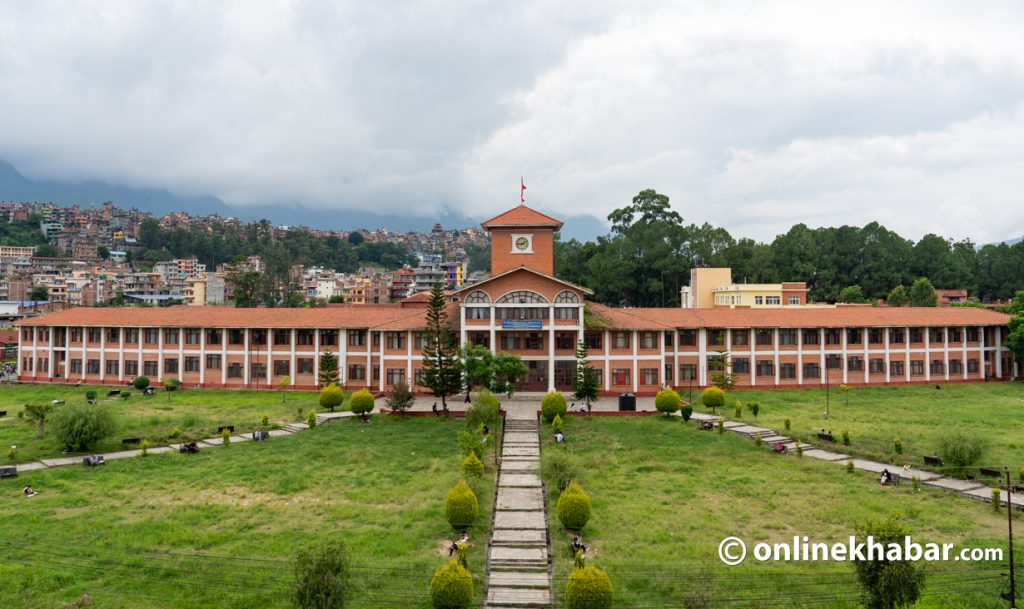
Last year (2025), the Commission for the Investigation of Abuse of Authority (CIAA) issued letters to 18 professors of Birendra Multiple Campus under Tribhuvan University (TU) regarding their outside employment. However, they produced permission letters issued by TU itself that allowed them to work part-time. The further investigation process did not advance.
“The CIAA had inquired whether they had obtained permission to work. After they showed the permit, nothing happened,” says Prem Sagar Bhandari, the campus chief.
TU has been granting such permissions under the provisions of the Tribhuvan University Monitoring Directorate Regulation, 2073.
“Subject to Rules 69 and 71 of the Tribhuvan University Teacher and Employee Service Rules, 2050, approval shall be granted ensuring that the university’s operations are not adversely affected,” the regulation states.
Rule 69 of the Teacher and Employee Service Rules states that employees must not work elsewhere. According to this rule, teachers or employees must not engage in any other form of employment outside of their TU duties without the prior approval of the official or committee designated by the Executive Council.
The rule also notes that they must not work simultaneously at TU and other universities, with or without an appointment, whether full-time or part-time.
However, Rule 71 opens a loophole to work with prior approval. It states that if a teacher or employee wishes to open or operate any consultancy or research-related institution, they must obtain the approval of the Vice-Chancellor.
“This rule shall not be deemed to prevent services or work of a research, consultancy, academic, or professional nature, and other arrangements regarding this shall be as prescribed by the procedures,” the rule states.
Based on Rules 69 and 71, TU formulated regulations to approve teachers and employees to work in private institutions by setting specific shifts and hours.
Permit used as a weapon
Approvals are granted, ensuring a half-hour gap between the employee’s designated TU office hours and their pre-approved outside working hours. Furthermore, it states that shifts must not overlap. However, members of the monitoring team state that this rule is not being followed.
While existing rules are being violated on one hand, a member of the Monitoring Directorate points out that provisions not even present in the parent Act have been included in the rules and regulations.
“TU has formulated rules on matters not provided in the Act. Based on those rules, they have created regulations to grant permission to work in the private sector,” says the member, who wished to remain anonymous. “Passing regulations on such critical matters is not enough; it must be provided in the Act itself.”
He argues that laws not passed by Parliament should not be manipulated by creating convenient internal regulations.
It is claimed that the TU Teacher and Employee Rules were formulated using the powers conferred by Sections 5(ja), 10(cha), and 34 of the Tribhuvan University Act, 2049. However, experts state that the rules and regulations include authority not guaranteed by the Act itself. Naturally, any provisions in the rules and regulations that conflict with the Act are automatically void.
Armed with these permits, professors frequently rush to teach at private colleges instead of TU. The university regularly receives complaints that professors are failing to teach during their assigned shifts. Based on these complaints, monitoring teams occasionally visit the respective campuses.
“We have even found fake timetables. The teachers and employees have turned these permission letters into a weapon. They are found skipping their scheduled teaching hours at TU to work outside,” says an officer involved in the monitoring process.
TU operates classes in three shifts: morning, day, and evening. If a teacher instructs at TU in the morning, they are given permission to teach part-time elsewhere in the day or evening. If they teach at TU during the day or evening, they receive permission to teach at another institution during the morning session.
“We grant permission according to TU rules. A 5-member executive committee sits down to approve it. If deemed unqualified, the application is rejected,” says Prof. Yam Bahadur Gurung, Executive Director of the Monitoring Directorate.
Attendance at TU, work in private sectors
Flashing their permission letters, professors mark their attendance at TU during their required teaching hours and immediately leave for private colleges.
“It has been found that they come to TU in the morning to mark their attendance and then leave to work at private institutions,” the monitoring team member told Onlinekhabar.
At TU, teachers are only required to sign the attendance register once a day.
“Since they only need to log attendance once a day, it has made working outside very easy. Though some good teachers teach during their TU shift and only teach elsewhere during their approved hours,” a Directorate official says.
Teachers and employees are not permitted to work in shifts other than a single shift at one external institution per fiscal year. However, the monitoring team claims to have found individuals teaching at two or more private colleges.
“The number of those who teach one period at one college and rush to another college for the next period is just as high,” he says.
Under the semester system, a teacher is required to teach 9 credit hours, and under the annual system, 15 to 18 periods per week.
“Yet, there are teachers who do not teach even a single period,” says a monitoring team member. “They are caught teaching at private colleges instead of TU.”
Even TU officials admit that the rule allowing part-time teaching is flawed.
“TU teachers and employees should not be allowed to go and work elsewhere. Going as a guest lecturer occasionally is acceptable. But they are working under official approvals. This rule must be scrapped,” says immediate past Vice-Chancellor Prof. Deepak Aryal.
Working without permission
TU routinely receives complaints about professors working in the private sector without any permission. Based on these complaints, TU even formed an investigation committee. However, monitoring team members state that these individuals avoid putting documents in their own names at private institutions.
“After receiving complaints that some were working as directors or principals, we went for inspection. But looking at the documents, we found someone else’s name listed,” the official says. “We suspect many have listed relatives as directors. They operate as principals and assistant principals, but they disappear when we go for monitoring.”
According to TU rules, full-time teachers and employees are prohibited from becoming directors or officials of another institution. Yet, TU employees are active directors of private colleges. They bypass TU by operating as private directors without seeking permission.
“The influential ones don’t even bother taking permission. Despite working in private institutions against the rules, no action can be taken against them,” says a monitoring staff member. “We receive up to 50 complaints in a single month.”
Complaints regarding unauthorised private employment land at the CIAA, the National Vigilance Centre, and TU itself. The files are then forwarded from the CIAA and Vigilance Centre to the Monitoring Directorate. Executive Director Yam confirms that complaints usually allege that teachers are not dedicating themselves full-time to TU.
“Permission is granted for part-time work. But complaints allege that they are covertly working full-time in the private sector,” Director Gurung says.
The Directorate investigates and sends reports to the TU Executive Council, which is the actual punishing authority.
However, TU usually lets them off with a simple warning. Former TU Vice-Chancellor Prof. Keshar Jung Baral states that during his tenure, he penalised one person.
“Action is taken according to TU rules. I had penalised one person,” he recalls. The “action” Baral referred to, however, was merely a formal caution to the professor.
Former Vice-Chancellor Kedar Bhakta Mathema recalls that during his tenure, he did not allow teaching at private institutions at all.
“In my time, I didn’t allow private teaching. I refused, saying it was absolutely unacceptable,” he says. “Earning a salary from TU and working at another institution is an academic crime. It is an abuse of the system. The provision granting permission must be abolished.”
Eligible for removal or dismissal from service
There are legal provisions stating that if an employee works outside without permission, or works outside full-time even after taking part-time permission, they can be removed or dismissed from service. Rule 84 of the Teacher and Employee Rules, 1993, outlines the conditions for removal or dismissal from service. Rule 83 provides for lesser punishments like censures, withholding grade increments, or halting promotions.
While rule-breakers are plenty, not a single individual has been removed or dismissed from service to date. The Executive Council merely issues warnings.
“The authority to take disciplinary action rests with the Executive Council. We only monitor and submit the reports,” says Director Gurung.
9,000 approvals for private work in 10 years
According to the Monitoring Directorate, 9,064 applications were received over the last 10 years to work in institutions other than TU. Out of those, 8,977 were approved, 13 were rejected, and 14 applications were received late.
In the single fiscal year 2025/2026, 788 individuals applied, out of which 779 were approved. They are currently active in various non-TU institutions.
According to the Directorate, 6 applications were rejected, 2 were cancelled, and 1 remains under consideration. During inspections, 5 individuals were caught working without any permission.
Subtracting the rejected, cancelled, and pending applications, 784 teachers and employees were officially found working in external organisations. However, TU officials state that the number of those working covertly is much higher. TU currently employs a total of 7,966 teachers and staff.
Assistant professors form the majority
Among those working outside of TU, assistant professors form the largest group. There are 506 assistant professors, 104 associate professors, 94 teaching assistants, and 27 full professors. The rest belong to other administrative positions.
The highest number of teachers working in external institutions belongs to Prithvi Narayan Campus, Pokhara, where 96 teachers and staff work outside. Similarly, there are 61 from Butwal Multiple Campus, 38 from Tri-Chandra Campus, 36 from Mahendra Morang Campus, and 33 from Thakur Ram Campus.
Furthermore, there are 32 from Patan Multiple Campus, 28 from Amrit Campus, 27 from Ramshwarup Ramsagar Campus, 26 from Bhairahawa Campus, 24 from Birendra Multiple Campus, 24 from the Central Campus of Technology in Dharan, 21 from Western Regional Campus, 20 from Mechi Campus in Bhadrapur, and 20 from Mahendra Ratna Campus in Tahachal. The rest are spread across other TU units.
TU comprises 157 units, including 64 constituent campuses, 44 central departments, research centres, and dean’s offices. Teachers and staff from 111 of these units are working in outside organisations.
Teachers and staff can secure permission to work at another institution simply by submitting an application along with a fee of Rs. 2,500. After they file an application specifying their current TU unit and the target private institution, the Monitoring Directorate reviews and grants approval.
“Once the application is received, the Executive Committee of the Monitoring Directorate makes a decision. The permit takes effect from that date and remains valid only until the end of that specific fiscal year,” Director Gurung says. “The number of applicants repeats every year.”
There is a mandatory provision to seek fresh approval once the fiscal year ends. The immediate past Rector, Khadga KC, proposes that this entire rule should be scrapped.
“Granting permission for a mere 2,000 rupees has severely affected the university’s academic atmosphere, studies, and research,” he says. “It raises serious questions about academic integrity. Even if it is written into TU’s Red Book, it must be taken to the Senate and abolished.”
He strongly believes that employees should not work elsewhere while enjoying TU’s services and benefits.
“Once you take up a job at TU, you enter the service with a salary, allowances, and a provident fund. Cheating the university to work in private setups under the guise of a permit is unacceptable,” he says. “This has done nothing to elevate the university.”
Historical precedent
Before the year 1974, TU teachers and employees were not even allowed to teach private tuitions outside.
“Action would be taken even for teaching outside tuitions,” recalls former Vice-Chancellor Baral.
According to him, higher education was nationalised in 1974. When TU’s constituent campuses could no longer handle the student volume on their own, community campuses began opening up.
“To establish a community campus, signatures from 5 TU teachers were required,” he told Onlinekhabar. “That’s when permissions to work at community colleges started being granted. Later, when private campuses mushroomed, approvals were extended to private colleges as well.”
Baral argues that this entire system of allowing teachers to split their time is fundamentally flawed.
“It makes scheduling classes difficult for department heads. A teacher’s time and mind get split between two places,” he says. “It dilutes quality teaching and stunts study and research.”
On the flip side, some professors argue that teaching outside is a matter of survival.
They claim that low pay and benefits at TU force them to seek alternative income.
“There are no proper benefits. No research happens at TU. We are forced to work outside just to make a living,” a TU professor says.
The Monitoring Directorate concludes that TU must find a way to engage its teachers and staff fully within the university itself.
“The university needs to invest. There must be avenues for study and research. If sustainable work opportunities are provided right within the university, no one will be forced to look outside,” says Director Gurung.