
Shree Krishna BK was found dead in the detention cell of the Khurkot Area Police Office in Sindhuli on April 20, 2025.
Shree Krishna was taken from custody to the district headquarters hospital, where doctors declared him dead. He had been under investigation on a rape charge after having married a 16-year-old girl. He died just four days after being arrested.
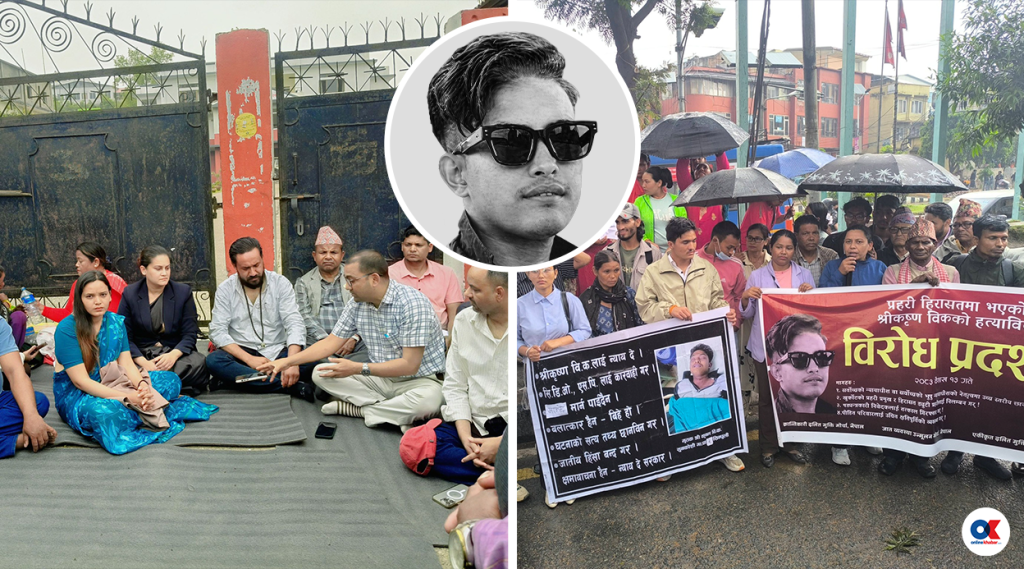
His death in custody drew national attention. Members of parliament from the ruling party visited the scene and raised their voices in demand of justice. Subsequently, Inspector General of Police Dan Bahadur Karki formed a five-member investigation committee under the coordination of DIG Dinesh Acharya.
The family, suspecting the death was mysterious in nature, had the body brought to Tribhuvan University Teaching Hospital in Maharajgunj for a post-mortem examination. Both the post-mortem report and the investigation committee’s findings have since been submitted. According to police sources, the cause of death stated in the report is hanging.
Nepal Police Central Spokesperson and DIG Abhi Narayan Kafle stated that the committee’s report has been forwarded to the Home Ministry. The report recommends departmental action against Inspector Basanta Bhujel, in charge at Khurkot, and Constable Arjun Singh, who was on duty at the detention cell. Ten other police personnel at Khurkot have been issued formal warnings and cautionary notices.
Experts say that even if a death inside custody occurs by suicide, it still reflects a failure of duty on the part of the police. Once a person is in custody, they should be even safer than outside, where they could be at risk of attack from the aggrieved party. Inside custody, the person is under police protection and is considered secure under a 24-hour watch.
Central Spokesperson Kafle himself acknowledges that any death or suicide inside custody indicates a failure of duty.
“Even if a person who dies of suicide after being placed in police custody, it is the police’s responsibility and duty to prevent that situation from arising. Such incidents have occurred due to lapses in duty. We need to keep improving, and we are doing so,” Kafle told OnlineKhabar.
In the Khurkot incident, Shree Krishna was the only person in custody at the time, and only one constable, Arjun Singh, was on duty. Police consider it deeply unfortunate that a suicide could occur under such circumstances.
“When a detainee goes to the toilet, the door should not be allowed to be locked. Especially when someone is alone in the cell, there is no reason for the door to be shut. This clearly shows a weakness in the duty of the person responsible for the detention cell,” says one police officer who served on the investigation committee.
Accordingly, departmental action has been recommended against the constable on duty for failing to carry out detention duties properly.
Much like the findings of the investigation committee, Rima Bishwokarma, a member of parliament from the Rastriya Swatantra Party (RSP), who even staged a sit-in over Shree Krishna BK’s case, argues that deaths in custody cannot simply be written off as suicide.
Speaking in parliament on May 12, MP Bishwokarma said, “It may not be surprising to call Shree Krishna BK’s death a suicide. But it is not natural that the majority of deaths inside custody are labelled as suicides.”
Rising deaths: An alarming situation
Shree Krishna is not alone. According to statistics from the Nepal Police Headquarters, 7 people have died in police detention so far in the current fiscal year 2025/26
One person died in Koshi Province, two in Bagmati Province, three in Lumbini Province, and one in Karnali Province, totalling 7 deaths in the current fiscal year. With two more months remaining in the fiscal year, this figure is likely to rise further.
In fiscal year 2024/25, only one person died in custody, a male in the Sudurpashchim Province. In fiscal year 2023/24 AD, again, only one person died in custody.
In fiscal year 2022/23 AD, five people died in detention across various provinces: one each in Koshi, Gandaki, Lumbini, Sudurpashchim, and Kathmandu Valley.
The highest number of deaths in the past five years was recorded in fiscal year 2021/22, when 10 people died in custody, two in Koshi, two in Madhesh, one in Bagmati, one in Gandaki, one in Lumbini, two in Sudurpashchim, and one in Kathmandu Valley.
This rate of deaths in detention has raised questions about both the quality of duty at detention cells and the physical infrastructure of those facilities. Although CCTV cameras are installed and detainees are supposedly under 24-hour police supervision, the Nepal Police Headquarters has noted that most such deaths occur in areas out of direct camera view, such as restrooms.
This points to a pressing need to improve the physical infrastructure of detention cells, an issue that each such incident brings back into focus. Additionally, psychiatrists suggest that treating detainees as if they were already convicted criminals and subjecting them to unnecessary psychological pressure pushes some individuals toward suicidal behaviour.
“When a person is taken into custody, they are already under stress. On top of that, if they are told, ‘You’re done for, your life will end in prison,’ what state of mind would that person be in? When someone loses all basis for hope from every direction, these tragic events happen,” one psychiatrist says to Onlinekhabar.
Retired Police DIG Pitambar Adhikari notes that physical health concerns are treated as primary while mental health remains secondary, and that is where problems arise.
When police arrest someone, they check for injuries, intoxication, or signs of assault, and similar concerns are raised during remand hearings. But the mental state of the accused tends to be overlooked, Adhikari points out.
He believes that the psychosocial condition of people taken into custody should be assessed. Just as psychological evaluation is required for juveniles in child justice cases, he says the same is now necessary for adults as well.
Conditions in prisons are even more alarming
It is not just detention cells; the situation in prisons is even more alarming. Analysis of death statistics across both detention facilities and prisons shows that around 80 people die every year.
In the current fiscal year so far, 54 people have died in prisons, 53 men and 1 woman.
In fiscal year 2024/25 AD, 79 people died in prison, 72 men and 7 women, according to Nepal Police data. In fiscal year 2023/24 AD, 82 people died, 78 men and 4 women.
In fiscal year 2022/23 AD, 69 men and 2 women, 79 in total, died in prison. In fiscal year 2021/22, 69 people died in prison.
Police explain that prison death tolls tend to be higher than detention deaths because prisoners stay for longer periods, the population of inmates is larger, and there is a significant number of elderly and chronically ill individuals among them.
A hospital specifically for inmates operates at Central Prison Jagan Nath Deval in Sundhara. Critically ill prisoners are brought there for treatment.
Prisons fall under the Department of Prison Management, though their security is handled by the Nepal Police. Incidents of brawls inside prisons and prisoners escaping have repeatedly raised questions about security.
Just last Saturday midnight, female inmate Sapana Tamang escaped from Central Prison Sundhara by scaling the wall. She had been serving a life sentence. Such incidents signal serious negligence in prison security.
Clashes at Kailali Prison, including deaths, have been reported on multiple occasions. The situation at juvenile correction homes is similarly concerning.
“Deaths cannot simply be called suicides”
Human rights activists have consistently argued that the deaths of individuals under police protection cannot be viewed solely as suicides. Apart from natural deaths or illness, any suspicious deaths should not be taken lightly, they say.
Organisations like the National Human Rights Commission and INSEC have periodically investigated such deaths in detention and prisons and published reports. While they have also recommended reforms, full implementation has not been achieved, which is why deaths and suicides continue to occur even within the police security perimeter.
Experts say that regular monitoring of detention facilities, understanding the mental states of detainees, closely assessing their problems, and providing psychosocial counselling are essential steps.
When Narayan Kaji Shrestha was Home Minister, he had launched a yoga initiative inside prisons and detention centres, citing the intensely negative emotions being generated among detainees and emphasising the need to cultivate a more positive mindset.
Security experts say the time has come to properly train personnel on detention duty, improve physical infrastructure, and provide mental health counselling to both prisoners and detainees.
Uncertainty and regret, triggering factors for suicide
Psychiatrists note that the risk of suicide is significantly higher among people in detention or prison compared to the general population. According to senior psychiatrist Dr Ananta Prasad Adhikari, global data shows that the risk of suicide in prisons and detention is very high, particularly within the first month, which is an extremely sensitive period.
Worldwide, it is estimated that approximately 800,000 people die by suicide inside prison every year, with mental health issues identified as the primary cause in most cases. Dr Adhikari says that mental health problems are the leading factor in suicides occurring within jails and police custody.
“When a person is suddenly arrested and placed in custody, they experience acute psychological trauma, fear, shame, and growing uncertainty about the future,” says Dr Adhikari. “That is why the risk of suicide is highest in the first week.”
International studies indicate that approximately 66% of suicides in prisons occur within the first month of detention.
Psychiatrist and researcher Dr Rishabh Koirala explains that being in custody intensifies mental stress, regret, and despair. Having to face the consequences of actions taken in anger or on impulse weakens many people mentally.
“Someone might make a mistake in a moment of impulse — drugs, a fight, or some other incident. But once inside custody, the anxiety of ‘what happens now?’ puts them under severe psychological pressure,” says Dr Koirala.
“For sensitive individuals, the period of detention is extremely difficult. In such situations, some may begin thinking of suicide as a ‘way out’ of their problems,” he adds.
Sometimes, even innocent individuals must remain in custody during the course of an investigation.
“If psychosocial counselling and mental health services are made available to vulnerable groups, the risk of suicide can be significantly reduced,” says Dr Koirala.