
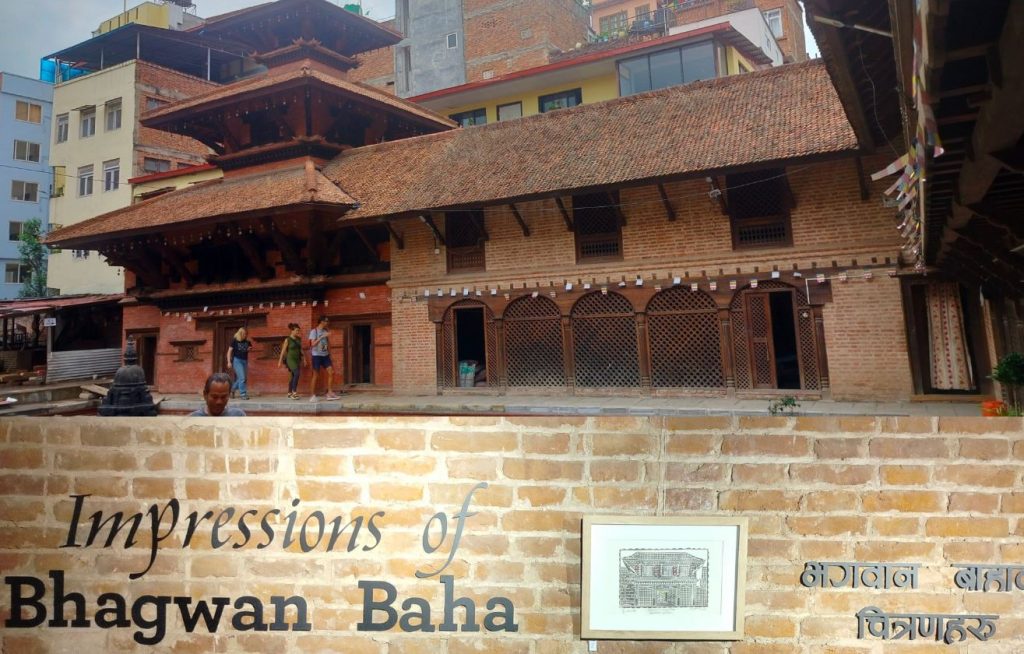
With a different perspective, one can dissect the same subject into multiple layers. Likewise, a new perspective often leads to discoveries. In this way, artist Samjhana Rajbhandari, through her artistic vision, explores Bhagawan Baha in the exhibition ‘Impression of Bhagwan Baha’.
Samjhana carries childhood nostalgia of playing and participating in rituals at the Baha. However, through the exhibition, she not only explores a place that is deeply familiar to her, but also highlights the value of spaces like the Baha, which hold significant religious and social importance.
From childhood nostalgia to the present
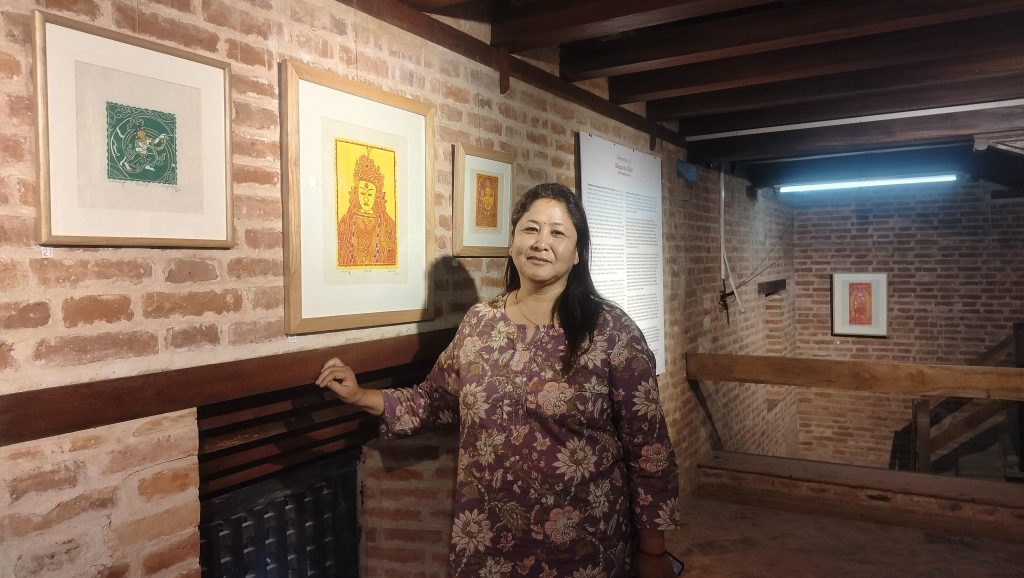
Samjhana remembers coming to the Baha with her mother during the family rituals, such as the marriage ceremony, Bartabandha and festivals such as Holi and more.
During Holi, the replica of the god is placed in the courtyard, and vibrant colours are used during the rituals, which she says, “If I connect the dots now, I realise the colours in my prints have been derived from the same experience.”
In the exhibition, her prints are not monochromatic like traditional woodcut prints. Instead, viewers encounter vibrant hues such as green, blue, yellow, and gold. In one of her prints, she has depicted the main deity of the Baha, Shri Simhasarthabahu Garuda, using vibrant yellow colour for the background and subtle red for the deity. Moreover, she has used a golden hue outlining the features of the deity, creating uniqueness in her print.
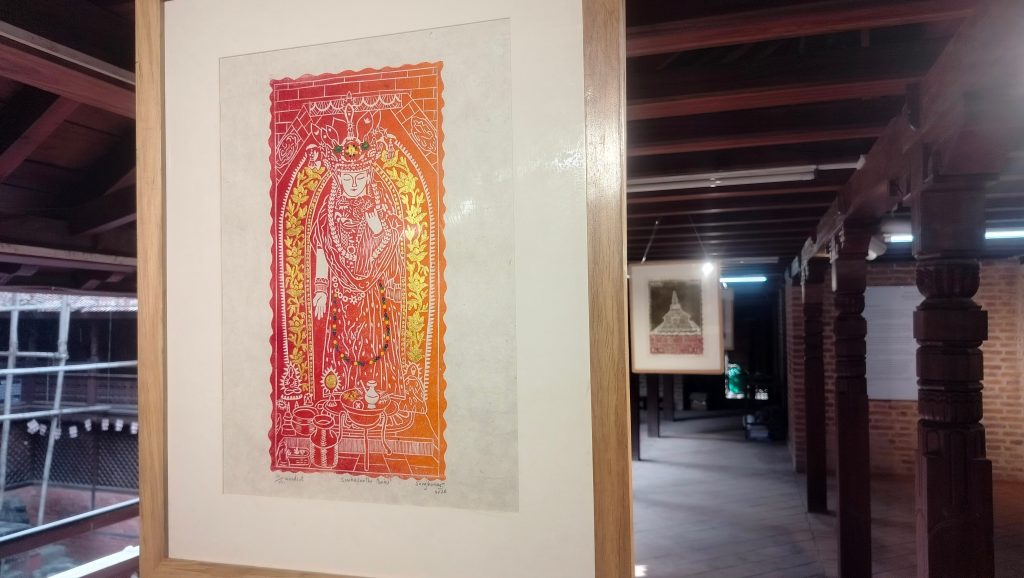
Exhibition by artist Samjhana Rajbhandari ‘Impressions of Bhagwan Baha’ at Thamel.
She says, “I didn’t notice that the replica of the deity is placed in the courtyard during the Holi festival; I thought the real deity from the temple was taken out. It was only now, during my research for the exhibition, that I realised it.”
Prints to preserve cultural memory
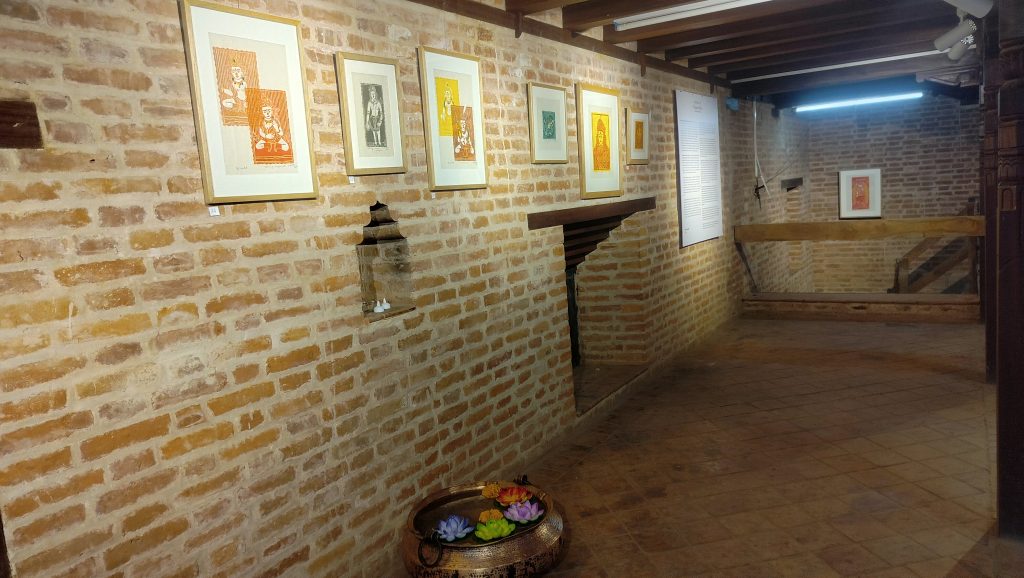
This is Samjhana’s 10th solo exhibition, inspired by Bikramshila Mahabihar, also known as Bhagwan Bahal or Tham Bahi, her mama ghar or maternal family place and a sacred monastic site.
“I used to come to this place with my mother and have very fond childhood memories. My mother used to tell me that every morning, lotuses from Kamal Pokhari — where Chhaya Center now stands — were offered to the deity,” shares Samjhana Rajbhandari.
To create awareness among viewers, she has placed artificial lotus flowers in a vase. As an artist, she believes it is necessary to preserve cultural memory and provoke dialogue through artwork.
Tham Bahi is one of the oldest monastic sites of Kathmandu valley, and it is also the unique Baha where its caretakers are not Shakya or Bajracharya Clan but the Pradhan from the Newa community. Moreover, this Baha marks the end of the core city as there’s no other Baha from here.
“This baha not only holds my memories, but also embodies a significant religious essence where Hinduism and Buddhism coexist in harmony,” says Samjhana.
Echoing this sentiment, Swosti notes that Samjhana’s work evokes nostalgic visual recollections of the baha’s rituals, material culture, iconography, and spatial rhythms through intricate woodcut prints. By bridging personal memory with collective heritage, the artworks transform cultural remembrance into a contemporary visual language.
Such artistic explorations not only safeguard intangible traditions but also reinterpret them for newer generations, drawing attention to cultural practices that may otherwise remain overlooked or inaccessible to many. At the same time, these presentations nurture a deep sense of community pride and belonging, reaffirming the enduring relevance of shared heritage in contemporary society.
The exhibition, featuring woodcut printmaking works, was showcased at Bhagwan Baha, Thamel, from May 9 to 11, and is currently on display at Gallery 108, Durbar Marg, from May 13 through June 7.