
Call it a manifestation of small states syndrome, default choice or what you may, nearly every regime in Kathmandu is scrutinised regarding how it will conduct its relations with the immediate neighbours, India and China, and the Western powers, say, for the sake of this article, the United States. This feeling of being under gaze stems from historical legacy, fear and fascination for the north and the south and powers beyond the seas, and the strong collective conscience that we must heavily safeguard our sovereignty.
Naysayers often dismiss geopolitics and the interests of the foreign powers as fiction, but the fact is that New Delhi, Beijing and Washington DC do watch the moves and actions of nearly every regime in Kathmandu in their own ways.
Hopes and doubts
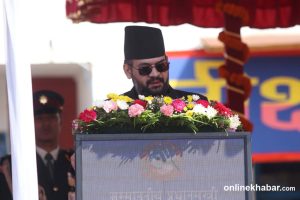
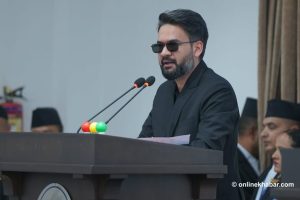
The government led by Balendra Shah, probably the strongest government of our times, may have attracted more international attention than any government before it. The barrage of congratulations messages that it received, conceivably from every quarter, may have to do with their genuine goodwill or PM Shah’s record of maintaining an uncompromising position on matters related to the sovereignty of the nation.
While he was the mayor of the Kathmandu Metropolitan City, Balendra Shah built an image of a leader who fiercely safeguards nationalism. He picked an issue with a dialogue in an Indian film that failed to attribute the Hindu Goddess’ origin to Nepal, announced to ban its screening in Nepal and declared he would not follow any court order when it comes to the nation, sovereignty and history. While politicians in Kathmandu appeared to be struggling with how to respond to India installing an Akhand Bharat mural showing Lumbini within it in the new Parliament building, he installed a Greater Nepal map in his office to make the Indians realise how the Indian side may have ‘hurt the dignity of Nepali people’ by incorporating Nepali territory inside the mural.
He was firm with China, too. He was the one to cancel his China trip, citing that the 2023 edition of China’s standard map did not acknowledge the new map of Nepal. He was among those to remind the then Prime Minister Oli in August 2025 that Oli must take up the matter of the India-China deal to resume trade via Lipulekh tri-junction without Nepal’s consent during his China visit.
How Nepal’s young prime minister and his team will engage India, China and the West is yet to be seen but he is going to be judged on this basis too, domestically and internationally.
As a mayor, he was not seen hobnobbing with the Western diplomats based in Kathmandu; his deputy would be seen in annual functions hosted by the embassies. After taking office, he has not said a word that could be interpreted as his foreign policy bias or preference.
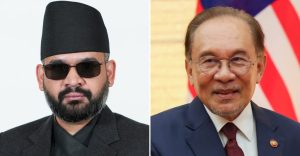
Yet his opponents have often portrayed the Prime Minister and his team as a group of people catapulted to power through conspiracy and grand design, hellbent on pushing the country to the precipice—by making Nepal a battleground of foreign powers, by disrupting the long-held non-alignment policy of Nepal and by inviting blatant foreign interference. In this unfair characterization, Prime Minister and his team, and nearly all the members of parliament from the ruling Rastriya Swatantra Party (RSP), are branded as Nepali Zelenskys (Volodymyr Zelensky may be a symbol of resistance against Russian invasion for many but in Nepal ‘Zelensky’ is used as an ugly metaphor to describe the trait of a political leader who, by mishandling foreign relations, invites the wrath of foreign powers to destroy the homeland.)
Disproving by deeds
Team Balen may not have had to see how hard it is for a country like Nepal to live by the ‘enmity with none, amity with all’ principle as yet. But they must have learned by now that brazen rhetoric on foreign policy does not help and that the government has to deal with power centres with competing interests (such that addressing one’s concern can invite serious displeasure from another side and vice-versa), be in their good book too and also be able to secure their support and goodwill.
Historically, dealing with external actors has hardly been easy for the Nepali rulers. There is literature on this. Besides, anyone who keeps an interest and follows Nepal’s dealings with the outside world can understand who wants what for what purpose from Nepal. There are some understood redlines Nepal is supposed not to cross and not allow others to cross. It is another thing that most people only speak of in insinuations and metaphors.
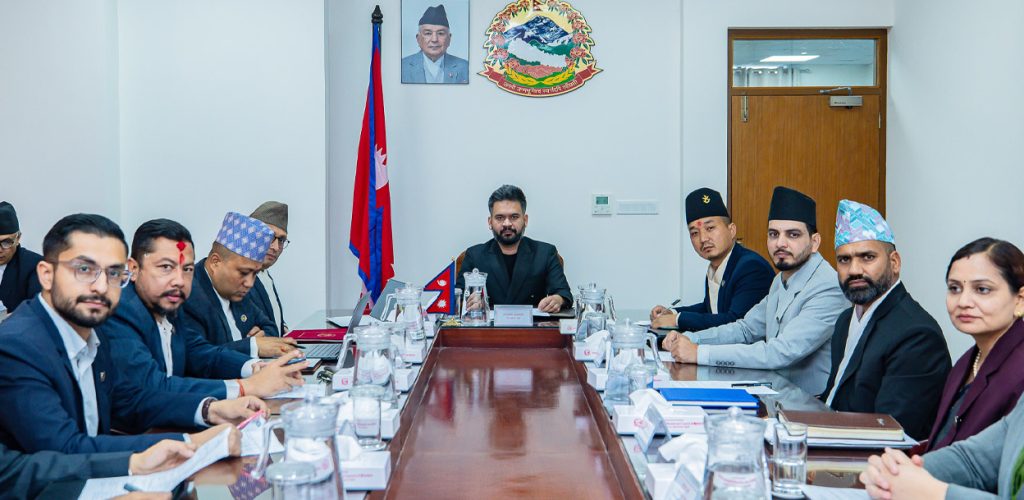
Opponents have portrayed Prime Minister Balendra Shah and his cabinet colleagues as a group of people catapulted to power through conspiracy to bring doom like that of Ukraine to Nepal.
Foreign Minister Shisir Khanal has said the Balendra government will not depart from Nepal’s longstanding tradition of non-alignment. The reins of state power in Nepal have shifted to the hands of young people, with senior most member of the cabinet being only 51. The best thing is that they look full of energy and committed to cleaning up politics, drastically easing service delivery and reforming institutions. Which is good. But since they are in the uncharted territory of administration and foreign policy conduct and want the result overnight, the worry among many is that they might make mistakes, not by intention but due to lack of patience and sense of proportion. Some bit of inexperience, innocence and immaturity may be excusable on the domestic front because they can be corrected. For example, the education minister announcing one day that all ‘bridge courses’ shall be terminated henceforth and later clarifying that the condition does not apply in case of undergraduate preparation classes, or the home minister saying on the record to the police officers ‘do not come to me asking for promotion and transfer to lucrative posts’ or posting comments on social media unbecoming of the dignity of his post. But when it comes to actions and decisions regarding Nepal’s relation with the outside world, ministers are supposed to stand firm and wise and take decisions we don’t have to later regret. One small misstep can bring embarrassment not only to the person concerned but to the whole nation.
The actors who commit such missteps, whether by design or by default, remain stigmatised even years after their deaths, while those taking well-thought-out decisions may be alienated during their lifetime but will still be revered after death. One could think of some good names from Nepali history. King Birendra’s idea of Nepal as a zone of peace resonates with significance even today. Kirtinidhi Bista, who was neglected by those in power during his last years, is remembered for playing an important role in getting Delhi to remove its checkpoints from Nepal’s northern frontier. We reverently speak of bureaucrats like Yadunath Khanal. Whereas Matrika Prasad Koirala, who must have some virtues about him too, is remembered as a person who compromised Nepal’s national interests.
One good course for Nepal at the moment will be to pursue what the RSP chair called ‘development diplomacy’ or ‘economic diplomacy.’ But in this day and age, foreign policy encompasses the whole gamut of issues, including climate change, national security, foreign investment, wellbeing and safety of Nepali people within and outside the country, being watchful of unfolding developments in the global sphere and their possible ramifications for Nepal, so on and so forth. Studying the precedents set by the governments of the past, assessing why they did what they did, may be helpful to understand certain constants and changes. Listening to and learning from scholars and actors with experience in the field will always be fruitful.
As for the allegation that the government ministers are the ‘Zelensky incarnate’ (a very serious allegation), this can be disproved with a more sensitive approach to maintaining relations with the rest of the world. The RSP stalwarts have an opportunity to add a new chapter to Nepal’s history, where, with competent, committed, sensible, and patriotic people in power, Nepal can navigate even the most complex foreign policy challenges without being dragged into the chasm of big-power rivalry.