
Kathmandu, January 21
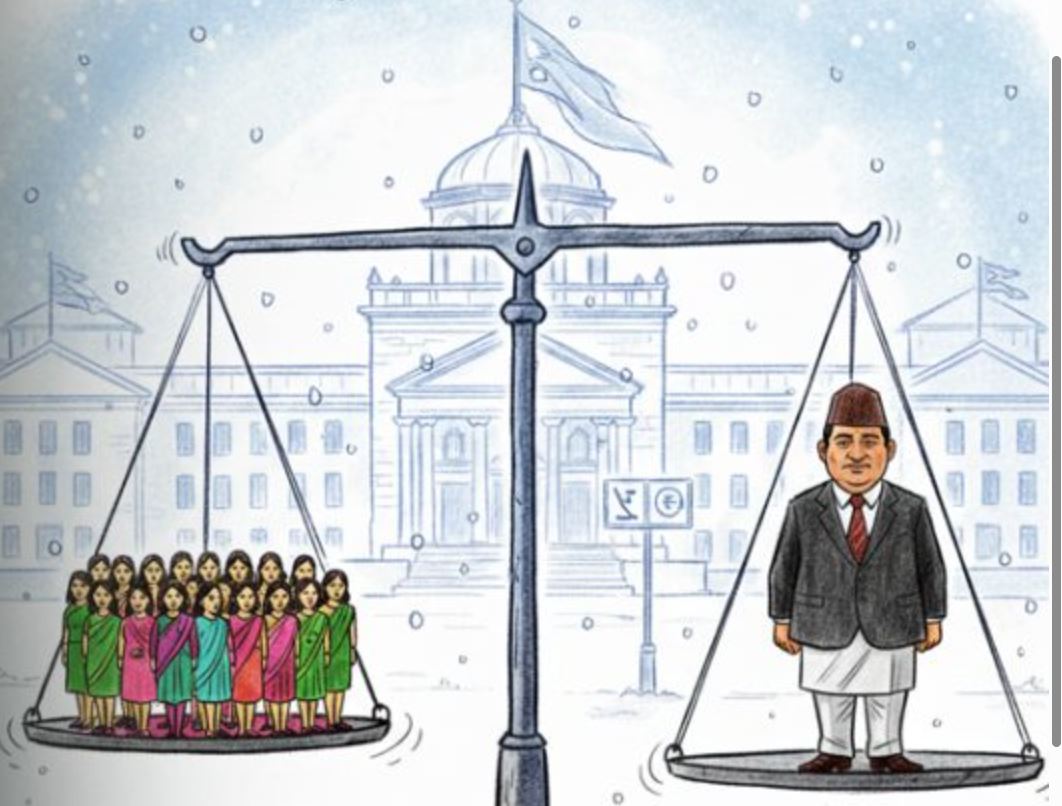
Despite the biting cold of Magh, Nepal’s political climate is heating up. As the country heads toward the scheduled elections on 21 Falgun, election-related activities have intensified. Yet, amid this political bustle, gender inclusivity within party ranks both in numbers and in meaningful roles appears weak across new and old political parties alike.
Women’s presence in national politics remains limited, and even the few women leaders who have emerged wield little influence within their own parties. Examples across parties, old and new, large and small, clearly show that it is not easy for women to reach parliament, raise their voices there, or assume executive roles through state power.
New parties that have projected themselves as alternative forces have, within a short span, gone through cycles of unity, adjustment, and renewed splits. Having claimed to be alternatives to traditional politics, these parties are now actively engaged in sharing power and positions and have entered the House of Representatives elections after completing ticket distribution.
Even at this stage, disputes have emerged over proportional representation lists within these alternative parties. They have also been accused of lacking inclusivity in the distribution of leadership positions. In the current nomination process for the House of Representatives, the number of women candidates remains minimal, only about 12 per cent of total candidates.
Following the earlier unification between then Ujyalo Nepal Party coordinator Kulman Ghising, Kathmandu Metropolitan City Mayor Balen Shah, and Rastriya Swatantra Party (RSP) chair Rabi Lamichhane, there was only one woman among the party office-bearers—treasurer Lima Adhikari. That unity has since collapsed, with Ghising’s Ujyalo Nepal charting its own course.
A similar picture emerged from the 11th general convention of the CPN-UML held in the first week of Poush. Of the office-bearers elected, 18 were men and only one woman, Padma Kumari Aryal, was elected as secretary. When Ishwar Pokharel and KP Sharma Oli competed with full panels, social media saw sharp criticism over the low number of women candidates.
Even earlier, during the UML statute convention held in Godawari from Bhadra 20, before the Gen-Z movement, voices had been raised demanding increased representation of women in the party’s leadership and central committee. Leaders, including former minister Bidya Bhattarai, Ashta Laxmi Shakya, Binda Pandey, and Pemba Lama, had called for constitutional guarantees of women’s participation, demanding at least one-third representation among office-bearers and 50 per cent in the central committee.
However, issues such as the renewal of former President Bidhya Devi Bhandari’s party membership and the removal of the two-term limit dominated the party leadership’s priorities, pushing women’s representation demands into the background. The impact of this was clearly visible in the leadership selection at the 11th general convention.
The Nepali Congress, too, elected Gagan Thapa as party president through a special general convention held amid intense internal power struggles ahead of the elections. After the Election Commission recognised Thapa-led Congress as the official party, the Sher Bahadur Deuba faction moved the Supreme Court seeking to overturn the decision.
Even before that, despite resistance from the party establishment, the special convention driven by then general secretaries Gagan Thapa and Bishwo Prakash Sharma saw men dominating both the frontlines of the convention and the newly elected central committee. The Deuba faction in the opposing camp was also dominated by male leaders, the so-called “seven brothers.” Notably, even reconciliation talks between the Thapa and Deuba camps did not feature any women leaders.
As a result, social media buzzed with questions about how many women the Congress convention would elevate to leadership, given the overwhelming presence of men in critical debates and power struggles. During the convention, Pushpa Bhusal, who broke the male-centric pattern of past office-bearers to become vice-president, addressed the gathering from the stage.
Elected unanimously, Bhusal said she had become the second woman vice-president of the Nepali Congress after Shailaja Acharya. As she spoke late at night at Bhrikutimandap, Bhupi Air, seated in front, was visibly emotional.
“We finally got a woman vice-president after such a long time. I couldn’t hold back my tears,” said Air, chairperson of the Padma Kanya Campus Free Students’ Union. “When I think about how much struggle women leaders must have gone through to reach this position, it gives me goosebumps.”
From the Congress special convention, three of the 11 office-bearers (27 per cent) in the new central working committee are women—Vice-President Bhusal, Joint General Secretary (women) Dr Dila Sangraula Pant, and Mukta Kumari Yadav from the Madhesi quota. However, outside reserved categories, women’s representation among central members remains almost negligible.
Whether UML or Congress, these mainstream parties continue to be dominated by men at the centre. Public discourse framed through headlines like “seven brothers” or “ten brothers” has also drawn widespread dissatisfaction on social media.
Even in the much-hyped unity involving RSP, Balen Shah, and Rabi Lamichhane, the final photo session featuring only male faces sparked criticism that even new parties were advancing with old political culture.
According to former education minister and UML leader Bidya Bhattarai, when brothers and sons are visible outside, society tends to expect sisters, daughters, and mothers to remain confined to the kitchen.
She argues that “brotherhood” politics and patriarchal thinking still dominate Nepali politics, with “sisterhood” neither publicly accepted nor embraced in the same way. Leadership and state governance are still viewed through a patriarchal lens.
“In our politics, there is constant talk of brotherhood, while women are discussed in terms of motherhood. Sisterhood is still confined within the home,” Bhattarai said. “Even though there is a mandatory provision of 33 per cent representation in committees, parties are reluctant to field and help women win at decisive levels like office-bearer positions.”
Local level: Women leaders increase, overall representation declines
Compared to the 2017 local elections, the 2022 elections saw an increase in the number of women in top leadership positions. However, overall women’s representation declined.
In 2017, only seven women were elected as mayors; that number rose to 13 in the latest elections. The number of women elected as rural municipality chairs also increased by one, reaching 12. Overall, the number of women elected as mayors and rural municipality chairs rose from 18 to 25, an improvement of just 3.34 per cent.
However, the number of women elected as deputy mayors and vice-chairs declined sharply. Women’s representation in the second tier of local government leadership dropped from around 700 in 2017 to 562 in the latest elections. Under the shadow of electoral alliances among ruling parties, women’s representation shrank.
This shows that while the number of women in top leadership has increased, overall women’s representation has declined.
Discrimination persists even after election
Although legal provisions have increased women’s participation in Nepali politics, gender-based discrimination and neglect persist in practice. Few women are nominated as candidates, and even those who win often do not experience respectful treatment.
Birtamod Municipality Mayor Pabitra Mahatara Prasai says discrimination does not end even after women are elected to leadership. She says women leaders’ work often goes unpublicised and undervalued, while the media prioritises male mayors’ statements and activities.
“No matter how well we perform, there is a tendency not to publicise our work. Beyond that, women’s voices are not readily heard,” said Prasai, Jhapa district’s only woman mayor. “Men interrupt women while they are speaking at public forums, and women’s views are not taken seriously. If a male politician is present, our words are ignored and deprioritised.”
Prasai, who began her political journey as a student in 1986 BS, says women face discrimination from the household level all the way to local governments, central ministries, and administrative offices. She recounts repeated experiences where male officials and secretaries ignored women representatives and failed to respond appropriately.
“It often feels like what we say has no meaning. That causes deep internal pain. But if we speak about it publicly, it feels like we will become targets of trolling,” she said.
This reflects how society struggles to accept women’s work even when they succeed on their own merit.
The experience of Maulapur Municipality Mayor Rina Kumari Shah in Madhesh Province is not much different. Although she was elected with family support and her own effort, she finds her voice less heard than that of male leaders at public events.
“I had support from home, which made it easier for me to enter politics. Otherwise, politics is not easy for women. Even after being elected, women are given less importance at public programs when men are present—so what must it be like otherwise?” she asked.
These experiences show that women face far greater struggles than men, not only to enter politics but also to survive and establish themselves after entry. Structural barriers and patriarchal thinking continue to prevent even women in decision-making positions from escaping gender discrimination.
Slow progress in parliament
Women’s representation in parliament has gradually increased numerically since the fall of the Rana regime, when there was only one woman lawmaker. However, women still struggle to secure meaningful roles commensurate with the times.
From the 2022 House of Representatives election, 92 of 275 lawmakers were women. At that time (2023), 22 of the 59 National Assembly members were women. Together, women made up one-third of the total 334 federal parliamentarians.
Because the constitution mandates one-third representation of women in the federal parliament, parties are legally compelled to meet that threshold. But beyond barely meeting the minimum, there appears to be little effort to further increase women’s representation.
Earlier, the 2017 elections had produced 90 women in the House of Representatives and 22 in the National Assembly. The Constituent Assembly had 601 members—197 women (33 per cent) in the first assembly and 176 (29 per cent) in the second.
Historically, women’s representation was far more dismal. In the 109-member House of Representatives and 36-member Upper House between 1958 and 1960, there was only one woman lawmaker in each chamber. At that time, Nepali Congress lawmaker Dwarika Devi Thakurani also became a minister, the first woman lawmaker and minister of Nepal. On June 30, 1959, the then king nominated Kamal Rana to the Upper House.
Women’s presence in the Rastriya Panchayat was also minimal. Between 1962 and 1986, only 21 women served as members, elected or nominated. After the restoration of democracy, 43 women became lawmakers between 1991 and 1999.
Despite numerical growth, women have continued to face challenges in exercising influence.
For instance, on February 14, 2023, during a meeting of the House of Representatives Rules Drafting Committee at Singha Durbar, then UML lawmaker Bidya Bhattarai took a firm stand. She insisted on the need for a separate unit to address women’s issues in parliament.
When it became clear that the proposal by Bhattarai and other women lawmakers for a dedicated mechanism might be rejected, she said, “If this does not happen, it will not be acceptable. This is the unified voice of women lawmakers.”
However, committee member Subas Chandra Nembang proposed an alternative, arguing that a women-specific unit resembled a caucus, and suggested a “Gender and Inclusive Advocacy Unit” instead. The committee accepted this proposal, though Bhattarai expressed doubts about its future implementation.
During final passage in the House, further discussions led to the unit being renamed the “Women Coordination Committee.” Accordingly, Rule 257 of the House Rules provides for such a committee.
Nearly three years later, Bhattarai’s doubts have proven valid. Despite the committee’s full 33-month tenure having elapsed due to House dissolution, the mechanism to discuss women’s issues has not been implemented. Women’s concerns have not been taken seriously within parliament.
According to Bhattarai, political parties rarely give women roles voluntarily unless compelled by law. “When the law makes it mandatory, they are willing to assign roles. Otherwise, there is little interest in doing so,” she said.
She also observes that when male leaders leave politics or switch parties, it becomes a major public issue, while women leaving politics are often dismissed as having “gone to look after family,” effectively privatising their exit.
“Not only that, our structures themselves reinforce this,” she said. “Traditionally, women are confined to leading sister organisations or women’s wings rather than the party’s main leadership. This weakens their presence in the party mainstream. This tradition also needs to change.”