Swastima Khadka, who studied architecture, stepped into the silver screen almost as a side pursuit. But her journey from Bulbul to Lalibazar made her a leader in the Nepali film industry. Strong across both commercial and arthouse currents in an eleven-year career, she has won two National Awards. She has also led the debate on equal pay between male and female actors in the Nepali film industry.
Eleven years ago, when I met 19-year-old Swastima Khadka at the workshop for her debut film Hostel Returns, the eagerness and curiosity for acting were clearly visible in her eyes.
When the film was released, she rose as a “star” right from her very first movie. Since then, the storytelling and craft of the domestic film industry have changed a great deal. In light of that change, Swastima is now among the most in-demand actresses in the Nepali film industry.
From Hostel Returns to Laalibazaar, Swastima has established herself not just as an actress but also in film production and social intervention. Her greatest strength is her ability to carry both commercial and arthouse films on her shoulders and move forward in balance.
On one hand, she worked in films like Bulbul, Chiso Manchhe, and Dimag Kharab, which examine society closely; on the other, she proved equally accomplished in commercially successful films such as the Chhakka Panja series, Nai Nabhannu La 5, Bhasme Don, Hari Bahadurko Jutta, and Lalibazar.
Over her eleven-year cinema career, she has worked in a total of 21 films, all of which are either box-office hits or critically acclaimed.
A desire to become an “architect,” a journey into acting
Coming from a military family background, Swastima’s childhood was spent in a military environment. Having studied while living in the hostel of an Army Public School, she grew up amid social expectations that she should “become a doctor or a pilot when she grew up.” At one point, she even dreamed of becoming an air hostess.
But when she started watching the series featuring Madan Krishna and Hari Bansha (Mahajodi) on TV and began feeling the characters they portrayed within herself, that was the point from which the seed of acting sprouted in her heart.
Having graduated in architectural engineering from Thapathali Campus, Swastima initially wanted to keep acting as only a side pursuit.
“I thought my permanent job would be in engineering,” she recalls.
That thinking remained in place through her debut film “Hostel Returns” and her second film “Love Love Love.” But when she worked in the blockbuster “Chhakka Panja 2” (2074 BS), her thinking changed completely. After that, she decided to make acting her permanent profession. Time pulled her in such a direction that she came to stand among the country’s top actresses.
Deep characters of ordinary people
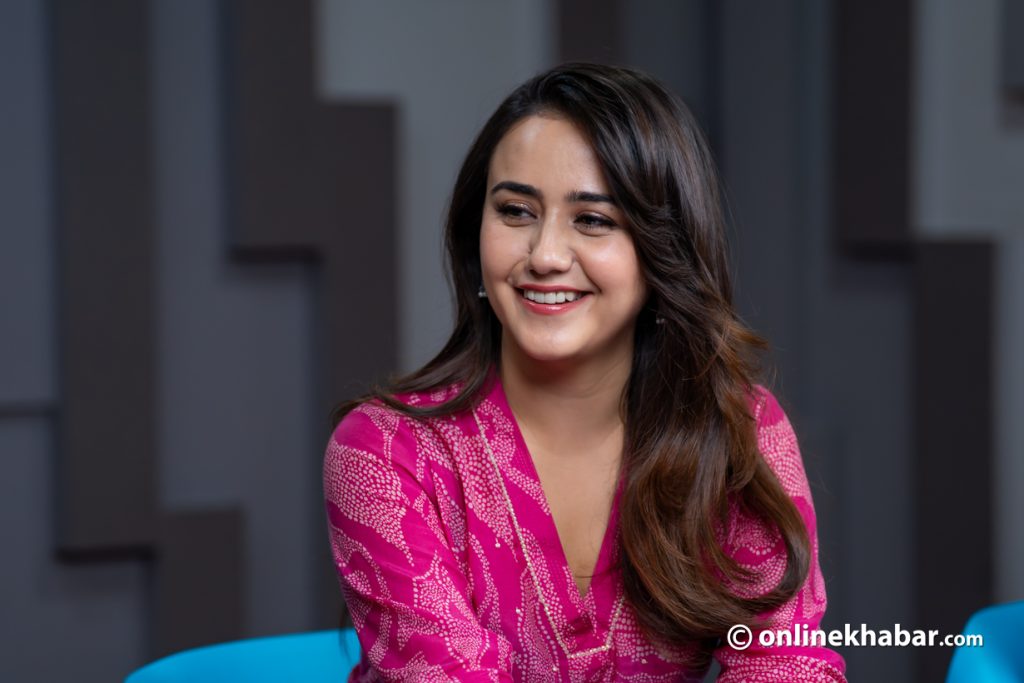
Whether it’s Madhubala of Lalibazar, or Pushpa of Chiso Manchhe, or Rankala of Bulbul, these deep characters that Swastima has lived on screen will always remain in the archive of Nepali cinema.
For her role as Rankala, a tempo driver, in Bulbul, she won Best Actress at the SAARC Film Festival held in Colombo within a week of each other, along with Nepal’s National Film Award. Likewise, for Dimag Kharab, she once again won the National Film Award for Best Actress.
Notably, her recently released film “Laalibazaar” is the biggest solo hit of her career. Earning close to 100 million rupees, the film brought a suppressed reality of Nepali society into public debate.
Swastima, who played the character of Madhubala, a rebellious mother, is being widely praised for her effort.
“These characters made it easy for me to connect quickly with audiences,” she says. “The reason ‘Bulbul’ resonates is that it was the story of an ordinary person. For ‘Chiso Manchhe,’ I went to the far-west and spent about ten days there meeting the local people and learning from them. If I had only been an architect, I would never have had this learning.”
This “learning” is itself the biggest achievement of this decade of her career. “Once you’re an actor, you can look at society from many angles. If I weren’t an actor, I would never have experienced or seen this,” she feels. She adds with a laugh, “Now there’s a path to study and then come into acting. It wasn’t like that in our time. I’ve been earning money and learning at the same time for ten years.”
Equal pay and the power of cinema
Swastima’s personality is not limited to being an actress. She was likely the first in the Nepali film industry to start the debate on equal pay between male and female actors. Other actresses in the domestic film industry are now also joining the debate she initiated and raising their voices for equal wages.
Having come to this position, I must also be able to say ‘no.’ I should make things easier for the girl who comes with a dream of becoming an artist,” Swastima says.
“I chose this path so that when I say ‘no,’ it becomes easier for the next generation to say ‘no’ too.”
Having reached this height of stardom, the audience’s love, awards, and box-office earnings alone are not enough for her.
“It’s not enough if the film does well commercially but isn’t critically acclaimed,” she says. “Working with a good creative team and achieving something meaningful, that’s what gives me real happiness.”
Last year’s release, Dimag Kharab, made her realise just how powerful cinema can be. Based on a story of youth leadership and intervention, the film’s release coincided with a heated atmosphere ahead of the Falgun 21 parliamentary election. Some leaders even criticised it, saying it had “manipulated voters’ minds by screening the film on night buses.”
“We start from a blank page, but it makes people cry and laugh too,” she says. “If you can change people’s minds positively without even meeting them, how powerful is the power of cinema! It was said that ‘Dimag Kharab’ even influenced the election results. This process of filmmaking keeps me very excited.”
Last year, she also stepped into production with the film Behuli from Meghauli.
Going forward, she wishes to bring to the screen more challenging characters who occupy an important but often-overlooked place in society.
Her one piece of advice to the new generation: “Do come into this field, but don’t stop being honest. Above everything else, honesty toward your craft is what matters.”