

The Bhotekoshi Flash Flood of August 26 did not end when the water level receded. It has entered another phase that is slower, less visible and perhaps more consequential. The causes are being debated, damage is being assessed, and government agencies and other institutions are beginning to define recovery priorities.
According to the government’s latest rapid damage and needs assessment, 7,570 private houses were damaged and around 32,933 people were affected. About 55 kilometres of roads, 37 motorable bridges and 68 suspension bridges were damaged. The flash flood also affected 1,806 hectares of agricultural land and caused major losses to hydropower and transmission infrastructure. The estimated recovery requirement is around Rs 723.31 billion, with infrastructure accounting for the largest share.
These figures are necessary. Roads need to be restored, electricity generation has to resume, and damaged public services must function again. Yet converting a disaster into numbers, sectors, costs and projects is not simply a technical exercise. It gives institutional form to the disaster and creates the basis for later decisions.
Once damage is translated into tables, sectors and costs, institutions decide what requires immediate action, what can wait, which sectors should receive priority, who should lead and where limited resources should go. The flash flood itself does not make these decisions. They emerge through institutions, available knowledge, political priorities and different capacities to influence public action.
This is why the Bhotekoshi Flash Flood can be examined through two related ideas, the politics of disaster and the political economy of disaster. Political scientist Richard Olson argues that disasters are inherently political because they place pressure on governments, alter public agendas and raise questions of accountability. They also affect whose interests and voices enter public decisions. Disaster politics begins before an event through investments in safety, continues through emergency response, and extends into reconstruction because decisions made afterwards shape future opportunities.
The political economy of disaster takes this argument further. It considers how power, institutions, ownership and access to resources shape vulnerability before a disaster and recovery afterwards. Some losses enter budgets and projects more readily than others. Reconstruction can therefore redistribute public expenditure, risk, opportunity and future security.
Disaster scholars Ben Wisner and his colleagues have long argued that hazards become disasters through socially produced vulnerability. Exposure, access to assets, settlement conditions and institutional capacity shape who is affected and how severely. The hazardous event may be natural, while the distribution of loss and opportunities for recovery are not entirely natural. The central issue for Bhotekoshi is therefore not only what was damaged, but how the disaster itself will be defined for the purposes of recovery, including which losses are prioritised, whose knowledge matters, which institutions gain authority and where resources are directed.
Public attention to disasters fades quickly
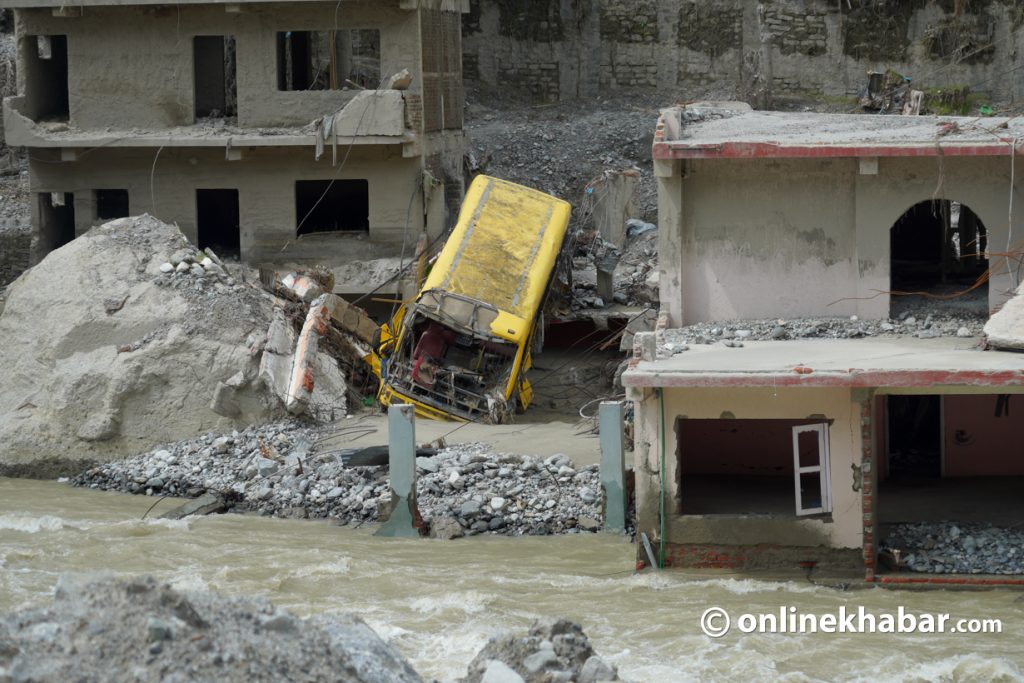
The first political resource in this process is attention. A major disaster can bring issues into national debate within days that might otherwise struggle for recognition for years. Glacier and glacial lake risks, transboundary information, early warning systems, river-corridor development, hydropower risk and settlement safety have all gained renewed attention after the Bhotekoshi Flash Flood.
Political sceintist Thomas Birkland describes major disasters as “focusing events”. They concentrate the attention of the media, political leaders and policy communities, creating a window in which neglected problems can become visible and policy change becomes possible.
However, public attention is limited. Scholars Stephen Hilgartner and Charles Bosk describe public arenas as having a limited “carrying capacity”. Social problems compete for recognition, and even a major disaster can lose visibility when another crisis enters the public arena. Research on online news coverage after a major earthquake in Mexico found that coverage fell by roughly half every eight days after the initial surge. Intense attention is therefore not the same as sustained attention.
This matters because attention influences institutional behaviour. While a problem remains visible, it is more likely to generate meetings, data collection, policy reviews, budget discussions and administrative action. Once attention declines, there is no guarantee that the same issue will remain a priority.
The period immediately after a disaster should therefore be understood as both a political and policy window. Nepal can mobilise quickly through committees, meetings, studies and commitments. The harder task is to convert this mobilisation into durable institutions, regulations, budgets and implementation. Otherwise, governance can fall into a recurring pattern of shock, attention, response and forgetting.
Political incentives can reinforce this tendency. Andrew Healy and Neil Malhotra, scholars of political economy, found that voters in the United States rewarded post-disaster relief more than preparedness, even though their analysis suggested that one dollar spent on preparedness could reduce future losses by around fifteen dollars. Economists Tim Besley and Robin Burgess similarly found in India that stronger media reach and political accountability were associated with stronger government response to flood damage.
This produces a persistent contradiction. Strengthening a bridge before it collapses rarely becomes a political spectacle; while rebuilding it afterwards can become a visible achievement. Preventing settlement growth in a hazardous location attracts less attention than rescue from the same place. Prevention often creates greater social value, yet response is more visible. he political significance of attention therefore lies not simply in how much attention a disaster receives, but in what that brief period of visibility succeeds in placing on the institutional agenda before attention moves elsewhere.
Political urgency is not always negative
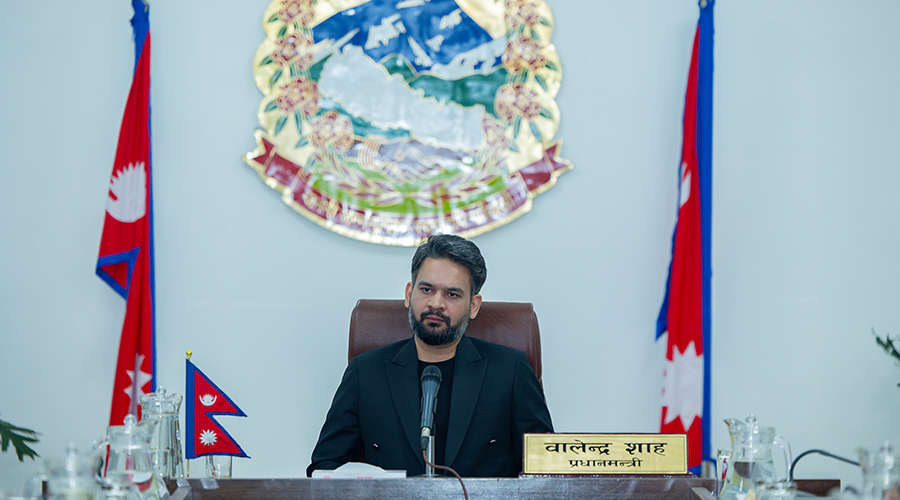
Yet the brevity of public attention does not make political urgency inherently problematic. Under certain conditions, the same pressure that encourages short-term responses can break institutional inertia, bring resources together and accelerate reforms that had remained stalled for years. A short period of public attention can become an important decision window.
The 2001 Gujarat earthquake provides a useful example. The earthquake struck on January 26. Only 13 days later, on February 8, the Gujarat State Disaster Management Authority, or GSDMA, was established. Reconstruction was linked not only with housing, but also with social infrastructure, livelihoods, risk reduction and longer-term institutional capacity. More than 202,000 houses were reconstructed and more than 908,000 were repaired. Owner-driven reconstruction became an important part of the housing strategy.
Political urgency helped create an institution that survived beyond the immediate disaster. Yet Gujarat also shows why speed and visible success are not sufficient measures of long-term recovery quality.
After the Gorkha earthquake, I was invited to CEPT University to speak on post-disaster resettlement. During that visit, I saw several post-earthquake resettlement sites around Bhuj. Rawalwadi particularly caught my attention. Its planned roads, new plots and housing created a strong impression of rapid and organised reconstruction. Yet the location raised an immediate concern about the movement of water and possible drainage problems during the monsoon.
Later research on post-earthquake development in Bhuj supported that concern. Studies found that micro-watersheds and natural drainage systems had not received sufficient attention in some relocation sites, and Rawalwadi had expanded across a seasonal drainage route associated with earlier flooding.
This does not justify describing Rawalwadi simply as a failed settlement. The more useful lesson is that politically necessary speed, visible physical reconstruction and long-term liveability are not always the same. A resettlement can appear successful when judged through completed roads, plots and houses while still carrying unresolved hydrological, ecological or livelihood risks.
Gujarat therefore illustrates two sides of disaster politics. Political urgency can create lasting institutions, while the same urgency can privilege speed and visible output over long-term habitability. The Bhotekoshi Flash Flood presents a similar challenge. The current momentum is also a moment to decide where reconstruction should occur, where it should not, what level of risk is acceptable, which families may require relocation and how livelihoods can be protected. These decisions will influence land, public investment, future exposure to risk and household opportunities. At this point, the politics of immediate response begins to become the political economy of reconstruction.
When the main question gets lost in a crowd of expertise
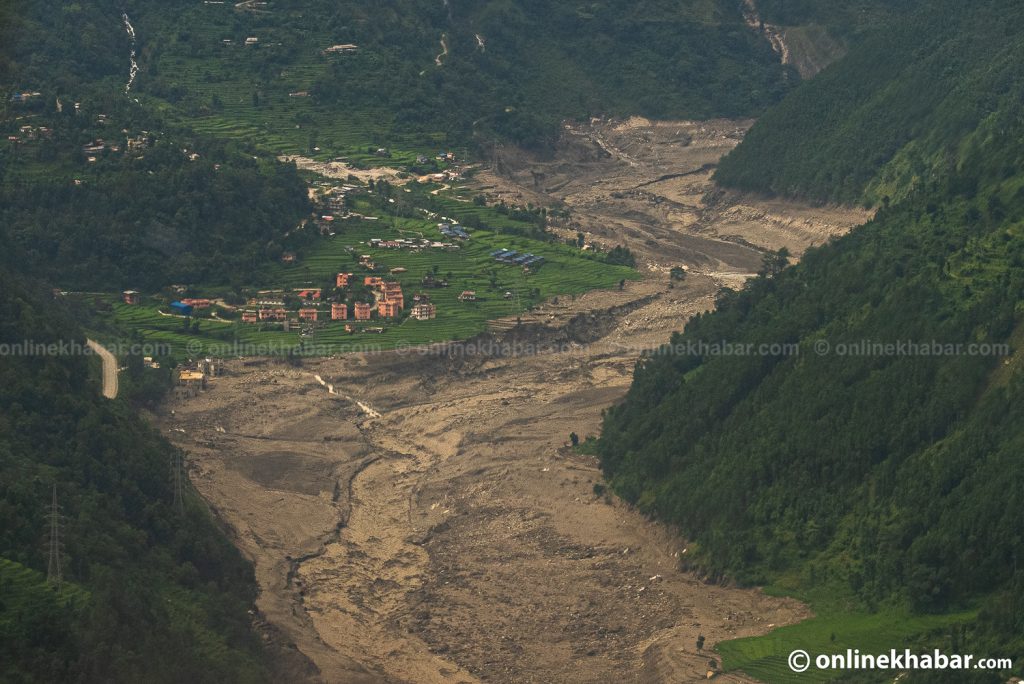
Political urgency shapes which problems receive attention. Knowledge shapes how those problems are understood. Institutions then determine which forms of knowledge become authoritative. This introduces another important dimension of disaster politics, the politics of expertise.
A complex Himalayan disaster such as the Bhotekoshi Flash Flood cannot be understood through a single discipline. Hydrologists examine river flow. Geologists study terrain, slope failure and sediment. Cryosphere and climate specialists examine high mountain systems. Engineers assess structures and infrastructure. Economists estimate damage and loss. Planners examine land use and settlements. Social scientists consider vulnerability, livelihoods and social relations.
All these forms of knowledge are necessary. Yet a room full of experts does not automatically produce decision-relevant knowledge. Interdisciplinary work becomes useful when the decision question is clear and the required expertise is organised around it.
Nepal has recognised the need to connect expertise with formal decision-making. The Disaster Risk Reduction and Management Act, 2074 provides for three experts, including at least one woman, to serve on the National Council chaired by the prime minister. This is important, but placing experts within a formal structure is different from creating a continuous system that connects multidisciplinary knowledge with policy, budgets and recovery decisions.
An expert dialogue organised by the National Planning Commission (NPC) after the Bhotekoshi Flash Flood illustrated this challenge from another angle. I participated in the discussion, which brought together more than sixty experts. The programme lasted around two hours, with a considerable part of the time devoted to institutional presentations by NPC itself. When the broader discussion began, much of the attention moved towards the physical causes of the flash flood, glacier monitoring, data systems and early warning technologies.
These issues are important. Nepal needs stronger scientific investigation, glacier and river monitoring, transboundary information and early warning. However, when the immediate purpose is to determine post-disaster damage, needs and recovery priorities, the questions are different. The process must establish what was damaged, how housing and livelihoods were affected, which settlements and groups suffered most, where reconstruction or relocation is appropriate and what resources are required.
This distinction explains the role of a Post-Disaster Needs Assessment, or PDNA. It is not a substitute for scientific research into causes. It brings physical damage, economic losses, human impacts and recovery requirements into a common government-led framework. Build Back Better remains important because reconstruction should not reproduce earlier vulnerability. Even so, explaining why a disaster occurred and determining what affected people require for recovery remain different analytical tasks.
Nepal used this approach after the 2015 Gorkha earthquake. Around 755,000 houses required reconstruction or substantial repair, and the estimated requirement for housing alone was about US$3.27 billion, close to half of total recovery needs.
The institutional lesson is that expertise does not make decisions by itself. Institutions decide which knowledge becomes an official basis for action, which risks are acceptable, which needs receive priority and how resources are allocated. If the Bhotekoshi Flash Flood is defined mainly as a glacier-monitoring problem, investment may move towards sensors, modelling and data systems. If it is defined as a settlement and livelihood problem, land, housing, relocation and social protection become more prominent. If it is defined mainly as an infrastructure problem, roads, bridges, hydropower and transmission systems may dominate.
None of these framings is inherently wrong. Nor are they mutually exclusive. But the framing that acquires greatest institutional authority influences what becomes urgent, which organisations move to the centre of recovery and where resources are directed. The deeper challenge is therefore to connect the right forms of knowledge with the decisions that must be made.
Parallel worlds of knowledge
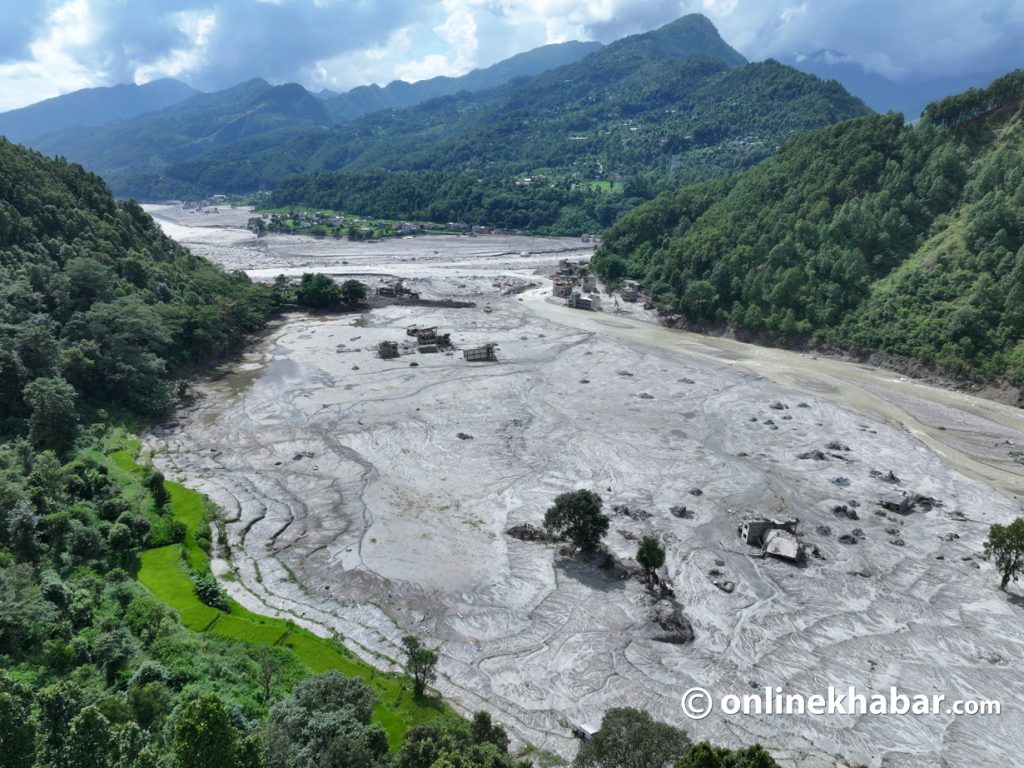
The problem, however, is not only how expertise is organised around a decision. The knowledge needed for recovery, the authority to act, the finance to implement and the capacity to deliver are often located in different institutions.
Government has the clearest legal and political authority. It can declare an area unsafe, provide or acquire land, allocate budgets, approve infrastructure, establish compensation rules and implement settlement decisions. Administrative authority, however, does not automatically provide technical depth in every field. The authority to make a decision and the knowledge required to make it are not always located in the same place.
Universities have a different strength. They train professionals, accumulate specialised knowledge and conduct longitudinal research that short project cycles rarely allow. Yet inviting individual academics to occasional meetings is not the same as creating a sustained institutional connection between universities and government decisions.
Independent research organisations and specialised centres can bring technical teams, GIS and data capacity, local networks and rapid mobilisation. Project-based financing, however, can influence what is studied, when it is studied and how long the work continues. Institutional memory may weaken when a project ends.
Development partners add finance, international experience, technical assistance and capacity support. Their contribution to disaster risk reduction in Nepal has been significant. At the same time, external agendas can influence national priorities and raise questions about ownership and unequal access to decision-making.
Development partners also work through country strategies, financing windows, project cycles and reporting requirements. A monitoring centre, data platform, bridge or school can be counted and reported. Restoring community relationships, resolving land arrangements or following displaced livelihoods for a decade is much harder to measure. What can be measured and reported is not always the same as what matters most socially.
This is where visibility can become a form of institutional currency. Political leaders, government agencies, universities and development partners all need to demonstrate relevance or results. These incentives are not inherently negative. The problem begins when what is easiest to see and count gains disproportionate influence over decisions and resources.
Political economy should therefore not be reduced to a search for bad intentions. Its purpose is to examine how authority, knowledge, finance, accountability and institutional incentives shape behaviour. Nepal’s deeper challenge lies in the disconnect between authority, knowledge, finance and implementation. Affected households, meanwhile, usually have far less capacity than institutions to convert lived experience into an official decision.
What did the Gorkha earthquake leave unfinished?
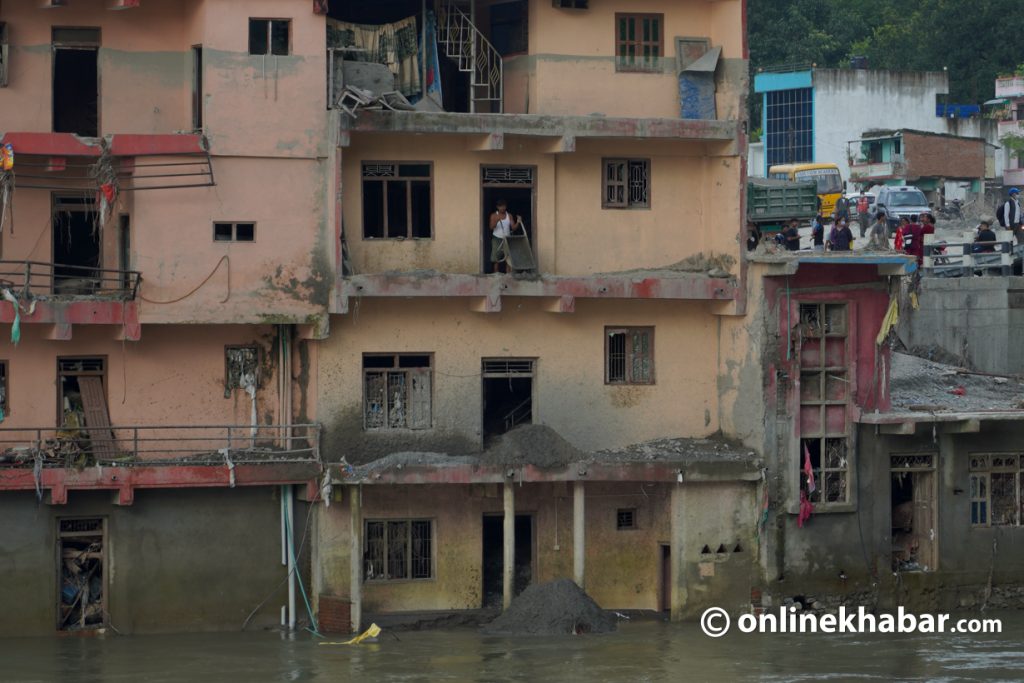
Nepal has already experienced this political economy of recovery after the 2015 Gorkha earthquake. Around 500,000 houses were completely destroyed and more than 250,000 were partially damaged. Overall, around 755,000 houses required reconstruction or substantial repair. Housing and human settlements alone accounted for an estimated US$3.27 billion, close to half of total recovery needs.
The scale of housing damage has already been well documented. The more important lesson for Bhotekoshi concerns what happened after housing reconstruction became an institutional programme. It concerns where and how families would resettle, how long public attention to these questions would persist, and what happened when government decisions and household decisions moved at different speeds.
The central challenge was not only how to rebuild structures. It was also where and how families would resettle. The earthquake created a rare planning opportunity because some communities became willing to reorganise inherited plots, access arrangements and ownership structures if this could produce safer and better planned settlements.
Jillu in Dolakha offered one such example. The community reorganised private land to improve roads, infrastructure and residential plots. In Nepal, a land ownership certificate, or lalpurja, represents more than an economic asset. It is tied to security, inheritance, identity and bargaining power. The post-earthquake period therefore created a short window in which collective decisions about land and settlement, normally very difficult, became possible.
However, this opportunity does not remain open indefinitely. Affected families cannot suspend everyday life while government plans are prepared. Children continue to attend school, farms and livestock require attention, families need income and loans must be repaid. When public decisions take too long, households create their own solutions. Some rebuild where they were, some migrate, and others return to risky locations because livelihoods remain tied to those places. The time of government planning and the time of household life do not move at the same speed.
The evolution of reconstruction priorities after the earthquake adds another dimension to this problem. The reconstruction of cultural heritage provides a revealing institutional comparison. Around 2,900 historic structures were damaged. In the immediate aftermath of the earthquake, unsafe settlements, relocation and resettlement received considerable political and public attention. As reconstruction progressed, however, heritage increasingly acquired institutional and political salience. Its relationship with national identity, tourism, World Heritage sites, international institutions and highly visible reconstruction projects helped it retain attention within the recovery agenda.
As attention and institutional momentum shifted, unresolved resettlement problems did not disappear. Their costs increasingly moved towards affected households. Families still had to decide where to live, whether to rebuild, how to sustain livelihoods and how to finance recovery even when public decisions remained incomplete. Delay could therefore become a private cost through additional borrowing, self-reconstruction, migration, livelihood disruption or continued dependence on locations exposed to risk.
This comparison is important because political priorities after a disaster are not fixed. A problem that is highly visible in the first months of reconstruction may lose institutional weight as other sectors acquire stronger political, symbolic or organisational constituencies. Yet households continue to live with the consequences of unfinished decisions long after that shift occurs.
Our own longitudinal research in Panipokhari and Jillu shows why these matters. Between 2021 and 2023, residential satisfaction remained relatively stable in Jillu, while it declined substantially in government-led Panipokhari. The difference was not explained by structural safety alone. Housing design, thermal comfort, drinking water, cultural suitability, participation, household economic capacity and the freedom to adapt a house to changing needs all shaped the longer-term experience of resettlement.
A structurally safe house is necessary for resettlement, but it is not sufficient evidence of successful resettlement. For the Bhotekoshi Flash Flood, the lesson is that the early period after a disaster can provide a rare opportunity to reconsider risky settlements, land, access, infrastructure and livelihoods together. Yet by the time institutions finish preparing a plan, households may already have reorganised their lives. The timing of decisions, meaningful participation and the integration of land, livelihoods and infrastructure are therefore as important as identifying a technically safe site.
Recovery happens inside the household
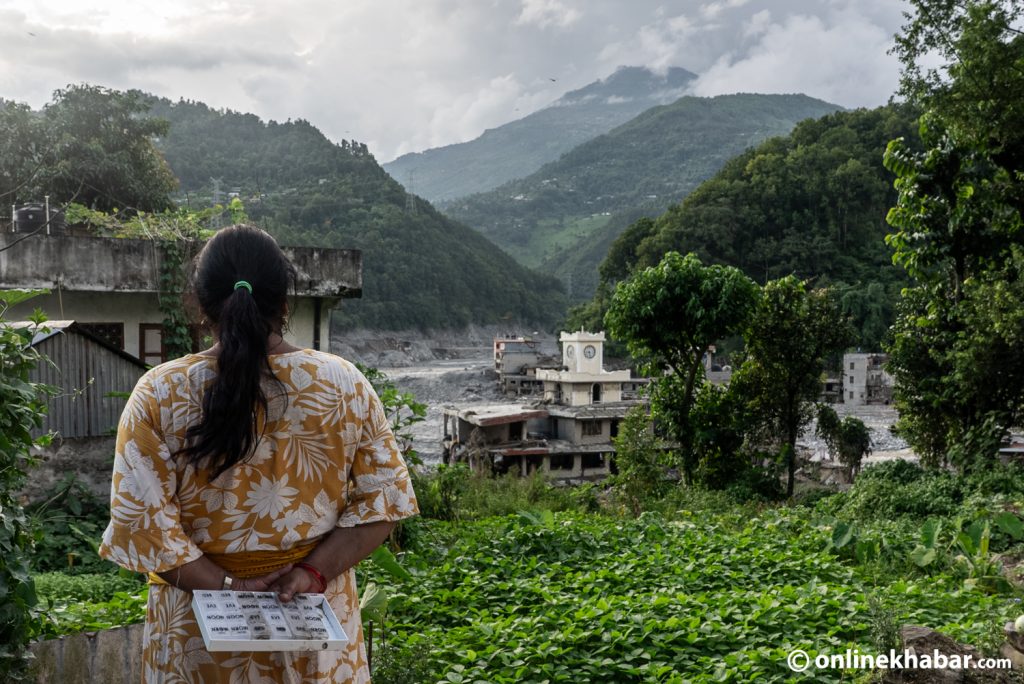
The Gorkha experience also reveals a further limitation of institution-centred recovery. Even when reconstruction progresses at the level of programmes and projects, recovery is ultimately experienced at the level of the household. For the state, a disaster appears through damage figures, sectors, projects and budgets. For a family, these disruptions occur within a single life.
Urban planning scholar Mariana Arcaya and her colleagues make an important distinction between the recovery of places and the recovery of people. A road may reopen, a market may function again and houses may be rebuilt, while the people living there do not necessarily return to their previous economic, social or psychological conditions at the same pace. Recovery varies according to income, assets, displacement, social position and access to institutions.
The same distinction is relevant to the Bhotekoshi Flash Flood. A road may reopen while a family remains economically displaced. A house may be rebuilt while its occupants continue to feel unsafe. A new settlement may be technically safer while placing a household far from its livelihood, neighbours and everyday support networks. Physical reconstruction and the restoration of life are related, but they are not the same.
Social capital is part of this difference. Political scientist Daniel Aldrich has shown how trust, mutual assistance and social networks help households gain information, labour, loans, childcare and emotional support during recovery. The cost of a road or house can be calculated relatively easily. The value of a neighbour who provides childcare or a relative who offers informal credit is much harder to capture in a damage assessment. Relocation may therefore reduce physical risk while creating new social vulnerability.
Place attachment also matters. People do not remain in hazardous locations simply because they fail to understand risk. Land, employment, ancestral memory, religious meaning, social identity and status may tie households to a place. Moving a family to a technically safer location can therefore create new economic, social and psychological costs.
Public-health research adds another dimension. Post-disaster mental health is connected not only with the event itself, but also with displacement, economic loss, loss of resources and prolonged uncertainty. Families may remain unsure whether land will be declared safe, whether they should rebuild or wait, how much compensation they will receive, where children will attend school and whether relocation will allow continued access to farms or employment. Officially, the emergency may have ended, while these uncertainties can continue for months or years.
Research in Nepal after the Gorkha earthquake found a similar pattern. A study following 400 households in four earthquake-affected communities showed that recovery varied according to displacement, livelihoods, hazard exposure, place attachment, mental health and institutional participation.
This is where political economy enters the home. Government may treat housing, roads, education, livelihoods, social protection and mental health as separate sectors. For a household, they are interconnected. The state separates these issues into administrative categories, while families experience them as one life. When institutional priorities change or public decisions remain incomplete, households do not escape those unresolved issues; they absorb them. Recovery must therefore be assessed not only through public budgets, but also through the costs that households are left to carry themselves.
Who controls the story?
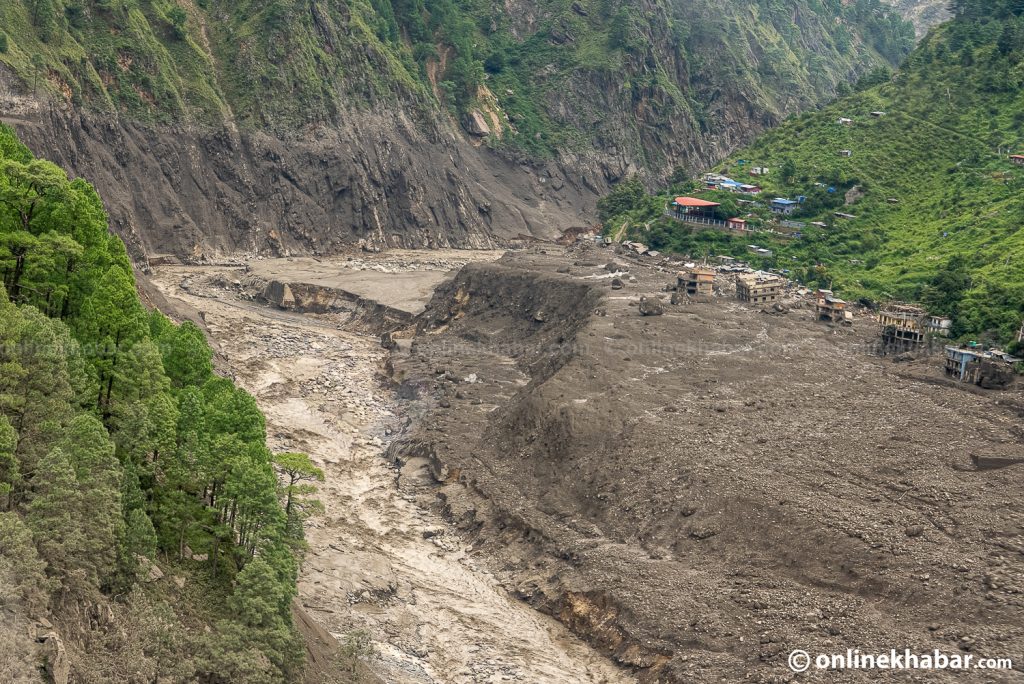
Political economy operates not only through budgets and projects. It also operates through the way a disaster is explained.
Several explanations of the Bhotekoshi Flash Flood are currently in circulation. Preliminary technical assessments suggest that a large mass of rock and glacial ice collapsed on the Tibetan side, temporarily blocked the river and contributed to the formation and failure of a debris lake. At the broader policy level, the disaster can also be framed through increasing climate and cryospheric risk, weak transboundary information and early warning, the concentration of settlements and infrastructure within a narrow river corridor, or inadequate attention to infrastructure location and risk-sensitive planning. These explanations are not mutually exclusive.
Public policy scholar Deborah Stone describes such explanations as “causal stories”. Policy problems do not arrive with a single self-evident cause. Actors construct accounts of what happened, why it happened, who suffered and where responsibility lies. These accounts then influence which responses appear necessary and legitimate.
Nepal is fully justified in connecting the Bhotekoshi Flash Flood with climate justice. Nepal contributes very little to global greenhouse gas emissions, while Himalayan countries face disproportionate risks from climate change and changes in the cryosphere. The unequal global political economy that produces climate risk is therefore part of the Bhotekoshi story.
At the same time, climate change should not become a complete explanation for every domestic vulnerability. If the disaster is presented only as a consequence of global warming or an event originating in the high Himalaya, important domestic questions may be pushed aside. These include where infrastructure was built, how land use was regulated, why settlements expanded in particular locations, whether construction standards were sufficiently risk-sensitive and how effectively preparedness systems operated.
The opposite interpretation would also be incomplete. If the Bhotekoshi Flash Flood is explained only as a failure of planning or administration within Nepal, the unequal global political economy that produces climate risk disappears from the analysis. Demanding climate justice internationally should not weaken accountability at home. Recognising weaknesses at home should not make global climate injustice invisible.
Narrative power also matters. Government agencies, scientific institutions, development partners, project developers, the media and affected communities do not have equal access to data, public platforms, finance or institutional prestige. The explanation that becomes official is therefore shaped by evidence as well as institutional power.
A framing centred on high-mountain monitoring may direct attention towards sensors and data systems. A framing centred on infrastructure risk may favour standards and river-corridor management. A framing centred on settlements and livelihoods may bring land, housing, relocation and social protection to the forefront. These are not merely different explanations of the same event. Once institutionalised, they create different reconstruction agendas. The causal story therefore shapes not only responsibility, but also the direction of solutions, institutional authority and resources.
A mature response to the Bhotekoshi Flash Flood should therefore place global climate risk, natural processes and domestically produced vulnerability within the same analysis. Doing so allows responsibility to be understood across international, national and local scales rather than reduced to a single convenient explanation.
From attention to budgets
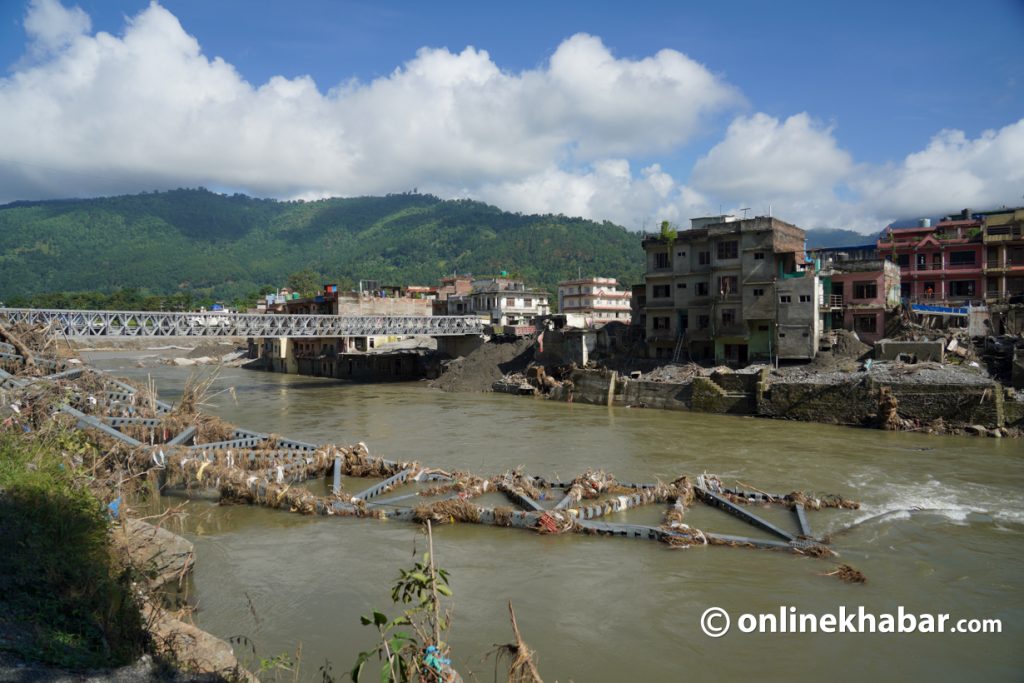
These competing explanations matter because causal framing does not remain at the level of public debate. Once an interpretation gains institutional authority, it begins to influence what is measured, which interventions are prioritised and where public resources are directed. This is the point at which attention and interpretation acquire material consequences. This is how public attention, interpretation and expertise eventually become budgets.
The estimated Rs 723 billion recovery requirement for the Bhotekoshi Flash Flood is therefore more than a financial figure. It is also an early representation of how the disaster has been institutionally classified and valued. Infrastructure accounts for around Rs 473.57 billion of the estimated recovery requirement, close to three quarters of the total. Given the scale of damage to roads, bridges, hydropower and other infrastructure, major investment in these sectors is clearly necessary.
The concern is whether other forms of loss enter the assessment with comparable clarity. Physical losses are generally easier to measure. Kilometres of damaged roads, destroyed houses, generation capacity and replacement costs can be estimated through established methods. Household and social losses are more difficult to quantify.
The dispersal of a neighbourhood has a cost. So does the additional travel time faced by a relocated farmer, the loss of informal childcare when extended families are separated, or the disappearance of a customer base for a small business. These losses are real even when they are difficult to monetise.
This difference can create a self-reinforcing cycle. Visible losses generate better data. Better data make it easier to define projects. Clearly defined projects attract finance. Financed projects produce measurable results, and measurable results are easier to present as political and institutional achievements. Less visible losses may remain weakly documented and therefore less competitive for public finance.
Attention, framing, expertise, institutional authority and budgets are therefore not separate domains. They form a sequence. What becomes visible influences how the problem is defined; the definition influences which knowledge becomes authoritative; institutional authority influences priorities; and priorities eventually shape where resources go.
That sequence is also why the question “who defines reconstruction?” matters. Whoever has greater capacity to define the problem also has greater capacity to influence what the state eventually recognises, organises and finances.
Keeping affected families in view
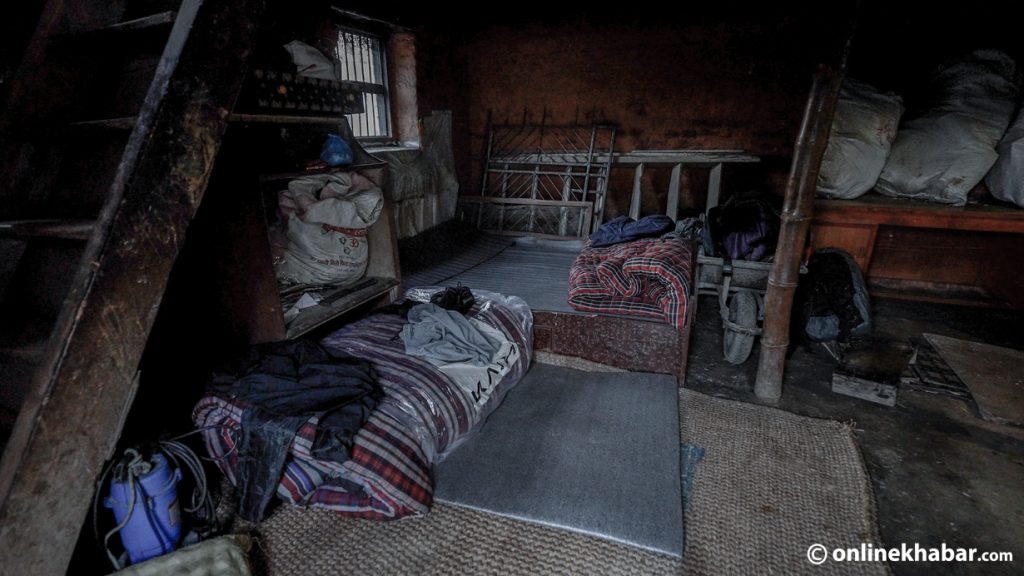
Ultimately, this entire sequence is tested in the lives of affected families. During the Bhotekoshi Flash Flood, those families became highly visible. Images of rescue, destroyed homes, blocked roads and displacement drew national attention. The more difficult test begins after the urgency of the event has passed.
Recovery takes place across different time horizons. The immediate period concerns safe shelter, basic services, income and access. The medium term brings decisions about permanent housing, land, settlement planning, common infrastructure and livelihoods. The longer term requires stronger river and mountain monitoring, early warning, infrastructure standards, land-use management and institutional reform.
All these levels are important. However, long-term technical solutions should not displace the immediate questions faced by displaced families. People need clarity about where they can live safely, what happens to land that can no longer be occupied, whether voluntary land readjustment is possible, how livelihoods will be restored, who will finance common infrastructure and how communities will participate in deciding the future of their settlements.
This is why a PDNA or RDNA is not simply a technical document. It creates an early institutional basis for determining which losses the state formally recognises, which needs receive priority and how recovery itself is defined. Its quality should therefore be judged not only by the total financial requirement it calculates, but also by the range of losses it succeeds in making visible.
The most meaningful measures of recovery may not be the easiest to publish. Five years from now, the stronger evidence will concern how many families have secure and legally recognised places to live, how many have restored stable livelihoods, how many carry additional debt because of reconstruction, how many relocated households continue to return to hazardous areas for farming or employment, and how many communities had a meaningful role in shaping their own resettlement.
No single discipline can answer these questions. Planners, engineers, economists, social scientists, psychosocial specialists and local governments all have roles to play. More importantly, affected families must be treated as sources of knowledge, not only as beneficiaries. They understand everyday risk, place-based livelihoods, social relations and which alternatives are practically workable.
The Bhotekoshi Flash Flood has made the state, experts, development partners and affected communities highly visible. The more difficult test of disaster governance begins when public attention declines, studies are completed, consultants submit reports, budgets are allocated and large infrastructure projects acquire their own institutional momentum.
By that stage, success should not be measured only by reopened roads, restored megawatts, improved monitoring systems or international assistance. These achievements matter, but they capture only part of recovery. A deeper measure is whether the people who are visible in disaster images today remain visible to the state when later decisions are made about land, livelihoods, settlements, budgets and future risk.
The experience after the Gorkha earthquake suggests why this matters. Political and institutional attention can shift, while unresolved recovery costs remain with affected households. Bhotekoshi therefore presents not only a question of how Nepal will reconstruct, but of who will retain the authority to define reconstruction as public attention, institutional priorities and financing evolve.
Which losses are recognised, whose knowledge becomes authoritative, who exercises decision-making power and where resources are directed will ultimately be reflected in the lives of affected people. Who defines reconstruction will, in the end, help determine whose recovery it becomes.