
Kathmandu, September 29
Nepal’s land-based trade with China has come to a complete halt after three days of continuous rainfall and natural disasters disrupted all three major border crossings with the northern neighbour.
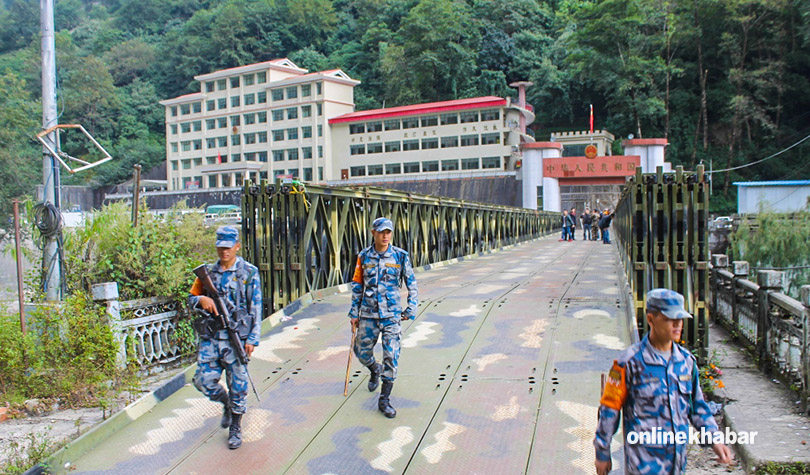
With just two weeks remaining until Dashain, the closure of the Tatopani-Khasa, Rasuwagadhi and Korala crossings has disrupted the land-based supply chain between Nepal and China.
According to Department of Customs data, Nepal imported goods worth more than Rs 76.40 billion from China in the first two months of the current fiscal year alone. But damage to roads and infrastructure leading to all three major crossings has now made large-scale trade through these routes impossible.
China had already closed the Tatopani-Khasa border crossing over concerns about landslides. The Rasuwagadhi crossing was then severely damaged after flooding in the Bhotekoshi River on August 26.
With both major crossings closed, the Korala crossing in Mustang had emerged as an alternative route for Nepal-China trade. However, flooding in the Kali Gandaki River has now severed road access to Korala as well.
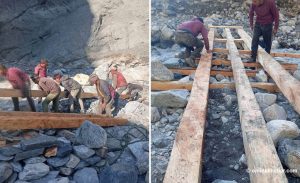
Floodwaters washed away approach roads to key bridges along the Kaligandaki Corridor and the Mid-Hill Highway, blocking the route to the Korala border. While the Korala border point and customs office remain safe, damage to bridges along the Beni-Jomsom road has halted the movement of cargo vehicles.
Billions of rupees worth of trade stuck on the roads
Trade pressure at the Korala crossing had increased sharply after Tatopani and Rasuwagadhi were closed.
In just 15 days, from September 10 to 25, 434 containers and 641 electric vehicles entered Nepal through Korala. By the last week of Bhadra, Mustang Customs had already collected more than Rs 2.31 billion in revenue in the current fiscal year.
The crossing handled imports worth Rs 14.41 billion and more than 3,000 electric vehicles last fiscal year. With the road now cut off, billions of rupees worth of trade have been brought to a standstill.
Only 30 percent of goods reach Kathmandu, prices expected to rise
The border closures have halted the movement of clothes, footwear, bags, electronics and electric vehicles from China, raising concerns among both traders and consumers.
Parshuram Dahal, president of the RB Complex Business Association, said only around 20 to 30 percent of goods brought in for Dashain have reached Kathmandu so far.
“Dashain-targeted goods are stuck on the roads. We tried to divert the goods in warehouses through the Korala border, but that has also stopped,” Dahal said. “At most, only 30 percent of the goods have arrived so far.”
He said customs procedures were not the main problem, but the rising US dollar exchange rate and transportation costs were pushing up prices.
“The dollar has risen sharply, and transportation costs have also increased after the roads were blocked,” Dahal said. “Because of the higher transport costs, the prices of goods arriving now are expected to increase by 25 to 30 percent.”
With large cargo trucks unable to operate, some traders have started bringing goods from India in smaller vehicles. But Dahal said Indian goods are more expensive than Chinese goods and transportation costs are higher when using smaller vehicles.
He said existing stocks and locally produced goods had provided some relief despite the disruption in Chinese imports.
Wholesale trade has also been affected as traders from outside Kathmandu have been unable to travel to the capital to collect goods after roads were damaged by several days of rain.
Some traders are taking orders through WhatsApp and social media, but business remains slow.
“It has been three consecutive years that roads are damaged and trade is disrupted by rain in September,” Dahal said. “Traders are always the ones who suffer. Everyone is now forced to bear the impact of this disaster.”
Traders call for infrastructure and diplomatic efforts
Manoj Babu Shrestha, president of the Federation of Nepalese National Businessmen, said the closure of all three crossings with China had severely affected traders, markets and the supply system.
He accused the government of failing to make sufficient diplomatic efforts while Chinese authorities had cited various reasons for keeping the crossings closed.
He said billions of rupees had been spent on infrastructure at the Tatopani border, including a dry port and parking facilities, but the crossing remained closed.
“We have already told the government that diplomatic efforts should be made to reopen the Tatopani border immediately. Lawmakers also raised the issue in Parliament yesterday,” Shrestha said. “But we have not been able to understand why the government does not want to reopen the border.”
Shrestha also pointed to delays in customs clearance and inadequate infrastructure at Korala.
He said the crossing had initially been clearing customs for around 50 containers a day during its first 15 days of operation, but the process had slowed.
“The government’s physical infrastructure at Korala is not adequate, and there is also a shortage of staff,” he said. “There have been major problems with software and networking. Sometimes the server goes down and sometimes there is no network. This problem has continued for a year, but the government has not been able to fix it.”
Transportation from Korala is also expensive because of the geographical distance.
According to Shrestha, trucks travelling from Kerung to Korala have to take a route of around 1,200 kilometres on the Chinese side, while the road from Korala into Nepal includes around 200 kilometres of heavily damaged road.
“Because of transportation costs, the price of a pair of shoes or a jacket increases by around Rs 100 to Rs 150,” Shrestha said. “Even if goods were more expensive, the market would at least have a regular supply. But now everything is blocked.”
He said the border closures had disrupted the market at a time when business activity normally increases ahead of Dashain.
“Traders are suffering greatly. The market should be picking up and showing excitement ahead of Dashain, but that is simply not happening,” he said.
What is happening at the border?
According to Bidur Chudal, chief customs officer at Mustang Customs Office, more than 150 cargo vehicles and containers are currently stranded at the customs point, including vehicles awaiting customs clearance.
Around 300 to 400 electric vehicles, along with empty and loaded containers, are also stranded in the yard and at the border.
“Although the flow of vehicles from the Chinese side has increased, traders are not in a hurry to complete customs clearance because the road on the Nepali side is blocked,” Chudal said.
He said the Department of Roads was working to repair the damaged road and that goods could be transported to Kathmandu once the route reopens.