

Kathmandu, September 25
Students who lost their parents or homes in the Rasuwa floods are being accommodated at schools so they can continue their education.
Residential arrangements have also been introduced for children affected by the floods in Rasuwa, Nuwakot and Dhading districts.
“Students have started staying in hostels and continuing their studies. Those who remain in Rasuwa have been accommodated at Nilkantha Secondary School,” said Durga Silwal, chief of the Education Development and Coordination Unit in Rasuwa.
Some students from Rasuwa have reached Kathmandu and Batār in Nuwakot. “Students who have reached Kathmandu and those staying in Batār have started attending schools there. Those who are in Rasuwa have also started going to school,” Silwal said.
According to Madhav Lamichhane, principal of Neelkantha Secondary School, 80 students are currently staying in the hostel.
“We have also brought students from across the river. There are no bridges or houses, and students who cannot travel from one side to the other have also been accommodated in the hostel,” Silwal said.
Lamichhane said students staying at the holding centre in Batār have not yet been brought to the school because the roads are inaccessible.
“The aim is to ensure that no child is deprived of education. But we have not been able to bring those staying in Batār because there is no road,” he said.
According to the Education Development and Coordination Unit in Rasuwa, 285 students in the district remain unaccounted for following the floods. Of the 17 teachers reported missing, the body of one has been recovered. Both parents of 39 students are also reported to be missing.
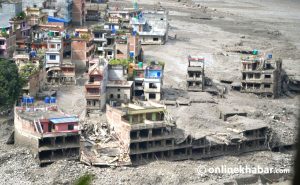
Four schools in Rasuwa have been completely destroyed. Students from those schools are being accommodated in hostels so they can continue their education.
A residential school has also been established in Nuwakot.
“Twenty-nine students have been accommodated at Annapurna Panchakanya School. The school has been converted into a residential facility and classes have begun,” said Surya Bahadur Chhetri, chief of the Education Development and Coordination Unit in Nuwakot.
Tribhuvan Trishuli Secondary School, which was completely damaged, has also resumed classes.
“About 80 percent of students have returned to school,” Chhetri said. “Three schools in Bidur-10 were completely damaged. Their students are attending nearby schools.”
In flood-hit Nuwakot, 224 students and 11 teachers remain unaccounted for. According to Chhetri, 10 schools have been damaged, including two institutional schools.
Tribhuvan Trishuli Secondary School, Ramchandra Basic School, Chetana Basic School, Ganeshman Singh Basic School, Trishuli Boarding School and Uttargaya Boarding School in Nuwakot have been completely destroyed. Chandeshwari Secondary School and Kshetrapal Basic School have sustained partial damage.
A residential school is also operating in Dhading.
“Two schools were completely destroyed. Classes have resumed after alternative locations were arranged,” said Krishna Kumar Shrestha, chief of the Education Development and Coordination Unit in Dhading.
He said students from Rasuwa, Nuwakot and Chitwan have also been arriving in Dhading.
“There are around 37 students at present, and more are arriving. Data collection is ongoing,” he said.
Three teachers remain unaccounted for in Dhading. According to the Education Development and Coordination Unit, the body of one teacher has been recovered. The bodies of four former teachers have also been recovered, while two remain unaccounted for.
Shrestha said authorities are collecting data on the whereabouts of students. Ten schools in Dhading have been damaged. Schools have said classes are being conducted only after providing psychosocial counselling to students.
Some schools that were completely destroyed by the floods have yet to resume operations. Officials at the district education units said arrangements have been made for students from those schools to attend nearby schools.
However, there is still no confirmed data on how many students have moved to which schools. Officials said the process of collecting the data is ongoing.
The government has also directed schools to regularly assess students’ psychosocial condition, as the floods may have caused fear, anxiety, stress and other psychological effects.
More than 9,000 students were affected by the floods, according to a Rapid Damage and Needs Assessment report prepared by a joint technical team from the National Planning Commission and the National Disaster Risk Reduction and Management Authority.