


Kathmandu, September 29
A computer operator at the Department of Immigration has been charged with forgery after investigations by the Central Investigation Bureau (CIB) of Nepal Police and the Commission for Investigation of Abuse of Authority (CIAA).
The CIAA has filed a case against 31-year-old Rajiv Mahato of Durgabhagwati Rural Municipality-2, Rautahat, accusing him of illegally altering immigration records, manipulating documents and failing to account for revenue collected for a visa.
Mahato has been charged under Section 276(1) and (2) of the National Penal Code, 2017, which prohibits forgery of documents. If convicted of forging government or public documents, he could face up to seven years in prison and a fine of up to Rs 70,000.
Mahato is currently giving his statement before a bench of Kathmandu District Court Judge Sudarshan Lamichhane. A detention hearing will be held after his statement, following which the court will decide whether to release him on general date or bail, or send him to prison pending trial.
Residential visa allegedly transferred between two foreigners
According to the charge sheet, Mahato is accused of transferring a residential visa issued in the name of Luxembourg citizen Paul Christian Pierre Geditz to US citizen Dean Jay Robinson.
The incident dates back to February 2024.
Records show that Geditz had been issued seven visas since 2019, including six residential visas and one tourist visa. Robinson, meanwhile, had received 10 tourist visas, two study visas and one residential visa since 2021.
Investigators found that the residential visa most recently issued in Geditz’s name was altered and issued in Robinson’s name.
Geditz had obtained a residential visa through a secretary-level decision dated June 8, 2014. The Department of Immigration had subsequently renewed the visa.
On January 1, 2024, the Department issued a residential visa under the same visa number on Geditz’s passport and generated a revenue payment of $1,200 through the RIMS portal. The required documents were also submitted.
The equivalent of Rs 159,408 was deposited at Global IME Bank as the visa fee after the payment was processed through the user ID of immigration assistant Prem Kumar Jha.
However, investigators later found that the same residential visa had been issued under Robinson’s passport number and attached to his passport.
Robinson had previously applied for a residential visa three times but had not received one. He had obtained a study visa on May 31, 2023, and applied for a residential visa after his study visa expired.
The Home Ministry had not made any decision approving Robinson’s residential visa, according to the investigation.
Investigators allege that Mahato, who was then working in the department’s non-tourist section, abused his access to the government system and used the Travel Centralisation function to merge Geditz’s visa records with Robinson’s details.
The charge sheet alleges that Mahato removed documents attached to Geditz’s record and merged Robinson’s documents with the existing visa record, making it appear that the residential visa belonged to Robinson.
The visa was subsequently printed and attached to Robinson’s passport.
Travel Centralisation is normally used to merge visa records when there are errors in a person’s passport or visa records and information belonging to the same individual needs to be consolidated.
The CIAA alleges that Mahato misused the system to transfer a residential visa belonging to one foreign national to another.
Mahato has denied knowing how the changes occurred. In his statement, he claimed that the Travel Centralisation option was not available in the department’s system at the time.
He also claimed that staff at the assistant level did not have access to the visa printer, visa stickers or the relevant system functions.
Investigation into alleged Rs 23,000 bribe continues
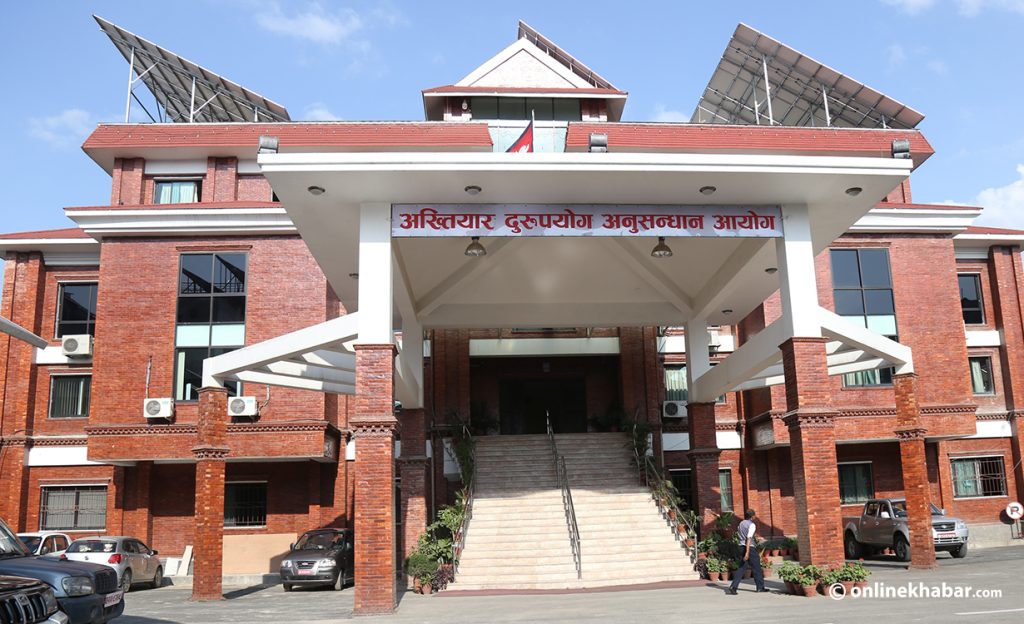
Meanwhile, the CIAA is also investigating a separate incident involving an alleged Rs 23,000 bribe at Tribhuvan International Airport.
On September 21, a man identified as Manish Bista reportedly travelled to Kuwait on a labour visa without obtaining the required labour approval. The incident is being investigated after suspicious activity was detected in the Department of Immigration’s Nepali Port system and CCTV footage.
According to Director General Ram Chandra Tiwari, the department began investigating after noticing the suspicious activity at around 6:30 am.
CCTV footage showed Bista entering immigration at the airport at around 6:30 am and speaking with immigration official Tek Bahadur Sejuwal for around 30 minutes.
Sejuwal allowed Bista to depart at around 7:10 am.
According to the investigation, Sejuwal provided Bista with the phone number of his brother-in-law, Dipak Malla, who was in Japan. Bista subsequently contacted Malla, and a deal for Rs 23,000 was allegedly agreed.
The QR code for the payment was reportedly shared through WhatsApp, after which Bista paid Rs 23,000 and travelled to Kuwait without labour approval.
Investigators have found that Sejuwal himself provided the QR code. The Rs 23,000 was later returned after the department became aware of the payment.
The CIAA is currently investigating the alleged bribery case.