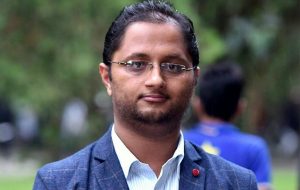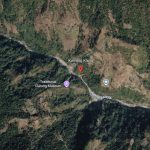


When Rajendra Pangeni looks back at the village where he grew up in Syangja, one memory stands out above everything else. Fire.
The house where he grew up was destroyed in a fire just as he was preparing to leave for Kathmandu to pursue higher education.
His books were gone. His clothes were gone. His family’s belongings were reduced to ashes. For Pangeni, the fire seemed to take his future with it.
“I felt that everything was over that night,” he recalls.
More than three decades later, Pangeni is preparing to return to that same village — this time after building a career in cancer research across three countries.
His journey has taken him from a rural community in Syangja to Mumbai, the United Kingdom and the United States, where he has worked on brain cancer and other areas of cancer research.
Now, he has resigned from his position as an assistant professor at a US university and is preparing to return home.
His plan is not simply to come back. He wants to help build a research culture in Nepal.
From working nights in Mumbai to studying cancer
Rajendra Pangeni’s route to scientific research was anything but conventional.
Growing up in Waling Municipality, Syangja, he was known as a curious child. His father taught at a local school, while his mother looked after the household.
While other children were playing football, Pangeni was often asking questions.
Why is the sky blue? How does rain fall?
The questions stayed with him, and so did the habit of looking for answers.
After completing his SLC in the first division in 1994, he dreamed of going to Kathmandu for college. At the time, for students from Nepal’s districts, studying in the capital was one of the clearest routes to a better future.
Then the fire changed everything.
Unable to afford college after the disaster, Pangeni eventually left Nepal. He travelled through Kanpur and Delhi before arriving in Mumbai with little money but a determination to continue his education.
He worked wherever he could.
At a petrol station. In hotels. In shops. At times, even in a dance bar. And he studied alongside the work.
“Sometimes I would work through the night and go to class in the morning,” he says.
After seven years in Mumbai, he graduated in microbiology from the University of Mumbai.
The experience also changed how he viewed his home country.
Compared with what he had seen in Mumbai, Nepal appeared to him to be decades behind in terms of opportunity, technology and coordination.
“I realised there was so much we needed to do,” he says.
In 2001, he returned to Nepal and began teaching. He later completed postgraduate studies through a college affiliated with an Indian university.
But returning to Nepal did not satisfy his appetite for learning. He wanted to go further.
The journey into cancer research

Rajendra Pangeni eventually moved to the United Kingdom to study at the University of Wolverhampton.
There, his interest in science became intertwined with his interest in people and institutions.
He contested and won an election for a non-political student union, giving him the opportunity to work with hundreds of students and understand the challenges they faced.
He also received a scholarship that opened the door to doctoral research into brain cancer.
His PhD focused on how breast cancer spreads to the brain and whether blood tests could help detect the disease at an early stage.
The research took him deeper into a question that would shape his career: how can laboratory science eventually become something that improves a patient’s chances of survival?
“Science helped me understand the deeper meaning of human suffering,” he says. “During the nights I spent in the laboratory, I realised that the purpose of research is to save lives.”
After completing his PhD, he moved to the United States.
At Northwestern University in Chicago, he carried out postdoctoral research into brain cancer, studying changes in cancer cells that can influence how effectively treatments work.
He later focused on glioblastoma, one of the most difficult forms of brain cancer to treat.
His research examined why existing treatments are often ineffective and how new approaches to treatment might be developed.
But after two years at Northwestern, Pangeni wanted to move beyond the laboratory.
He wanted to see how research could translate into actual patient care.
That took him to City of Hope National Medical Center, a major cancer treatment and research institution in the US.
There, he also became involved in research related to developing drugs for lung cancer.
The experience reinforced something he had increasingly come to believe.
“Science must create meaningful change not only in the laboratory but also in the lives of patients,” he says.
The question that kept following him

Despite building a career overseas, Rajendra Pangeni says he never stopped thinking about Nepal.
In fact, he says he had made a decision as early as 2010, when he went to the UK.
“I had decided that I would return to Nepal after completing my PhD,” he says.
But returning is easier said than done.
Through conversations with Nepali scientists and professionals living abroad, Pangeni noticed a common pattern.
Many wanted to return. Many wanted to contribute. But few wanted to make the move alone.
“Thousands of friends living abroad often expressed their desire to return to Nepal,” he says. “But they also felt that returning alone and working in Nepal would be difficult.”
That led to the Nepal Farkau Maha Abhiyan, an initiative aimed at bringing together Nepalis abroad who wanted either to return or contribute their expertise to the country.
The idea was straightforward: instead of asking individuals to solve the problem alone, create a network that could make returning and contributing easier.
The initiative has since attracted people from around the world, with some members already returning to Nepal.
But Pangeni wanted to go further. He wanted to create an institution.
Building a research network for Nepal
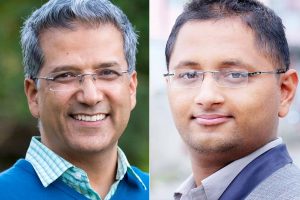
That vision eventually became NIRI Nepal — the National Institute for Research and Innovation.
The idea emerged through online meetings and discussions among Nepali scientists and researchers scattered across the world.
The ambition is to build a world-class, non-profit research institution that connects Nepali talent globally and directs that expertise towards research and innovation in Nepal.
It started with 27 people.
Today, Rajendra Pangeni says, 42 Nepali scientists from around the world are part of the network.
For him, the numbers matter less than what they represent. Nepal does not necessarily lack talented people, he argues.
It lacks the systems that bring them together.
“Nepal also has excellent minds,” he says. “What we lack is coordination and trust.”
NIRI Nepal is already working with Kathmandu Cancer Center through research projects involving cancer and other diseases.
One area of research is looking at why certain types of cancer appear more frequently among different ethnic communities in Nepal.
Research is also being conducted into cerebral palsy and other conditions.
Pangeni himself has published nearly four dozen research papers in international journals.
Now he is coming home

For years, the idea of returning to Nepal remained a plan for the future. Now it is becoming reality.
Rajendra Pangeni has resigned from his US university position and is preparing to move back to his village.
He plans to continue teaching remotely for the American university while living in Nepal.
For someone who once believed a fire had ended his educational dreams, the decision carries a certain symbolism.
He is going back to where it all started.
“I want the children in my village to understand that you don’t have to go abroad to dream,” he says.
That may be one of the most important parts of his return.
Pangeni does not want young Nepalis to see international universities and foreign countries as the only places where serious scientific work can happen.
Instead, he wants them to believe that Nepal itself can become a place where research happens, where difficult problems are studied and where young scientists can build careers.
His focus will be on attracting a new generation of researchers and working on problems rooted in Nepal.
It is a very different ambition from the one he had as a young student dreaming of Kathmandu.
Back then, Kathmandu represented opportunity because opportunity seemed unavailable at home.
Now, after spending years in some of the world’s leading research institutions, Pangeni wants to help create that opportunity at home.
Back to the hill where it began
There is an image Rajendra Pangeni returns to when he talks about coming home. Standing on the hill near his village and looking towards Mount Manaslu.
“When I stand on the hill in my village and look at Mount Manaslu, I feel that dreams can grow even from ashes, if you still have the confidence to believe in them,” he says.
The house where his childhood dream seemed to burn away is part of that story. So is Mumbai, where he worked nights while studying. So are the laboratories in Britain and the United States where he spent years studying cancer. And now, so is the village he once had to leave.
“I am returning to where the journey began,” he says. “I want to go there and do something new.”
For Pangeni, returning to Nepal is therefore not a retreat from the world.
It is an attempt to bring what he learned from the world back home.
The boy who once wondered why the sky was blue grew up to spend his life searching for answers to far more difficult questions.
Now he is returning home with another question in mind:
What can be built in Nepal if its scientists, researchers and young people begin to believe they do not have to leave to do their best work?