The silent decline of the giant honeybee, Apis dorsata, threatens not only wild honey production but also pollination services, forest regeneration, agricultural productivity, and centuries-old honey hunting traditions across Nepal’s Terai landscape.
Every year on 20 May, we observe World Bee Day to recognise the indispensable role of bees and other pollinators in sustaining ecosystems, food systems, and human livelihoods. The day serves as a reminder that the future of people and the planet is inseparable from the survival of pollinators.
This year’s theme, “Bee Together for People and Planet”, celebrates the long relationship between humans and bees across cultures and landscapes, while encouraging innovative approaches to pollinator conservation, sustainable beekeeping, and rural livelihoods.
For Nepal, the occasion carries special significance. The country is home to an extraordinary diversity of honeybee species, centuries-old traditions of honey hunting, and landscapes that have long supported both wild and managed pollinators.
Nepal hosts five species of honeybees, several species of stingless bees, and a remarkable diversity of bumble bees, solitary bees, beetles, birds, butterflies, moths, and other pollinating organisms. Together, these pollinators play a vital role in maintaining biodiversity, supporting food production, sustaining rural livelihoods, and contributing to ecosystem restoration.
Among them, the giant honeybee of the subtropics (Apis dorsata) stands apart, yet it is showing signs of alarming decline.
Giant honeybee: Terai’s keystone pollinator
Apis dorsata, known locally as sinkus or khago mauri, is one of the most important wild pollinators of Nepal’s Terai and inner-Terai valleys. Through its extensive foraging range and highly efficient pollination behaviour, it supports both agricultural landscapes and natural forest ecosystems across the lowlands.
These bees build massive single-comb nests high in the canopy of towering trees, such as Simal (Bombax ceiba), as well as beneath water towers and under the eaves of tall buildings. Dozens of colonies sometimes cluster together at a single site, forming spectacular living aggregations that often return to the same locations year after year.
The relationship between Apis dorsata and the nesting trees represents a remarkable ecological partnership shaped through centuries of co-evolution. The bees migrate to higher elevations during summer and return to the lowlands in winter, following the rhythm of flowering cycles and seasonal changes, which is shaped over centuries of co-evolution.
Now, the nesting trees, particularly Simal, are disappearing, and climate change is increasingly disrupting the synchrony between flowering seasons and bee migration. Altered temperatures and shifting rainfall patterns are changing crop and forest phenology, making traditional migration patterns less reliable for the bees.
Challenges for giant honeybee population
Evidence from across South and Southeast Asia suggests that Apis dorsata populations are declining. In parts of Nepal’s Chitwan district, nesting trees and water towers that once hosted large aggregations of colonies now host only a fraction of their former numbers. Similar declines have been reported from parts of India, China, and Indonesia.
No single factor explains the decline. Instead, multiple pressures appear to be acting together, which are as follows:
- Loss of nesting habitat and quality forage: Large nesting trees such as Simal are increasingly being cut for timber, infrastructure expansion, and agricultural conversion. When old-growth trees disappear, bees lose not only nesting sites but also traditional aggregation areas used repeatedly over generations. Although overall forest cover in Nepal has increased, native nectar-rich plant species have declined, reducing the quality and reliability of forage resources for bees.
- Climate change: Changes in rainfall patterns, rising temperatures, and prolonged dry periods are disrupting synchrony between flowering seasons and bee migration. When plants bloom too early or too late, colonies may face food shortages during critical stages of reproduction and brood development.
- Destructive honey harvesting: Traditional honey hunting practices in Nepal often involved carefully removing only part of the comb while allowing colonies to survive. However, commercial harvesting driven by growing demand for wild honey increasingly destroys entire colonies, including brood and queen cells, reducing the chances of recolonisation.
- Pesticide exposure: The intensification of agriculture across the Terai has brought widespread use of pesticides, including neonicotinoids and organophosphates. Even sub-lethal exposure can impair bee navigation, weaken immunity, and reduce colony survival.
- Parasites and diseases: Wild bee populations are also vulnerable to pests and pathogens. Under natural conditions, when infestations of Tropilaelaps clareae mites become high, Apis dorsata colonies often abandon the comb and migrate to new nesting sites, thereby escaping heavily infested habitats and building fresh combs. However, with the introduction and widespread presence of Apis mellifera, mites may persist year-round at the same sites and can more easily spill over into wild bee populations, increasing the risk of transmission and reinfestation.
More than just honey
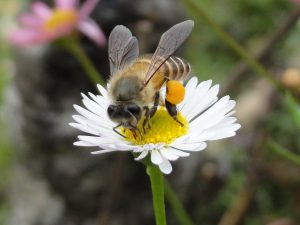
It is easy to think of bees as honey producers, but their ecological role extends far beyond honey. For their food, bees collect nectar and pollen, which would otherwise remain unused in nature. While doing so, bees facilitate pollination, enabling plants to produce fruits and seeds, thereby contributing to the regeneration of vegetation.
The giant honeybee is among the most effective wild pollinators in Asia’s sub-tropical ecosystems. It plays a major role in pollinating forest vegetation and crops, such as mustard, fruits, and vegetables cultivated by Nepal’s smallholder farmers. It also serves as prey for several birds, insects, and other animals that are important components of ecosystem food webs. The decline of wild honeybees and other pollinators, therefore, has cascading consequences across landscapes and food systems.
Reduced pollination can diminish crop yields, weaken forest regeneration, reduce seed production, and ultimately erode biodiversity and ecosystem resilience.
There is also a cultural dimension to the loss of this particular honeybee species that cannot be easily measured. In ‘Golden Harvest of the Raji’, Eric Valli documented the bond between the giant honeybees and Raji communities in western Nepal. Their traditions, livelihoods, spiritual practices, and ecological knowledge were woven around forests, rivers, seasons, and wild honey harvesting. Embedded within these practices is a generation of intimate understanding of forest ecology, bee behaviour, and seasonal rhythms. Eric Valli mentioned that ‘Raji never destroys the nests, they would take only the honey portion’ and if the bees vanish, this inheritance may vanish with them.
What Nepal can do
Protect and restore nesting trees: Simal and other traditional nesting species must be incorporated into community forestry plans and conservation frameworks. Old-growth trees that support repeated nesting aggregations should be recognised as irreplaceable ecological assets. Due consideration should be given to include native nectar-rich plants while implementing plantation and afforestation programmes.
Integrate pollinator conservation into invasive species management: In forests and buffer zones where invasive plants are reducing floral diversity, pollinator needs must be explicitly considered in restoration planning.
Promote non-destructive honey harvesting practices: Non-destructive honey harvesting practices, particularly those held by Indigenous and local communities, deserve formal recognition. Building on indigenous knowledge and proven best practices from across the region, practical handouts and tools need to be co-developed and promoted.
Strengthen pesticide regulation and farmer awareness: In areas where intensive agriculture overlaps with critical pollinator habitat, stronger safeguards and targeted education programmes are urgently needed.
Establish long-term population monitoring: Nepal currently lacks systematic data on giant honeybee colony numbers and trends. Regular documentation of nesting and aggregation sites could provide early warning of further decline and inform timely, evidence-based responses.
World Bee Day reminds us that urgent action is needed to protect Nepal’s giant honeybee before the decline of colonies becomes irreversible. If its decline continues unchecked, the consequences will extend far beyond the loss of wild honey.