
Photo: AI-generated
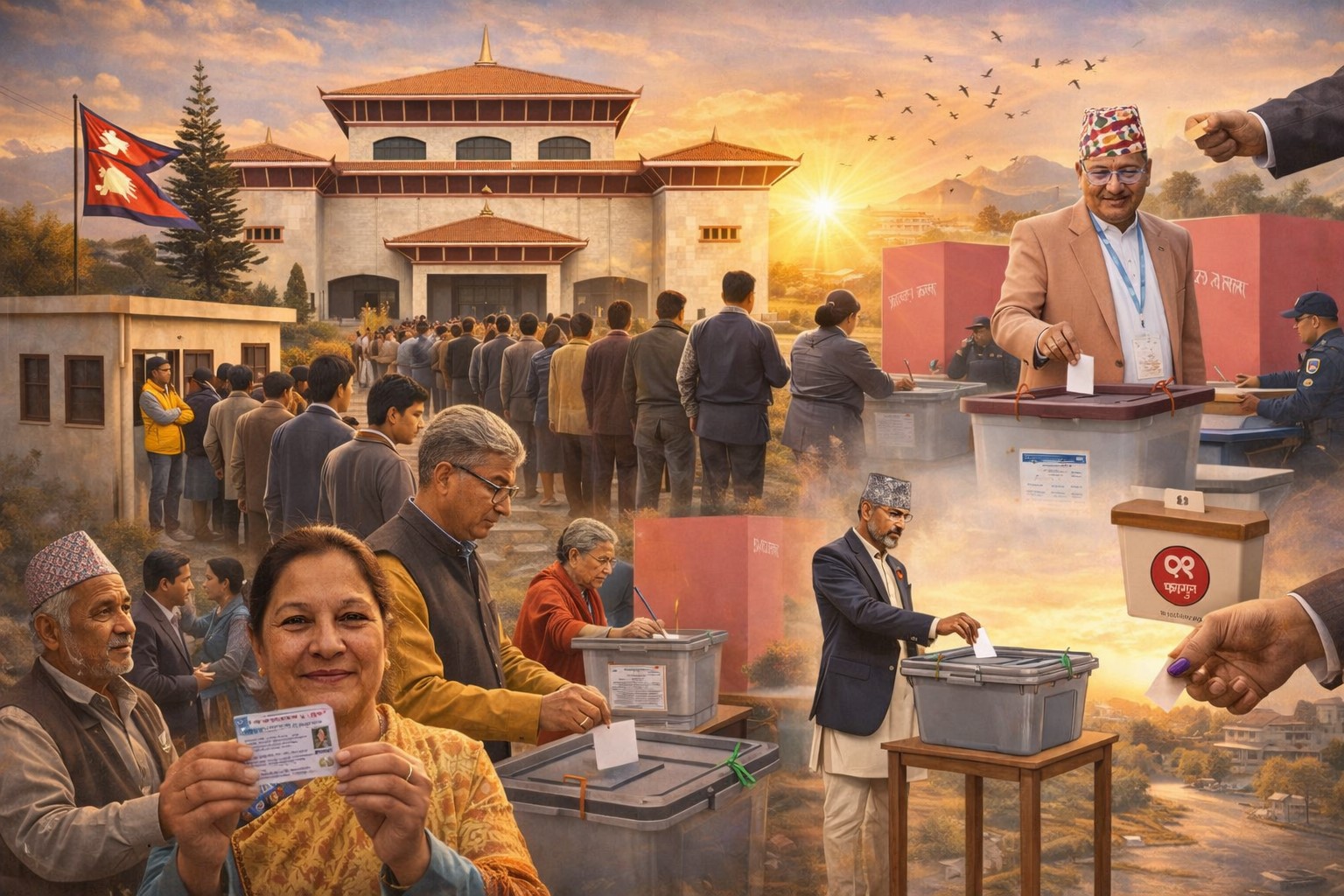
In a democracy, elections are not merely a formal mechanism for transferring power; they are an important moment to redefine the relationship between citizens and the state. Each ballot counts not only as a vote for representatives but also as a reflection of voter expectations, frustrations, and hopes.
The March 5, 2026, general elections in Nepal signal a call for new energy, ideas, and change in governance. A total of 18.9 million voters were registered, with turnout estimated at 58–60 per cent, according to the Election Commission of Nepal. The number of voters increased by nearly one million compared to previous elections, reflecting rising political participation, especially among the youth.
A decisive electoral shift
Interim Prime Minister Sushila Karki and her team deserve special recognition. Maintaining stability and ensuring a democratic process during political transition and uncertain times is no easy task.
The results sent a powerful signal. The Rastriya Swatantra Party (RSP) won 182 out of 275 seats, securing close to a two-thirds majority. This marks the first time in decades that a single party has achieved such dominance. The Nepali Congress won just 38 seats, while CPN-UML secured 25.
It is now clear that voters have opted for a new kind of politics based on truth, competence, accountability, and service.
Beyond victory: The responsibility of leadership
Leadership is not just about winning an election; it is about earning the public’s trust after the victory. Good governance is not simply about holding power; it requires cooperation, competence, and long-term planning.
Nepal faces multiple challenges: the economy, employment, infrastructure, education, and governance. These issues are deeply interconnected, and no single party or ideology can resolve them alone. One of the most striking aspects of this election is the strong participation of youth, particularly Generation Z. As a digitally connected generation, they are more outspoken about national issues, especially through social media and public discourse.
Their influence was evident in the demonstrations of September 2025, initially sparked by concerns over social media censorship. These protests quickly evolved into large-scale movements against corruption, unemployment, and poor governance. Reports indicate that 76 people lost their lives, and hundreds were injured. These events revealed not only the frustration among young people but also their determination to demand political change.
Lessons from history and inclusive leadership
History shows that inclusive leadership plays a crucial role during times of national transition. During the American Civil War, President Abraham Lincoln adopted the “Team of Rivals” strategy by including political opponents in his administration. He understood that leadership during a crisis must transcend partisan politics and prioritise merit and national interest.
Nepal can benefit from a similar spirit of cooperation, where honesty, competence, and national interest take precedence over political rivalry. The message of the election is not only for the winners. For the losing parties, it is a moment of reflection. In a democracy, elections serve as a dialogue between the people and their institutions. When voters withdraw support, it signals dissatisfaction with leadership and direction.
The strength of democracy lies in its ability to correct itself. While election outcomes can sometimes come as a shock, such moments can lead to reform, reflection, and renewal.
Nepal’s geopolitical and structural challenges
Nepal is often described as a pivotal buffer state between China and India, holding significant strategic importance in South Asia. A stable, inclusive, and democratic Nepal would contribute not only to its own prosperity but also to regional stability.
However, electoral victory alone cannot resolve the country’s persistent challenges. These include a sluggish economy, youth unemployment, outmigration, weak infrastructure, gaps in education, and institutional inefficiencies. The fact that Nepal has had 16 prime ministers since 2008 reflects the extent of political instability.
The World Bank has also highlighted structural issues such as youth unemployment and migration.
At a crossroads: Opportunity and risk
Nepal now stands at a crossroads. The rise of the Rastriya Swatantra Party reflects a strong public desire to combat corruption and reform governance. However, history offers caution.
From the democratic restoration of 1990 to the republican transition, leaders such as Girija Prasad Koirala, Pushpa Kamal Dahal “Prachanda,” and KP Sharma Oli played pivotal roles. Yet, governments with strong mandates have often fallen prey to the “curse of majority”, a tendency to dominate institutions, suppress internal debate, and make hasty decisions without building sustainable systems.
Political transformation in Nepal has not been driven solely by parties. When Balen Shah won the Kathmandu mayoral race and addressed the public in Janakpur, it sparked a shift in the political consciousness of youth, particularly in the Terai region.
The real test now lies in reform. Key structural changes could include separating ministers from Parliament to build a more professional executive, expanding the candidate pool for presidential elections, strengthening the National Assembly through direct elections, ensuring an independent election commission, establishing effective anti-corruption mechanisms with citizen oversight, and increasing public funding to enhance participation among women, ethnic groups, and Dalits.
Such reforms could help Nepal break free from its three-decade cycle of political instability. If these reforms are not pursued, history may repeat itself. For any new government, the greatest risk is often not the opposition, but the magnitude of its own victory.