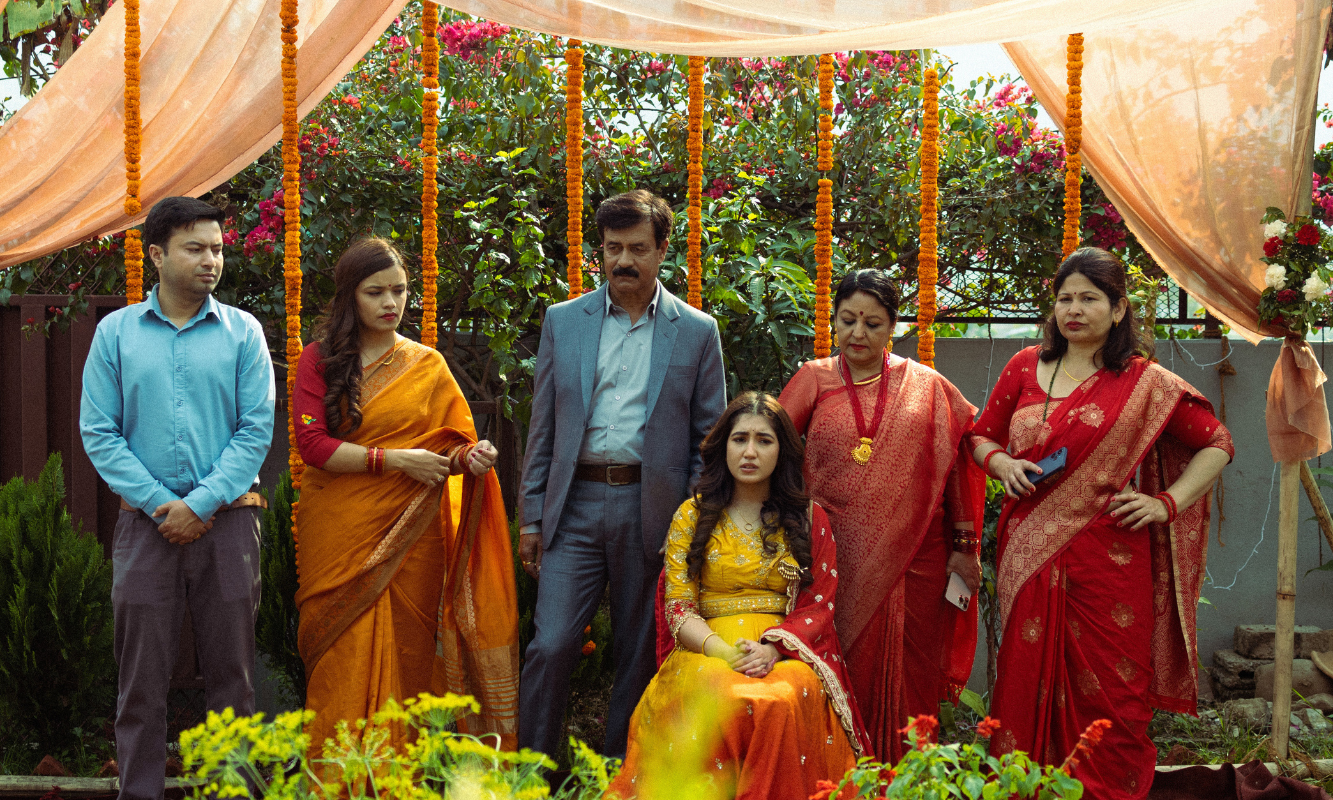
As the credits rolled for Ek Mutthi Badal, I just sat there, numb. Questions erupted one after another as I replayed the scenes in my head: the dilemma of our protagonist, Maili; her fiancé trying to handle the situation; the dynamics between her sister and her husband; the brother’s intentions; the mother’s actions; and the father’s reactions. Everything swirled in my mind. And then I realised the brilliance of the film. It is a film that unsettles you, forces you to confront yourself, and makes you want to rewire the way you think. So, it is not only a well-made film, but also an important one.
In the beginning, we see Maili, her fiancé, and her father at the ward office to register the marriage. She seems bothered, and soon enough, we learn why. She is upset because the groom’s family wants her to pierce her nose. I remember sitting there thinking: Wait, this is it? Is this going to be the central conflict of the film? It seems like such a small issue.
But it is not. That is exactly what the film is trying to show. It is not just about the nose pin. It is something much larger. It is a symbol of all the supposedly small compromises women are expected to make — gracefully and continuously. It is through these small negotiations that a person slowly loses herself and disappears. The film understands that life is not always destroyed by a single dramatic incident. Sometimes, it is undone by countless tiny concessions.
“Apparently, dukhda ni dukhdaina,” Maili’s fiancé casually says while trying to convince her to get her nose pierced, as if the level of physical pain determines whether something matters. The father uses similar logic later in the film when the mother is wincing in pain. He dismisses it, saying, “Dukhne jatro ghau pani bhako chhaina.” These moments make it clear that women’s suffering is often measured not by how they experience it, but by how the people around them perceive it. The film understands that patriarchy does not survive only through loud violence or obvious cruelty. Sometimes, it survives through little dismissals. Little compromises. Little silences. So small that nobody notices them accumulating until they become a woman’s entire life.
And honestly, no matter how different I believed I was, my first instinct was still to dismiss her discomfort as something small. I failed to fully understand it, too, which is precisely the point.
What struck me most was how the film called me out as a man. It made me realise how easy it is for men, even supposedly “good” men, to fail women quietly. Not through hatred or aggression, but through ignorance. We fail to notice the structures that wrong women because we benefit from them.
For instance, Maili’s fiancé is not a monster. If anything, he comes across as caring. He listens to her, tries to explain things to his parents, and attempts to help her when her brother gets into trouble. But he never fully understands her. This is where the film’s strength lies. It shows how domination does not always arrive loudly. Here, it arrives through assumptions.
He assumes Maili is only concerned about the pain or her appearance. He fails to understand what the piercing represents. What she fears losing is her agency. She knows that failing to take a stand here will lead to a hundred more compromises in the future. In Nepali culture, a woman is already expected to compromise in marriage. She is the one who leaves behind her family and the house where she was raised.
She is expected to place a new family before herself and adapt to their ways. Yet, even after all these sacrifices, she is made to feel unreasonable for refusing a piercing on her own body. People often say marriage unites two families into one. But more often than not, that remains only a phrase, while women and their families are left carrying the burden of adjustment.
There comes a point in the film where Maili refuses help from his family. In his eyes, she is simply being stubborn and making things difficult. He tells her she needs to accept his family as her own and trust them. But does he do the same with hers? If he did, why did he allow his family to unreasonably increase the number of janti, or complain baselessly about the hotel? Maili understands that the help they offer would never remain just help. Debt quietly attaches itself to kindness. Gratitude becomes another form of obedience. She knows how small her parents already feel in front of his family, and she does not want to add to that humiliation. The tragedy is that he genuinely believes he is being understanding.
Maili’s brother serves as another example of this kind of ignorance. At first glance, he appears progressive. He believes he is honouring women through his film project. He speaks passionately about mothers and women’s struggles. But gradually, we realise that his empathy also comes with conditions. He respects women who have what he calls “maya lagdo behaviour,” unlike his sister Maili. Even though he says it jokingly, the thinking behind it feels painfully familiar. Only women who are soft, agreeable, or emotionally pleasing are seen as deserving care. The moment women question, challenge, or push back, that care disappears.
There is also a certain irony in the way the brother confidently says, “Katha haru yahi chhan, bidesh jana pardaina,” as though his sisters left the country because they could not recognise the possibilities here. In reality, it is he who cannot see that his sisters were never given the same privilege he had to stay.
At another moment, when his sisters accuse him of behaving better around foreigners, he jokingly responds that they do not deserve his respect and adds, “Yo mero kotha ho, maile basna dirako ho. Be grateful.” That line exposes a deeply ugly mindset in our society, the belief that women should be thankful simply for being given space, no matter how limited that space may be. The film has a remarkable way of capturing these quiet humiliations. Take the family photograph, for example. Maili, the bride herself, is pushed aside so the son can stand at the centre. The moment is brief, but it tells us everything.
The father is an equally fascinating character. At first, he appears modern because he supports Maili, representing the younger generation, during arguments. On the surface, he seems gentler than the stereotypical fathers we are used to seeing on screen. Yet it quickly becomes clear that his progressiveness has limits. His wife, who manages the household in his absence, is still labelled as “pothi baseko.” Equality exists only as long as it does not threaten male authority.
Men are never told to laugh softly or shrink themselves. A man speaking directly is considered assertive, while a woman doing the same is accused of “talking back.” For women, it is never “bichara bani nai estai chha”; it is always “esko paara nai thik chhaina.” For men, it is “walking confidently”; for women, it is “attracting attention.”
A man can rarely do wrong, while a woman rarely does anything right. A man is accepted in all his forms, while a woman is accepted only when she is nurturing and self-sacrificing. Even as viewers, we are quick to judge Maili and her mother smoking together. The scene immediately feels uncomfortable to many of us. But if the same moment involved a father and son, nobody would think twice about it. I am not saying smoking is good. I am saying that women are rarely allowed to be messy. They are not allowed to fail, and even when they succeed, their achievements are rarely celebrated.
Throughout the film, women’s dreams are repeatedly pushed aside to preserve male comfort. One of the saddest moments comes when Jethi admits she stopped dreaming long ago. Later, when she is asked what those dreams once were, she has no answer. That is heartbreaking, not because her dreams failed, but because she no longer even remembers them. It shows how motherhood and marriage consumed her before she had the chance to become a person outside responsibility. And although having a baby was likely a shared decision, she alone bears the harsher consequences. She is expected to leave work. To sacrifice ambition. And when she struggles, she is reminded, “Ghar nakinna parthyo ni,” as though her choices alone caused her suffering. His failures remain situational. Hers becomes personal.
At one point, the film presents an especially impactful scene in which a newly married bride says she wanted to wear a lehenga but settled for a saree because it was her husband’s fantasy. In exchange, she asked for a necklace of her choice. Here, desire becomes negotiation. Comfort is not something women are simply allowed; they must bargain for it. They are taught to seek permission even for their own desires. They are taught to shape themselves around everyone else’s happiness.
This is exactly the kind of woman Maili’s mother wants her daughter to become. She tells her: “Ii ful haru fulxan… sablai rijhauxan ani marera jaanxan.” Maili is terrified of becoming like those flowers. She wants more than survival and sacrifice. She wants to live life on her own terms instead of merely being useful to others. But when she reaches towards freedom, her mother warns her: “Singo aakash nakhoj chhori, yo bato le talai narka puryauchha.” The line is devastating because, deep down, the mother probably knows her daughter deserves that sky. But she also knows exactly what society does to women who dare to reach for it.
This idea is hauntingly illustrated through the story of The Flower of Pompeii. As narrated by Maili, we hear of a woman walking deeper and deeper into a river in search of the flower for a man in her life. No matter how far she walks, the distance never shortens, while the water keeps rising around her. The man standing on the shore insists that the flower is right there, that she only needs to go a little further. But he is not the one inside the river. He is not the one struggling to keep balance or slowly drowning. That image captures womanhood in the film perfectly. The flower could represent freedom, acceptance, happiness, or a good life, all the things women are promised. They are presented as attainable. A little more sacrifice and they will reach them. A little more adjustment and they will reach them. A little more endurance and they will reach them. But before they ever truly do, they are submerged beneath duty and sacrifice.
This raises an unsettling question: What choices do women in our society actually have? In one scene, Maili and her fiancé play a small game. He holds out two closed fists and asks her to choose one. Whatever is inside will belong to her. The first time they play, the hand she chooses is empty, but he gives her the prize from the other hand anyway. Later, when they play again, the hand she chooses is once again empty. But this time, when he opens the other hand, that one is empty too. Suddenly, the entire film crystallises into one terrifying realisation: perhaps the choice itself was always an illusion. Women in our society are offered “choices,” but every option exists within structures controlled by others. Compromise is packaged as agency, and obedience as maturity.
All of this, of course, is simply my interpretation and the aspects of the film that affected me most. The film contains many other layers as well. It explores class differences, generational trauma, and the effects of modernity with equal effectiveness. What I admired most was that it never tries to force its ideas onto the audience. It simply places these people before us and allows us to observe the contradictions ourselves.
The film feels deeply real. The house feels lived in, like an actual home. The actors inhabit their characters so naturally that not for a single moment does it feel like they are performing. It genuinely feels as though these are people who grew up together. Nothing feels artificially constructed simply to make a point.
However, I did find myself wanting more from Fupu and Kanchhi, as both characters carried emotional weight and narrative promise. Other than that, it is clear that the filmmaker knew exactly what kind of film she wanted to make, and that kind of clarity is rare. Even the colour palette and music move in harmony with the emotional rhythm of the story. At times, they feel warm; at others, muted and heavy. The film never tries to become louder or grander simply to hold our attention. It remains restrained from beginning to end.
Its greatest strength and perhaps its greatest risk is that it fully trusts its audience. It gives viewers the space to observe and think for themselves. To sit in silence. To notice small details. To feel what remains unspoken. Some people may find this frustrating, especially if they are used to films that constantly instruct them how to feel through repetitive speeches or dramatic musical cues. Some may even feel as though nothing is happening at all. But so much is happening. The film simply refuses to manipulate us. And because of that, it would be unfair to dismiss it as boring. The film knows exactly what its strengths are.
I also understand that it may not be an easy watch for everyone. But now and then, we need films like this, films that force us to look inward and question the ways we think, speak, love, and live. Films that make us walk out of the theatre slightly more self-aware than when we entered.
Of course, every form of cinema shapes emotion in some way. By choosing what to show, filmmakers are already guiding us. But this film leaves enough space for viewers to arrive at meaning on their own. That freedom can feel uncomfortable when we are accustomed to being told what to feel.
But that is also why the film lingers.
Even after it ends, it continues unfolding inside you.