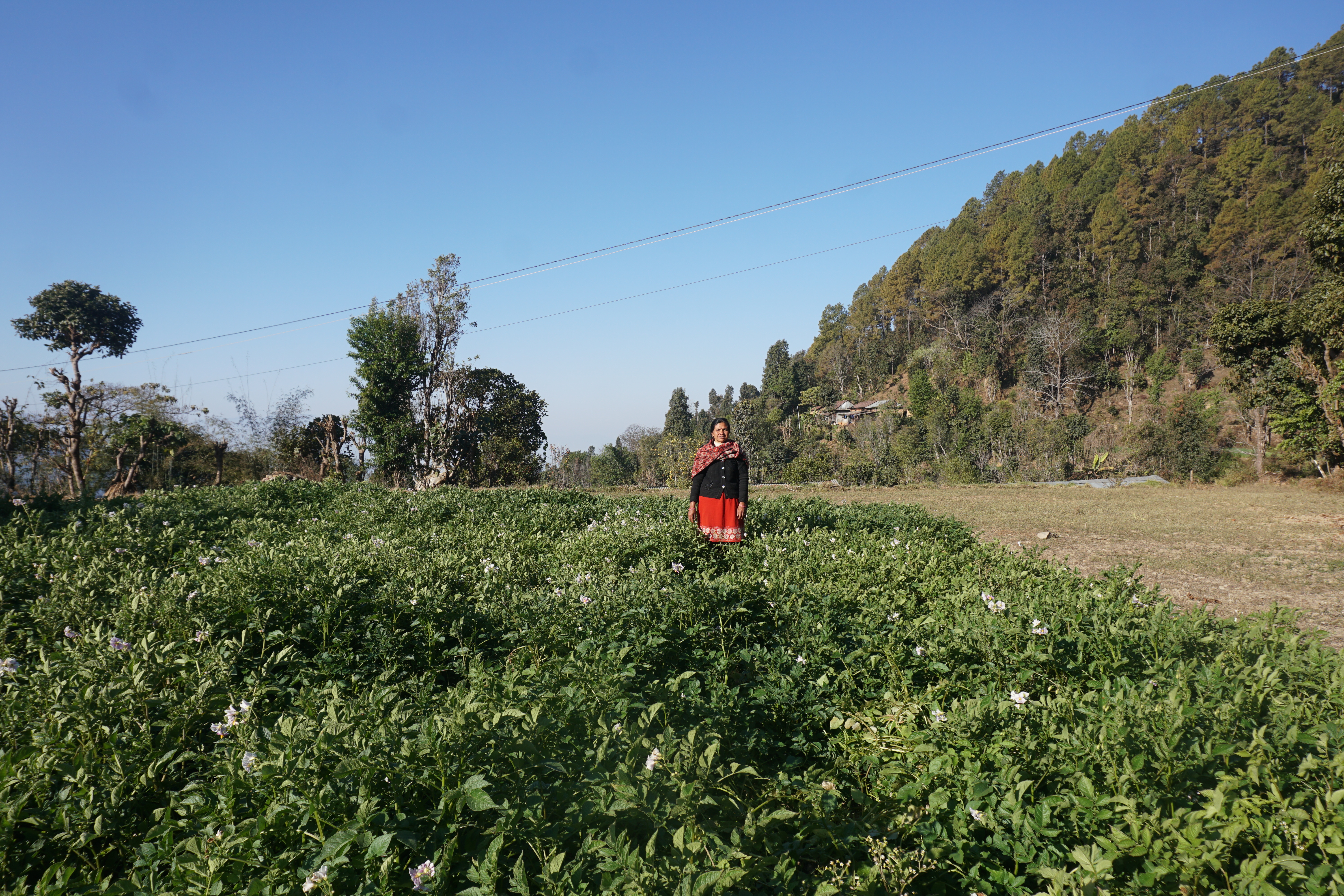
In the quiet hours of the morning, Gendramaya Budhathoki plants vegetable seeds in the garden next to her house. She grows mustard, fenugreek, millet, rice, greens, cucumber, and cauliflower. To make her farming sustainable, she has built a small cemented pond to collect wastewater from washing for irrigation, turned cow dung into compost, and fermented cow urine into liquid manure. This way, Budhathoki cultivates biodiversity-rich organic crops.
“We love nature and grow crops that suit it. Sometimes, we even sell them,” says Budhathoki, 58.
Budhathoki began farming after marrying at 17. Her mother-in-law preserved corn seeds by hanging them in a wooden strut for the next year, stored beans and other vegetable seeds mixed with millet, and covered them with mugwort before planting, ensuring the seeds stayed safe. From these practices, Budhathoki learned to grow crops and feed her family of 10.
Back then, she recalls, the rainy season followed a reliable rhythm: continuous rain for 10 days during the season, falling in November and again in March/April. Now, with shifting weather patterns, rains arrive intermittently and skip winter entirely.
When villagers switched to hybrid seeds, Budhathoki followed suit. But as seasons grew drier, her hybrid corn yielded only enough for cattle fodder. Delayed rains stunted her hybrid rice, while pests and diseases ravaged her crops.
However, most farmers in Budhathoki and Thokarpa villages have now returned to native crops, thanks to the community seed bank they established.
Community seed banks have quietly become one of Nepal’s most important front lines against the changing climate patterns. With 53 seed banks now operating nationwide, they are conserving 1,700 varieties from 75 different crops and distributing them to smallholders – often at low cost or for free. These traditional varieties, adapted over generations to local conditions, can tolerate extreme weather and resist pests better than hybrids, helping stabilise yields and protect food security.
From seed exchange to seed banks
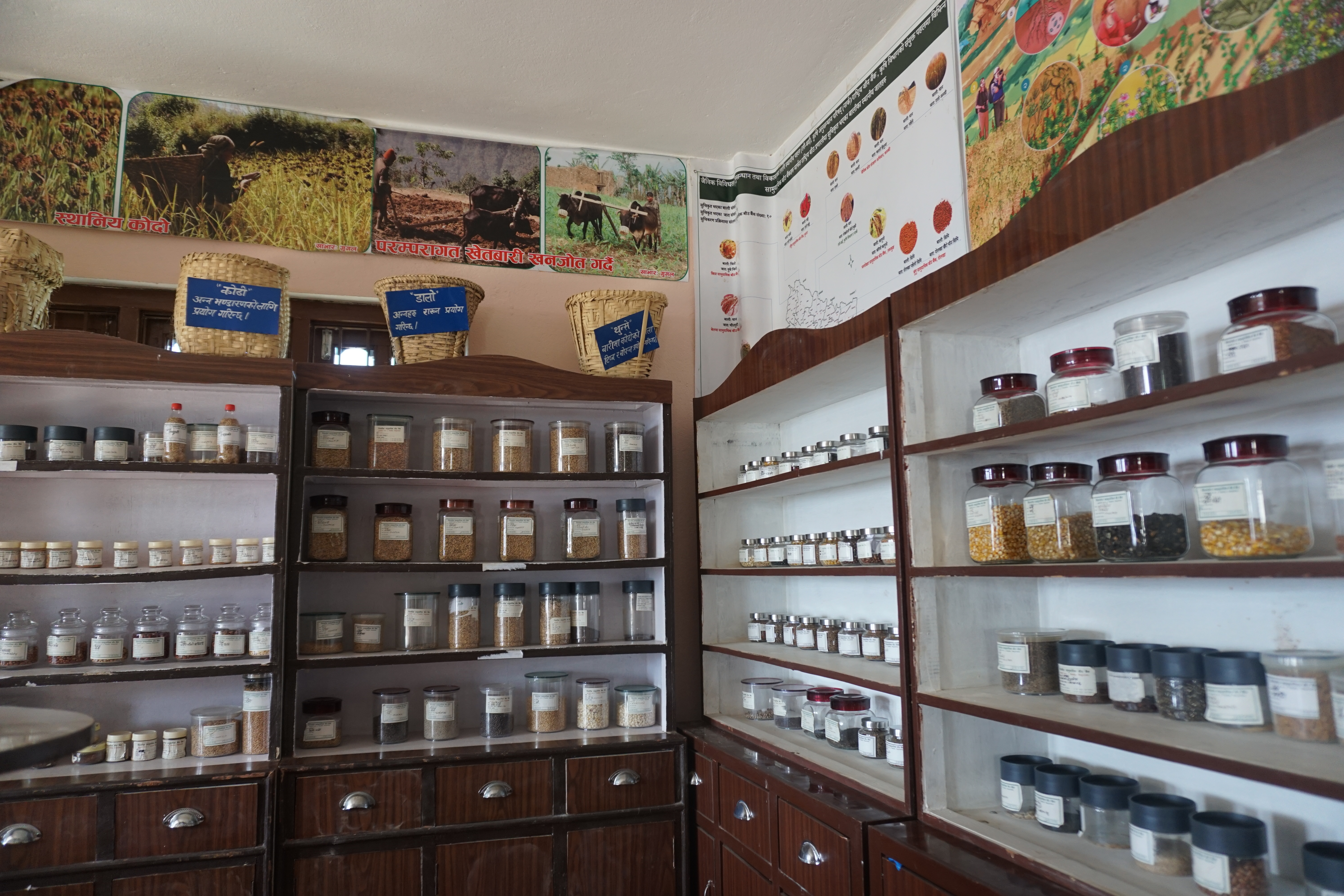
Farmers have been exchanging and saving seeds for thousands of years. Seed exchange was a central part of farming life, helping create local crop varieties and adapt them to different climates and soils.
By the 1960s, scientists and policymakers began to see that traditional crop varieties and their wild relatives were disappearing fast. The Green Revolution and the spread of modern, high-yielding varieties pushed farmers toward monoculture, replacing diverse local crops with a few uniform ones. Modern agriculture and land-use changes accelerated the loss of crop diversity. Community seed banks emerged as an early form of in situ conservation. This strategy involves preserving native varieties right on farmers’ fields rather than in distant storage facilities. Seed saving soon grew into a global biodiversity effort, paving the way for ex situ strategies – storing seeds off-site in gene banks for long-term preservation.
In Nepal, the concept of community seed banks emerged in 1994 as part of ex situ conservation efforts, aiming to preserve local landraces and make seeds and related knowledge available to farmers.
Pitambar Shrestha, program advisor at the Community Seed Bank Association Nepal, says, “community seed banks conserve, promote, and utilise native seeds, saving and transferring them for future generations.”
Budhathoki did not know which seeds would withstand drought, pests, and extreme weather. She would plant whatever seeds she found. Half would sprout, and half would rot.
She planted hybrid maize, vegetables, mustard, and rice. However, over time, the seasonal cycle shifted. This led to groundwater not being recharged enough, and the soil lost its ability to retain moisture. Three or four years after she started planting hybrids, pests began to attack her crops.
“I have stopped sowing seeds in my fields many times. The expensive seeds and labor costs, plus the fear of pests and diseases. Instead of growing them myself, I started buying from the market. The land became barren.”
However, four years ago, a community seed bank was established in her village under the name Pingdanda Community Seed Bank. She started getting free seeds of native varieties. She received training on which crops to plant in each season. The seed bank helped sell the grains she grew and provided loans for seed production. Now her garden is lush with many types of grains and vegetables, rich in biodiversity.
The Pingdanda Seed Bank alone maintains 15 varieties of rice, including green cauchin and Pokhareli basmati rice, 15 varieties of beans and pulses, and oilseeds like mustard and sesame. Altogether, this seed bank conserves 154 crop varieties.
Native crops vs. hybrids
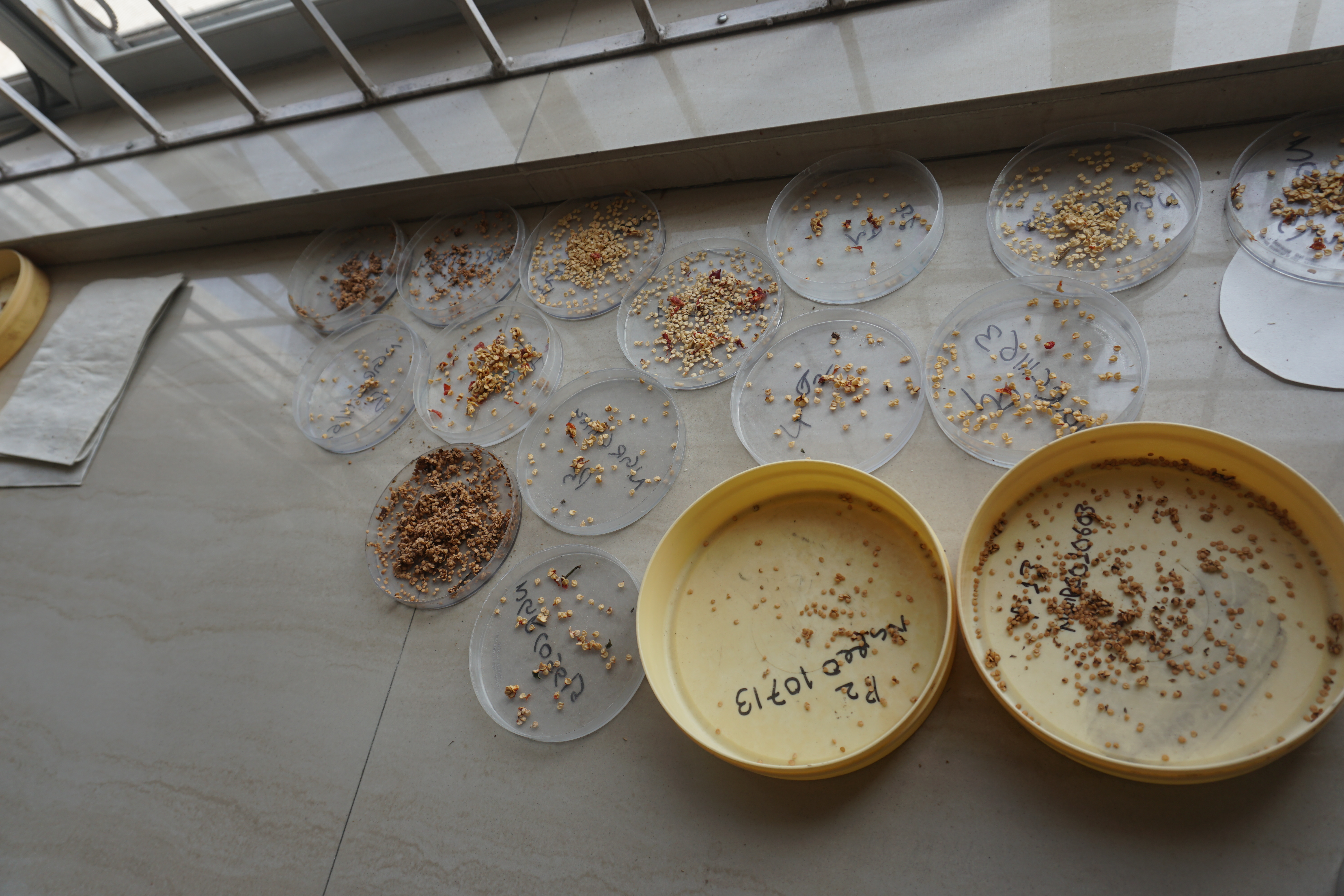
“Native crops, adapted to our climate over centuries, are naturally climate-resilient,” says Ramkrishna Shrestha, Joint Secretary at Nepal’s Ministry of Agriculture and Livestock Development. “They resist pests and diseases better, endure drought and extreme cold or heat, deliver superior nutrition, and play a vital role in food security.”
Agriculture currently contributes about a quarter of Nepal’s gross domestic product. Despite this significant contribution, the country still imports seeds at a high level.
Against this backdrop, the 53 community seed banks provide locally adapted seeds and help reduce dependence on imports.
At a time when Nepal is heavily dependent on imported seeds, community seed banks are playing a key role in producing, exchanging, and conserving both native and improved varieties, says Joint Secretary Shrestha. They also store endangered seeds in gene banks to safeguard them and support the development of seeds with better, more resilient traits.
Devraj Phuyal, a senior agricultural technician at LI-BIRD, says while hybrid varieties generally give higher yields, native crops have a clear advantage when it comes to low-cost, low-input farming. “Local varieties rarely require chemical fertilisers and need much less management. Hybrids are more vulnerable to pests and diseases, so farmers have to spray pesticides regularly. In terms of overall cost and practical impact, native crops perform much better.”
Phuyal works directly with the seed bank and farmers in Pingdanda. “We don’t just provide seeds. We improve the soil, teach farmers composting, use traps to manage pests, build ponds to collect water, and protect forests and springs.”
Before 2008, farmers in Nepal were not allowed to register the native seed varieties they produced; only foreign or formally bred varieties could be registered. With the second amendment to the Seed Act 1989, Nepali farmers were finally given the right to register their own local seeds.
Balkrishna Joshi, chief of the National Gene Bank, who campaigned for this legal provision, says that only after seeds were officially registered could they be legally sold in agrovets across Nepal. More than 700 seed varieties have been registered with the Seed Quality Control Centre so far. Joshi adds that another key reason for registration is to ensure that Nepal’s own seeds are not claimed by other countries.
The gene bank safeguards native seed varieties on the verge of disappearing. The seeds are stored at minus 20 degrees celsius to remain viable for up to a hundred years. Farmers can access these seeds free of charge. The bank currently holds 12 crop species and around 600 varieties.
The Crop Development and Agricultural Biodiversity Conservation Center under Nepal’s Ministry of Agriculture and Livestock has launched a program to establish a community seed bank at every local level of the country. According to Keshav Devkota, head of the center, the program has channeled 500 million rupees to local levels over the past five years.
However, community seed banks in rural Nepal struggle to stay afloat. Most are run through cooperatives or supported by INGOs. The Pingdanda Community Seed Bank is run by a small farmers’ cooperative. The bank’s chairman, Him Bahadur Acharya, says it is very difficult to gain farmers’ trust in native crops in a hybrid-dominated seed system. About 1,100 families have benefited from this seed bank so far.
Bishnu Bhusal, a Senior Program Officer at Local Initiatives for Biodiversity, Research and Development (LI-BIRD), says, “Whether these seed banks become sustainable or not depends largely on how much farmers themselves have invested in them, both financially and in terms of participation.”
“We are working to promote native seeds, but the sad part is that 55 percent of the ministry’s budget still goes to chemical fertilizers,” says Shrestha, Joint Secretary at the ministry.
But Budhathoki is strongly committed to native crops. She is now gathering native seeds for next season’s planting. “I hastily planted a hybrid and made a mistake. Now I am back in the rhythm of my ancestors, who planted native seeds, ate them, and then left them for the next generation.”