
“It’s a good job. Don’t worry.”
That was what a 36-year-old Bagmati (name changed) was told before leaving for Kuwait.
Hoping to improve her family’s financial situation through overseas employment, she trusted people she knew through her village and relatives who were already in Kuwait.
Within weeks of arriving in Kuwait, however, her hopes turned into fear.
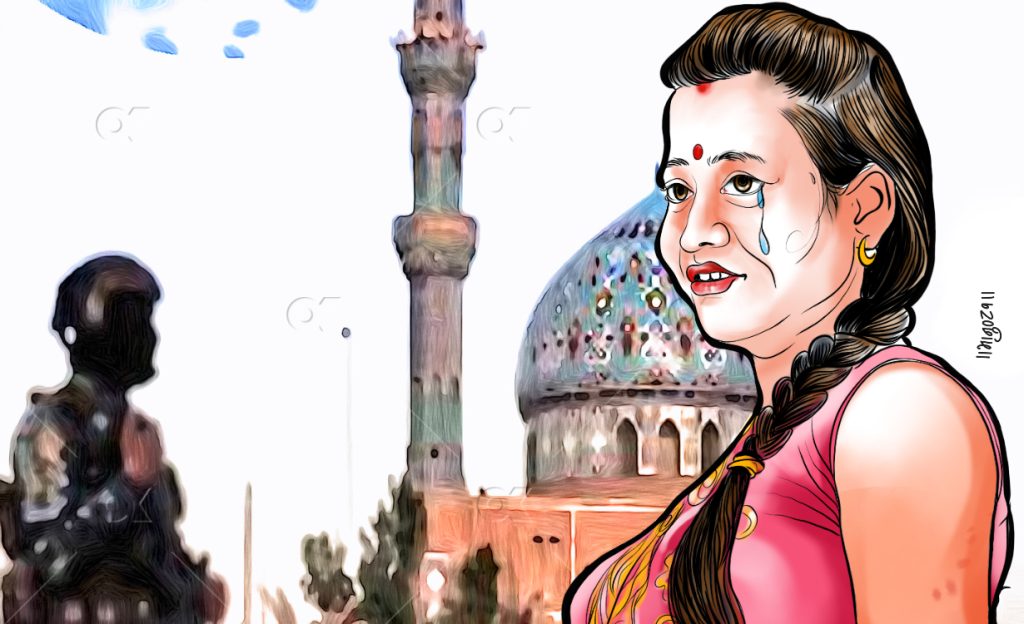
Bagmati has now returned to Nepal after what she describes as weeks of confinement, deprivation and mistreatment. Recalling her days in Kuwait, she broke down several times while speaking about what she experienced.
“I messaged my brother secretly, asking him to get me out of there by any means,” she said. “I had started feeling that I might never be able to get out.”
Her experience, she says, began with a promise of decent employment but ended with her secretly seeking help from her family to escape.
A job offer from someone she trusted
Bagmati had been supporting her family in her village when she heard that she could find a good-paying job in Kuwait.
Her husband had previously worked in different countries, and she also had relatives in Kuwait. That made her feel more confident about going abroad.
A person known to her introduced her to another woman who claimed to be from Dang’s Deukhuri area.
“I trusted her because my sister-in-law had apparently worked with her,” Bagmati said.
She then travelled to Kathmandu, where she underwent a medical examination at a private hospital in Gongabu. She was told to leave her citizenship certificate and passport with the people arranging her travel.
“They said, ‘Nothing will happen. I’ll also come there tomorrow,’ so I trusted them and left my passport and citizenship,” she said.
She had heard about the requirement for labour approval but was told she did not need to go through the process.
“They said getting labour approval and going through a manpower company would take too long and that they could send me easily,” she recalled.
She was told that her visa had arrived three or four days after the medical examination. About a week after arriving in Kathmandu, her flight was arranged.
“They told me it was a good job and not to worry. My sister-in-law was also there, so I gathered the courage to go,” she said.
She flew from Tribhuvan International Airport to Sharjah in the UAE, where she spent around three hours in transit before flying to Kuwait with two other women.
But within days of arriving in Kuwait, she began to realise that the reality was very different from what she had been promised.
‘Everything changed after 16 days’
Initially, Bagmati was placed in a house where she worked for around 16 days.
Her duties included cleaning and ironing clothes. Although the work was difficult, she said it was manageable.
After 16 days, however, she was transferred to another house.
There were around seven or eight Indian women and other workers there. Bagmati said the language barrier made things more difficult, as the others spoke Tamil.
Her work also became much more demanding.
“I had to carry things outside in temperatures of around 50 degrees Celsius,” she said. “There was no proper time to eat or sleep.”
After working there for around 10 or 11 days, she said her health deteriorated. She told them she could no longer continue working and asked to be taken back to the first house.
Instead, she was taken somewhere else on the assurance that she would be returned to her previous workplace.
That place, she said, became the most frightening part of her ordeal.
‘One meal in 24 hours’
According to Bagmati, she was kept inside a locked room and had to sleep on a cold floor.
“I was kept there for 18 or 19 days,” she said. “They would give me one piece of bread and stale, rotten food once every 24 hours.”
Access to drinking water was also difficult.
“When I opened the bottle to drink water, there would be insects inside. I had to remove them and drink the water,” she said.
When she fell ill and asked for hot water, she said she was instead scolded and pressured for being unable to work.
“When I was sick and asked for hot water, they didn’t give it to me. They would torture me, asking why I had come if I couldn’t work,” she said.
Her mobile phone was also taken away, leaving her with almost no way to contact the outside world.
Still, she held on to one hope: that her brother would come looking for her.
Bagmati said she was not the only Nepali woman being kept there.
Other Nepali women were also in the same situation, she said. One had allegedly been kept there for a long time and had been beaten, resulting in a ruptured eardrum. Another woman from Ilam was also there, according to Bagmati.
“Everyone was crying. They were afraid that no one would come to rescue them,” she said.
But Bagmati believed her brother would find a way to get her out.
That belief gave her the courage to secretly contact him when she got an opportunity.
A message that triggered the rescue effort
Her brother said Bagmati managed to send him a secret message.
“She messaged me saying, ‘I’m having a very difficult time here. Get me out, even if you have to pay the agent,’” he recalled.
He then began trying to find out how she had been sent to Kuwait.
His attempts to contact the agent initially failed. He later discovered that Bagmati and the other women had been sent on visit visas, rather than through the regular foreign employment process.
He then approached government authorities for help.
According to him, he contacted the Prime Minister’s Office, after which the matter was taken up with the Ministry of Labour and the National Investigation Department.
Officials from the National Investigation Department helped locate and track Bagmati, he said.
“They helped a lot in tracking my sister,” he said.
The rescue effort also involved negotiations with the agent. According to her brother, the agent initially demanded Rs 200,000, with efforts later made to settle the matter for Rs 125,000.
After government authorities began taking action against the agent, the situation changed, he said.
The agent was arrested, and pressure was subsequently placed on the relevant office in Kuwait. Bagmati was eventually provided with a ticket and sent back to Nepal, according to her brother.
Forced to record a ‘false’ video
Even after securing her return ticket, Bagmati said she was subjected to further pressure.
Before taking her to the airport, people at the Kuwait office allegedly made her record a video.
“They told me that if I didn’t say what they instructed me to say, they wouldn’t let me return to Nepal,” she said.
In front of the camera, she was made to say that she had been given good food and treated well.
But she says that was not her actual experience.
“I was forced to record a false video,” she said.
At that point, she said, she had only one thought: to get back to Nepal by any means possible.
Eventually, Bagmati returned to Nepal.
Her brother and others involved in the rescue effort were waiting for her at the airport.
Returning to Nepal brought relief, but the fear of what she experienced in Kuwait remains.
“I came back alive because everyone made an effort,” she said.
For her brother, the episode was more than just rescuing his sister. He said it also made him feel that government institutions could help families like theirs.
“We felt that there is a government for poor families like ours,” he said, thanking the officials and others who helped with the rescue.
Bagmati now has a warning for Nepalis considering overseas employment: do not trust even familiar people without verifying the details.
“Please don’t go on a visit visa like this,” she said. “Even relatives can put you in trouble.”
Her return has brought an end to her ordeal, but her story raises questions about other Nepali women who may still be in similar situations abroad.
How many are unable to contact their families? How many have no access to their phones? And how many may be forced to tell a camera that everything is fine when it is not?
Bagmati returned home, but the fear of those locked-room days remains.
Her advice is simple: check the documents, verify the visa, understand the job and employer, and never hand over your passport or your future solely on the basis of trust.
A journey that begins with the dream of a better job, she says, can turn into a struggle for survival when it falls into the wrong hands.