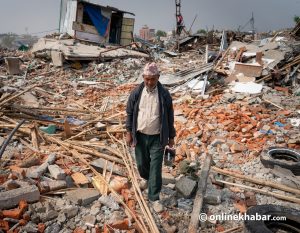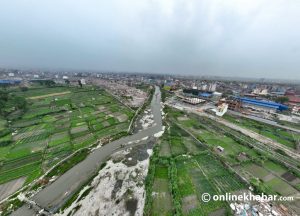


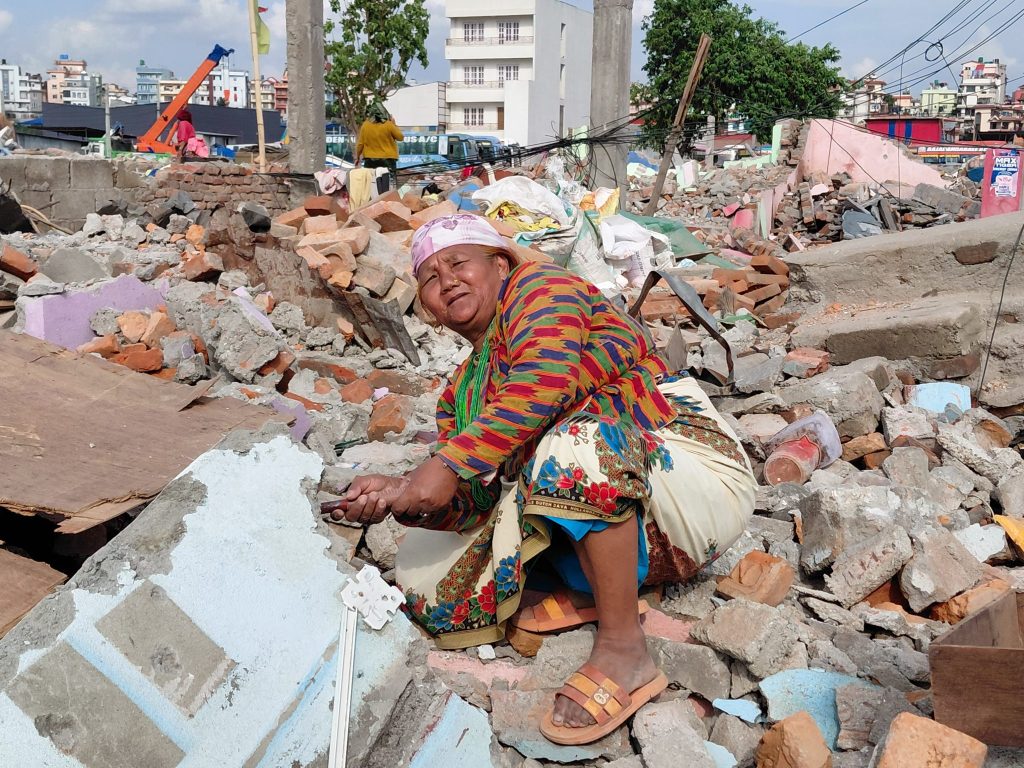
The Manohara squatter settlement is now empty. Not a single intact building, house, or shack remains. Whatever structures stood there have been reduced to rubble. Former residents come by occasionally, clinging to a faint hope of finding some of their belongings buried in the debris, sifting through the ruins.
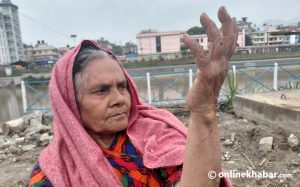
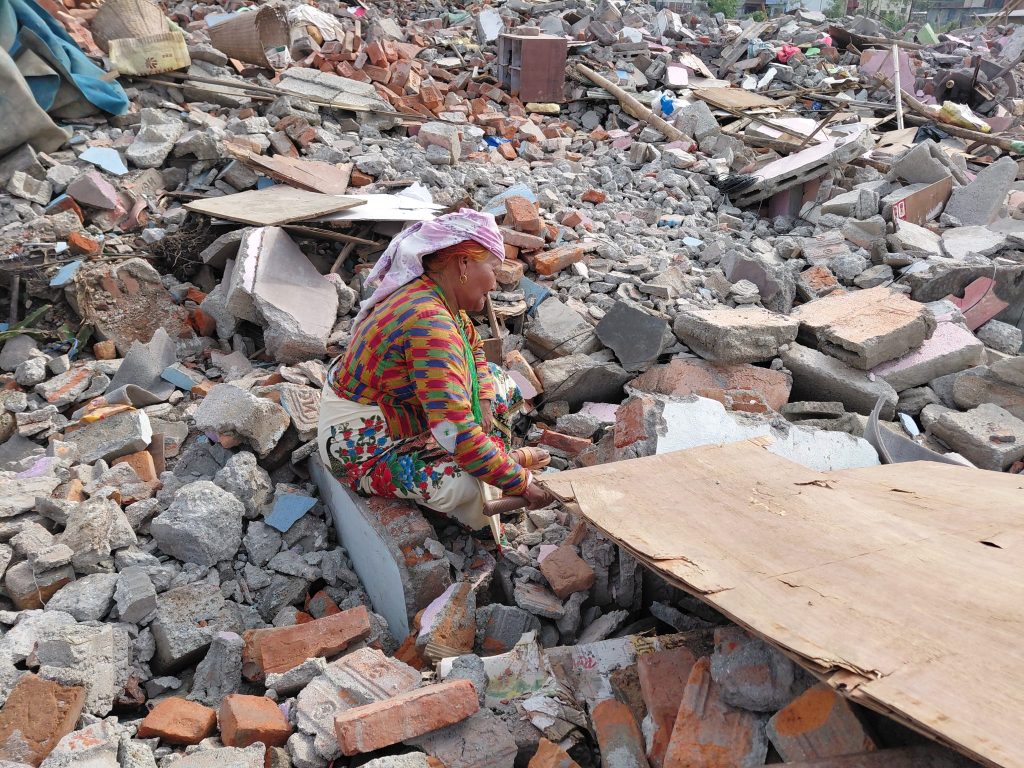
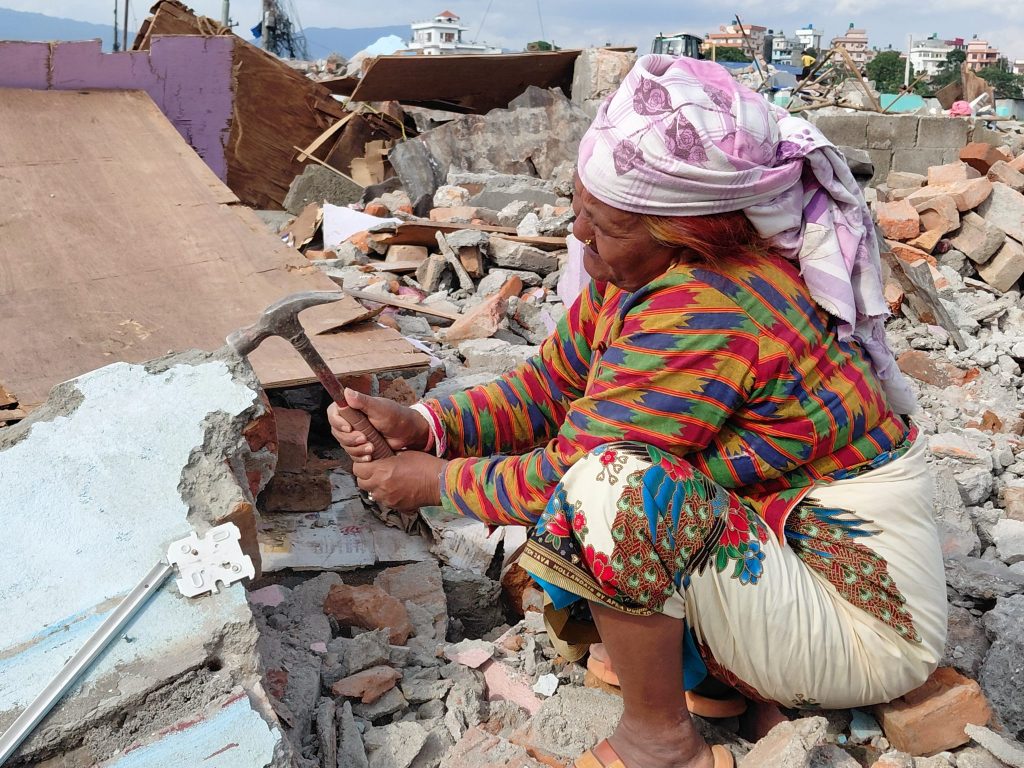
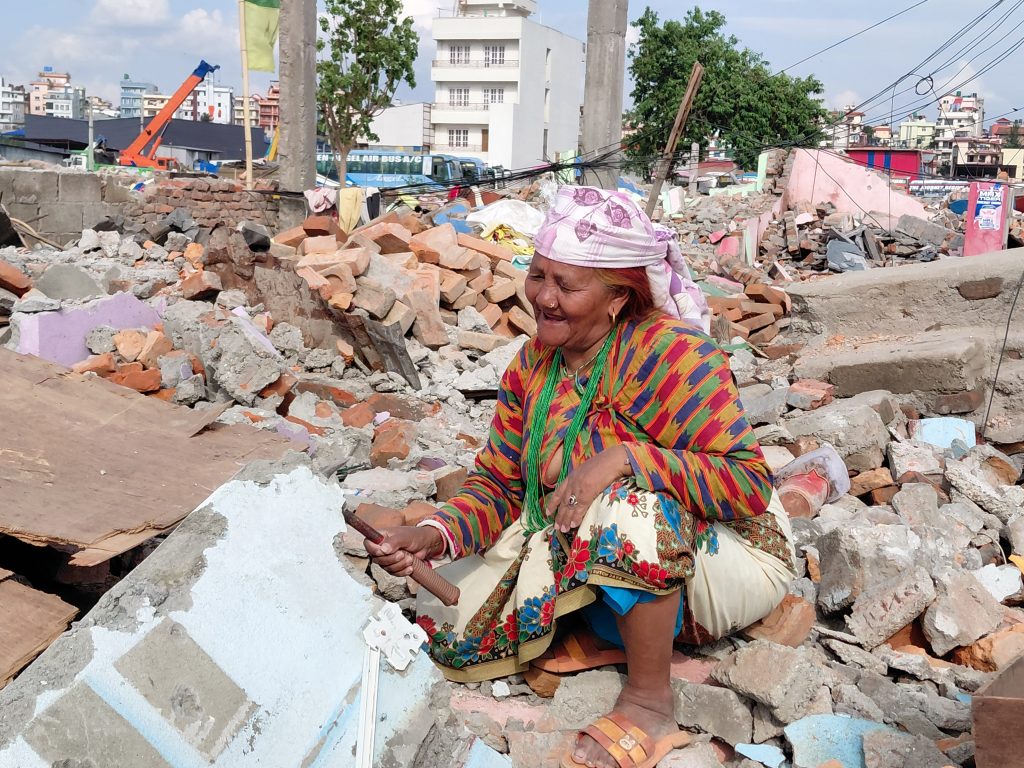
When Onlinekhabar correspondents arrived at the eastern edge of the Manohara settlement, they found Chandra Kumari Magar at the spot where her home once stood. She was striking the small, broken pieces of wall with a hammer. Beside her, her husband Ram Bahadur Gurung was collecting whatever he could.
Their goal was to salvage as many intact bricks as possible, for two reasons: first, to use them if they managed to build a new shelter on some other land; and second, if that plan failed, to sell the bricks for some cash.
The elderly couple, both past their sixties, worked their worn hands through the rubble as they spoke with Onlinekhabar.
Chandra Kumari is a native of Okhaldhunga, but she remembers little of her roots. Her father passed away when she was young. She doesn’t know her mother’s whereabouts. A brother who had gone to work in Solukhumbu died when he was crushed by a tree. She says she is past sixty but doesn’t know her exact age. She has even less track of her husband’s.
With no one to rely on in the village, she saw no choice but to come to the city to earn a living. She believed Kathmandu would offer work. She was in her mid-20s at the time.
After arriving in Kathmandu, she found work in a carpet factory, where she met Ram Bahadur Gurung. He, too, was from the east, brought to Kathmandu at the age of six or seven, with little memory of his past, surviving as a day labourer. The two fell in love through work and got married.
After marriage, they rented a room in Kaushaltar, where their first child, Sapana Gurung, was born. Gradually, their financial situation worsened. They could no longer afford rent in the city, and there was nothing left for them in the village either.
Then an acquaintance of Chandra Kumari’s told her about land in Manohara, where people were building homes, land available to live on without paying rent. The prospect was appealing: land, shelter, and no rent. The family moved to what would become the squatter settlement.
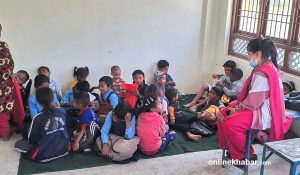
Two more daughters were born there, Bipana and Kalpana. All three children studied at the local Saraswati Basic School up to Grade 8, and Bipana and Kalpana both passed the SLC (school leaving certificate).
The couple continued their labour work even after settling in Manohara. Gradually, they used their savings to improve their shack, and when their eldest daughter Sapana went to Qatar for foreign employment and started sending money home, they built a proper concrete structure.
The settlement had been growing steadily, new people kept arriving, more houses and shops were being built, and floors were added. Neither the local nor the federal government ever said anything. So the residents never imagined this fate awaited them. They didn’t even know for a long time that the land they lived on was public property.
They assumed that since their community had grown so large, it was like any other neighbourhood in Kathmandu, and that, as squatters, living somewhere was even a matter of their rights.
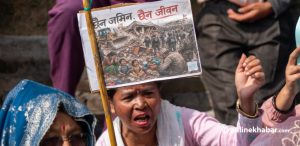
When Balen Shah was elected Mayor of Kathmandu Metropolitan City, the squatter issue came to the surface. Bulldozers attempted to clear the settlement multiple times during his term, though the effort remained incomplete. That was when residents finally became aware that their settlement could be cleared at any time.
But when hundreds of residents resisted, and political leaders gave speeches in favour of the squatters, and Balen’s attempts failed, Chandra kKmari’s family regained confidence that they would not be evicted.
In the most recent elections, Chandra Kumari’s family voted for Balen Shah’s party. RSP Chairman Rabi Lamichhane had promised to “stand in front with his chest out” to defend squatters if bulldozers came. Balen had also promised land ownership certificates (lalpurja) during a visit to Jhapa. They believed these promises.
Chandra Kumari recalled going to Lokanthali School on election day and standing in line to vote for the “bell” symbol.
Now, she feels no hesitation in saying her vote was wasted.
“Rabi Lamichhane said if bulldozers came to the squatter settlement, he’d stand in front with his chest out. I had voted for the bell,” she said. “Now the bulldozer has already come and gone through my house. Where is he? He never came.”
Why trust someone who had already sent bulldozers against squatters while serving as mayor? She replied with a tired laugh:
“That’s just our luck, son. When Balen was mayor before, he had already shown what he would do. But when voting time came, we forgot, ‘bell, bell,’ we said.”
She had never imagined her eviction would come like this. Twenty-five years of living here. A house built with hard-earned money, gone. She grieves the house, yes, but she grieves more the way the government treated them. The humiliation. The betrayal of their expectations.
If only the government had given them 3–4 days to remove belongings and find a room before demolishing, the pain would have been much less, she said.
They got the news too late. The rumour that the settlement would be cleared only reached them on April 24, by word of mouth. But contradictory news also circulated inside the settlement; some said it wouldn’t be cleared after all. Some residents had started moving their belongings. Others stayed calm.
With no official, reliable notice from the government, Chandra Kumari left that Friday evening to spend the night at her younger daughter’s rented room nearby, she had been feeling unwell, and still believed the demolition wouldn’t come so suddenly.
But the next morning, Sunday, bulldozers razed the settlement within moments. Ram Bahadur managed to save a few things while the machines were working. But most belongings were buried under the rubble, including their essential medications; both are patients with high blood pressure and diabetes and must take medicine regularly. That evening, rain fell, making it impossible to dig through the debris.
Everything lost: seven brass plates, ten blankets sent by their daughter from Qatar, and everyday clothing. Scavengers (kabadwala) had taken everything from the ruins by Monday afternoon.
The life they had slowly and painfully built has now been reduced to nothing again. This time, their ageing bodies may not let them recover. And beyond the physical destruction, there are deeper worries: two daughters still to be married off. And above all — where will they live now?
“The daughters will leave once they’re married,” says Chandra Kumari. “And my daughter in Qatar hasn’t received her salary for three months because of the war, they say. Once they’re all gone, who do we lean on at this old age? Balen has ruined us in our twilight years.”
Despite everything, neither of them plans to go to the government’s holding centre. Their dignity, though battered by the state, remains. They would rather suffer independently. If they can find a piece of land somewhere, they’ll rent it and build a new shack. If not, they’ll find a room to rent.
“Our daughters will manage somehow. We two old people will struggle for however long we live. But I won’t be crammed into a room the size of a rich person’s toilet,” she says. “They must think we’re nothing.”