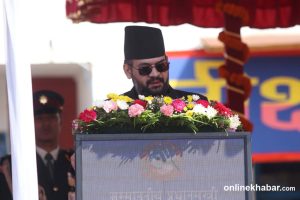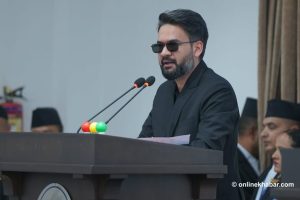

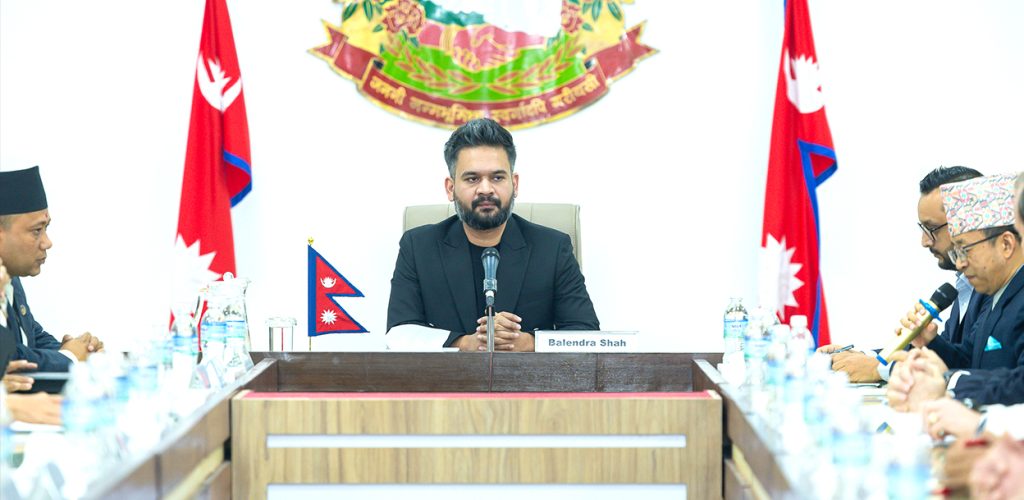
The government formed under the leadership of Balendra Shah (Balen), a senior leader of the Rastriya Swatantra Party (RSP), managed to send some positive signals in its very first month. One example is its commitment to incorporate the positive aspects of all parties’ election manifestos into a unified “National Commitment.”
On the very day the government was formed, March 27, the Council of Ministers approved a hundred-point governance reform agenda. The third point stated that a “National Commitment” would be prepared by consolidating the manifestos, pledges, and commitment documents of all political parties that participated in the election, with the Nepal Government establishing ownership over it.
Accordingly, the government has already prepared a draft of the “National Commitment.” Whether it will take concrete shape cannot be said with certainty right now. But what can be said is that this is certainly a good beginning. As the ancient Greek philosopher Aristotle said, a good beginning is half the work done.
Recalling past practice in which even coalition partners would criticise each other’s good policies under the guise of ideological differences, this exercise by the Balen government is hard not to applaud.
This decision signals that the government intends to free itself from the tendency to oppose things simply for the sake of opposition. It is significant from a philosophical standpoint. It has initiated a culture where future governments will have to acknowledge positive contributions even from opposition parties.
Former Government Secretary Sharada Prasad Trital analyses that the RSP government, which won nearly two-thirds of the vote, has shown encouraging early signs.
“What this government has done in its first month is different from anything any previous government has done,” he says. “Past governments spent much of their time in meetings and ceremonial garland-giving. This government has given reason for hope.”
Observers note that the government has shown positive signs in areas like governance reform, good governance, and service delivery, as outlined in its commitment documents. Prime Minister Blaen has been running the government from his Singha Durbar office. Rather than using the official Baluwatar residence, he has activated the Office of the Prime Minister and Council of Ministers, stating he will not attend formal programs unless absolutely necessary.
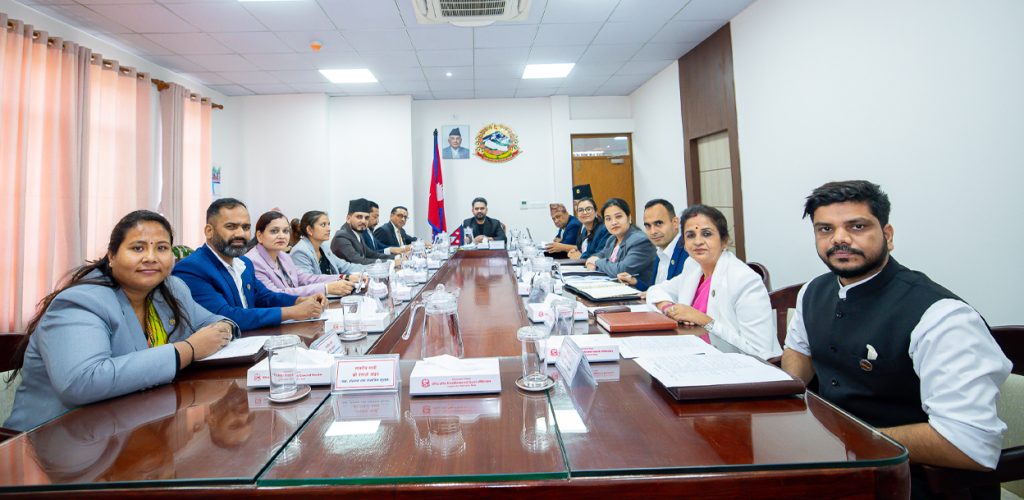
Other cabinet members have similarly kept a low profile, with no public images of unnecessary meetings, ribbon-cutting ceremonies, or the customary garland-placing rituals seen in the past. Citizens who have long endured inefficiency and dysfunction have come to regard even the absence of wrongdoing as something praiseworthy.
Prime Minister Balen’s group meeting with heads of diplomatic missions was widely welcomed. Foreign Minister Shishir Khanel has sent the message that foreign policy will not change every time a new government comes to power. However, the government’s reference to Nepal as a “buffer state” in its commitment document drew sharp criticism.
During his time as mayor, Prime Minister Balen had won praise for bringing transparency to the scholarships that schools are obligated to provide. He has made a similarly bold move in health. The decision to strictly enforce the provision requiring both government and private hospitals to make 10 percent of their beds available free of charge to the poor, vulnerable, and abandoned patients has been widely praised. In a country where many cannot afford treatment, experts say such a provision must be implemented rigorously.
Public health expert Dr Rita Thapa says the 10 percent free beds in private hospitals should be made transparent, while government hospitals should offer 100 percent free treatment to the poor. She recommends strengthening health insurance as well.
According to a recent Oxfam International report, Nepal’s wealthiest one percent hold 519 times more wealth than the poorest 50 percent of the population.
Most individuals in high public office fall among the wealthiest. The government has formed a Wealth Investigation Commission to collect and examine the asset declarations of senior political officeholders and high-ranking bureaucrats who have held public positions since 2062/63 BS. Experts say that if this commission, given a one-year mandate, brings out the truth fairly and effectively, it could become a milestone in good governance. They recommend strengthening it through legislation rather than limiting it to an executive order.
Efforts to eliminate middlemen and streamline services at high-traffic government offices such as the Land Revenue Office, Passport Department, and District Administration Offices have received positive responses. Whether this will be sustained is too early to predict. However, the provision imposing customs duties on household goods worth more than one hundred rupees has drawn sharp criticism.
The RSP government appears to be working to cut the roots of syndicate culture and political patronage. It has signalled a challenge to the situation where citizens who do not hold party membership can barely survive. The real test, however, will be whether it avoids replacing old affiliates with its own.
Decisions such as abolishing employee unions and student organisations have received mixed responses. The decision to clear informal settlements has also drawn mixed reactions. While critics have pointed to human rights and humanitarian concerns, many have also commented that the move is welcome from the standpoint of the rule of law and the executive’s authority to decide.
Senior advocate Raju Prasad Chapagain disagrees with how the government handled the settlement evictions.
“Evicting people first and then verifying their status is like punishing someone before investigating,” he says.
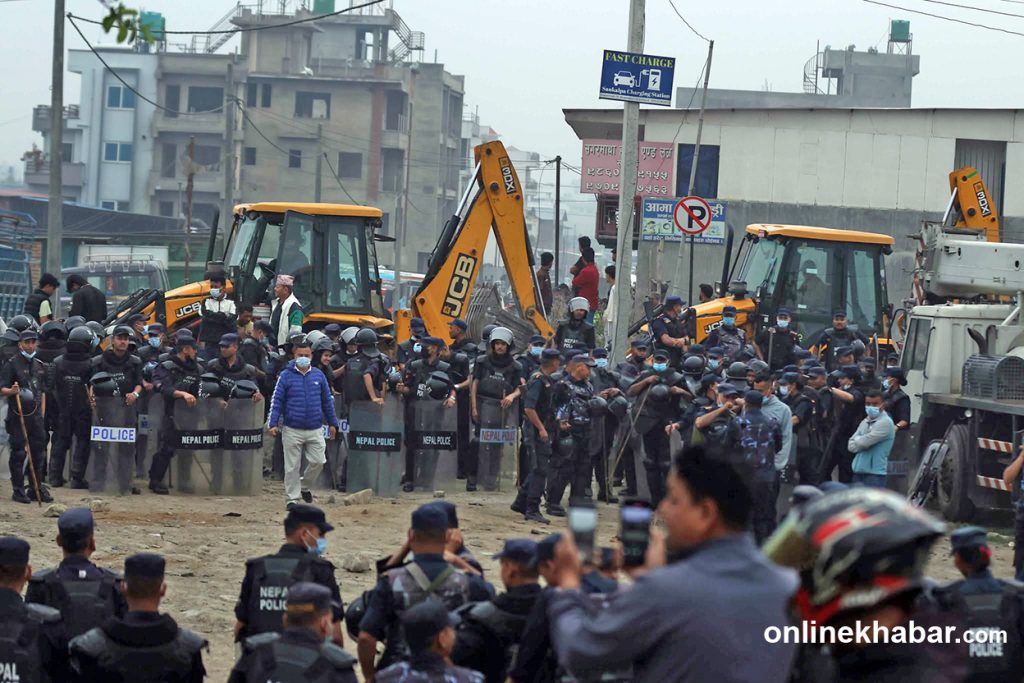
The issue of informal settlers is not new. The constitution and laws provide clear frameworks for how to resolve it. The constitution and land-related laws clearly explain how to provide land to landless Dalits and landless squatters. There is no shortage of laws on how to relocate unorganised settlers, either.
However, those who were displaced complain that the government did not treat them with dignity. Pawan Gurung, vice-president of the Joint National Squatters’ Front, describes the process of clearing settlements in Thapathali, Gairigaun, and Manohara as incomplete and flawed.
He says that announcing evictions by loudspeaker one day and having police cordon off the area the next is not a humane way to proceed.
“Before demolishing our settlement, the genuine squatters should have been verified,” Gurung says. “If they had been relocated to suitable places after verification, that step would have been welcome.”
The government is the guardian of all citizens. Its actions must be both lawful and seen to be legitimate. In this context, British Lord Chief Justice Lord Hewart once said that justice must not only be done but must also be seen to be done.
In the name of acting quickly, the government’s actions have at times raised questions of legality and at other times, of public acceptance.
Scholar Ramchandra Shrestha, based in Butwal, says the government appears active but uncertain about its direction.
“The government looks extremely action-oriented,” he says. “But without dialogue and parliamentary endorsement, there is confusion and mystery about where it is actually headed.”
Constitutional expert Bipin Adhikari says the government made a good start on the squatter issue. While some aspects deserve criticism, he believes the government did what needed to be done.
The government had committed to its hundred-point governance reform agenda to complete a data collection and verification process within two months and provide land within a thousand days. Adhikari says the government appears to be working accordingly.
“The Prime Minister appears to be acting in line with the government’s announcements and the party’s commitments,” he says.

However, Adhikari concludes that some of the government’s actions have looked like hasty waste-making. For example, he points to the arrest of former Prime Minister KP Sharma Oli and former Home Minister Ramesh Lekhak without completing the due legal process.
“I said it then, and I say it now: the arrest of the former Prime Minister, former Home Minister, and others was unlawful,” says constitutional expert Adhikari.
Stakeholders say that while the government’s intentions may not be wrong, it does not appear to have respected the constitution and existing laws.
Experts and stakeholders protested that the federal government issued directives resembling centralised governance even in areas where the constitution explicitly grants exclusive authority to provincial and local governments.
Schedule 8 of the Constitution grants local governments full authority over basic and secondary education. Yet the federal government issued directives not only on when schools should open and for how many days, but also on examination management.
Subsequently, the Nepal Municipal Association and the National Rural Municipalities Federation met with the federal Education Minister to formally protest and proceeded to defy what they called unconstitutional directives. Although the government had said schools should not open until May 4, most schools have already resumed operation.
The government’s immaturity was also visible in how it called the federal parliamentary session. The government recommended to the President on April 21 to convene the session. The President called the session on April 22. But the very next day, the government recommended suspending the session of both houses.
Parliamentary experts say such a decision cannot simply be called immature or a sign of unpreparedness. There are many past precedents of governments abruptly ending sessions in order to bypass parliament and issue ordinances at will. Such behaviour is not expected from a party that holds close to a two-thirds majority and claims to be different from the parties of the past.
Before completing even one month, the government had to remove two ministers. Whatever the reasons, the exits of Home Minister Sudhan Gurung and Labour Minister Deepak Sah did not go uncontested. From one angle, this can be seen as the government’s zero-tolerance policy. From another, it reflects poor selection in the first place.
True to its promise, the government formed a task force to prepare a discussion paper on constitutional amendment. Past constitutional commissions were led by figures such as Bishweshwar Prasad Koirala, Suryanath Upadhyay, Rishikesh Shah, Aniruddha Prasad Singh, Laxman Aryal, and Bishwonath Upadhyaya. Some have criticised the fact that this time the government gave the task an administrative character.
Constitutional expert Bipin Adhikari, however, says the task force formed to prepare an initial draft should be viewed positively.
Sociologist Ajay Yadav, who teaches at Ramswarup Ramsagar Multiple Campus in Janakpur, says the public holds enormous hope and trust in this government, formed amid prolonged political instability.
“People who had been frustrated for decades voted by placing their hope in one individual,” he says. “That is why public expectations are very high. Looking at what the government has done so far, it seems to be doing well. But I see more enthusiasm than caution. That balance needs to be struck going forward.”