Kathmandu, November 25
Lawmakers at a parliamentary committee have raised the minimum age for children entering the work, constitutional rights, international standards and the socio-economic causes of child labour. The discourse took place during the ongoing discussion of the principles of a bill to amend the child labour law.
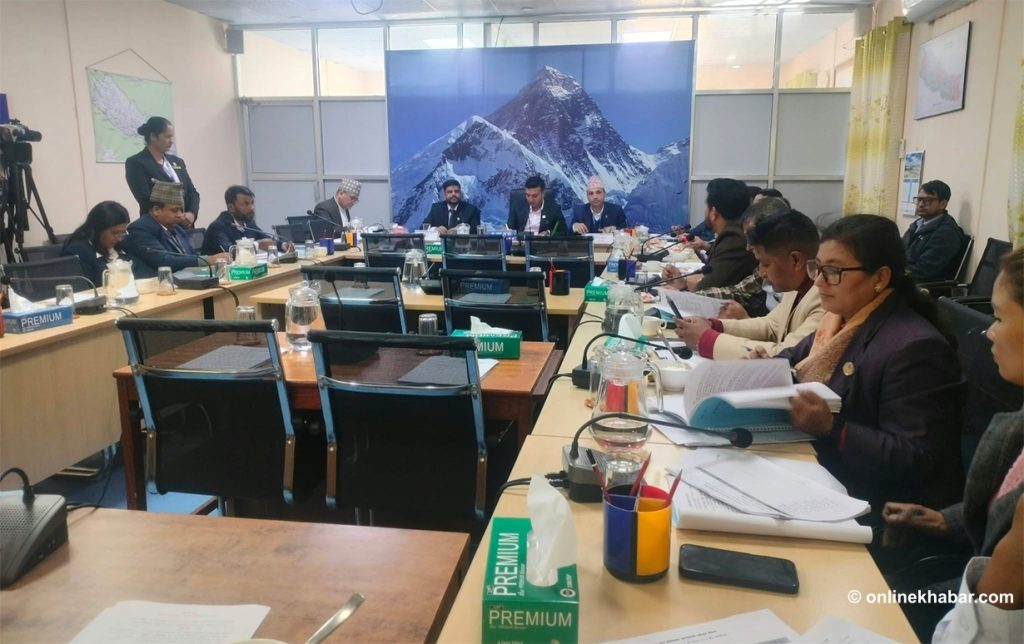
At a meeting of the House of Representatives’ Industry, Commerce, Labour and Consumer Interest Committee, MP Kripa Ram Rana said the bill should be aligned with the constitution and international labour standards. He said it should be advanced in a way that protects children’s right to all-round development.
MP Som Sharma said child labour cannot be controlled through laws and fines alone. He stressed the need to address family economic conditions and the lack of employment as well.
The Child Labour (Prohibition and Regulation) Bill, introduced by the government, proposes that children who have completed 13 years of age could be engaged in light work under certain conditions. The committee is discussing this provision, along with those on forms of child labour, working hours, employers’ obligations and child protection.
MP Rana said the bill’s principles should be reviewed with the fundamental rights of children, guaranteed by Article 39 of the Constitution, at the centre.
He said the Constitution guarantees children the rights to education, health, nurturing, proper care, sports, entertainment and all-round personality development. The proposed bill, he said, must not end up weakening those rights.
“Are there any conflicts between the matters related to the bill we have brought and the constitutional provisions? We have to look at that first, in principle and in policy terms,” Rana said.
He said the committee should examine whether the bill adequately guarantees the right to all-round development in Clause 2 of Article 39. It should also check whether it adequately guarantees the provision in Clause 4 that children cannot be employed in factories, mines or hazardous work.
Rana said the forms of work listed in the bill’s schedule also need close discussion. Because the risk can differ for the same type of work depending on its nature and conditions, he said, the limits on employing children must be clearly defined.
Rana also raised the International Labour Organization’s (ILO) Convention 138, which sets the minimum working age at 15. But he argued that the nutrition, family conditions, geography and social context of Nepali children should also be considered in the debate on setting the age.
“The age of growth and development of children in developed countries and children in developing and lagging countries is definitely different,” he said. “That is why this maturity period also varies somewhat, higher or lower.”
He said ILO Convention 182 requires the immediate prohibition and elimination of the worst forms of child labour. This should also be included in the bill and made clearer in the clause-by-clause discussion, he said.
Rana said child education and the protection of childhood should be prioritised over child labour. In his view, the bill’s purpose should be to protect children’s rights, not to bring them into work.
Poverty is also a cause of child labour
MP Som Sharma said child labour should not be viewed only through legal provisions.
He said that looking for the causes of children being put to work reveals factors such as lack of protection, family economic conditions, lack of education and employment, and the abuse of children.
He said the situation of children outside parental care should be studied separately. The same applies to children sent from rural areas to live with other people in the name of education, and children sent to work because of financial hardship.
“Either the child could not see a good life for themselves, or the family could not see a good life for themselves,” Sharma said, describing the two situations he sees when analysing the causes of child labour.
He said families in rural areas send children to work in Kathmandu and other cities because of poverty.
“Even if you tell them ‘please don’t do this’, why wouldn’t they? Either you give us food, or you give us money. It is hard to support a family here,” Sharma said, describing the compulsion of rural families.
He argued that although a law prohibiting child labour is necessary, the government must give assurance of protection and support to families under economic pressure.
He said the law must stop work done with the intent of putting children into child labour. But he said families that send children to work because of economic compulsion need employment and economic security.
“If employment can be arranged for such people, and the government takes the initiative and creates an environment of trust, then perhaps that child labour can be stopped to some extent,” he said.
Sharma suggested that, to prevent child labour, the government should arrange employment for citizens with weak economic conditions. He also said it should build an environment of trust and take steps to end the situation that forces families to send children to work.