
Kathmandu, November 25
The era of Chandra Shumsher Rana’s rule in Nepal was approaching its second decade when he wrote a letter to British envoy Colonel Kenyon in Nepal on August 23, 1920. In the letter, the Rana prime minister outlined the conditions Nepal had put forward for allowing the British government in India to build the Sharada Barrage on the Mahakali River.
Nearly two months later, in October, Colonel Kenyon delivered a letter from the British Indian government accepting Nepal’s conditions. The exchange of letters formalised the Sharada Barrage agreement.
The agreement primarily covered three provisions.
First, Nepal ceded 4,000 acres of land to India for the construction of the Sharada Barrage. Before the agreement, Nepal occupied one bank of the Mahakali River while India occupied the other. Following the agreement, both banks of the barrage came under Indian territory. In exchange, India provided Nepal with an equivalent area of grazing and forest land in various locations.
Second, British India agreed to bear the entire cost of constructing the barrage and canals. In return, it retained full control over the structures.
Third, India agreed to provide Nepal with 460 cusecs of water from the Sharada Canal during the monsoon and 150 cusecs during winter. Nepal was also entitled to receive up to 1,000 cusecs if surplus water was available during the monsoon.
The agreement specified the quantity of water Nepal would receive but imposed no limit on India’s water consumption. This effectively gave India unilateral control over the Mahakali’s water, which it used to irrigate vast areas of Uttar Pradesh.
The Sharada Barrage, under which Nepal was disadvantaged, was completed in 1928. Chandra Shumsher died the following year. The agreement governing the barrage has long since expired. Yet, 106 years later, Nepal’s position has hardly changed. India’s unilateral use of the Mahakali’s water has continued, while successive barrages and unequal agreements have further weakened Nepal’s position.
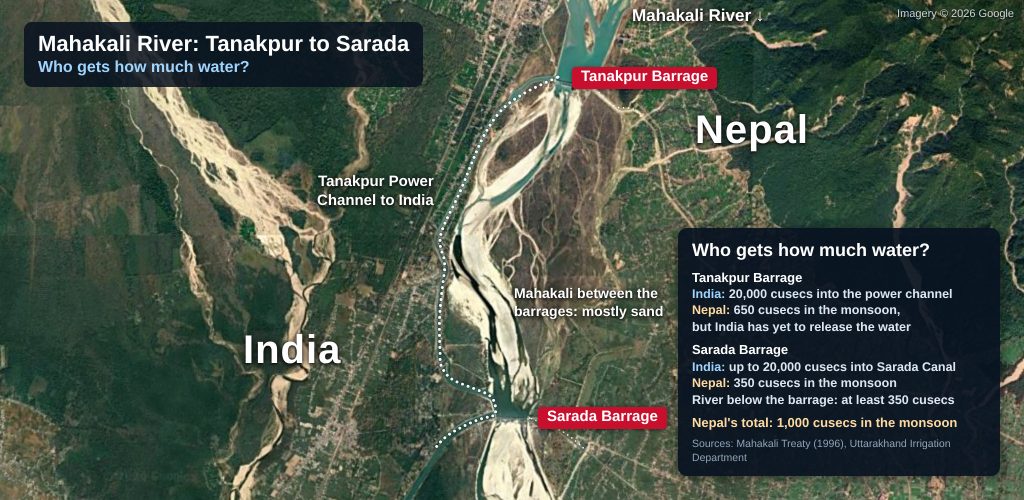
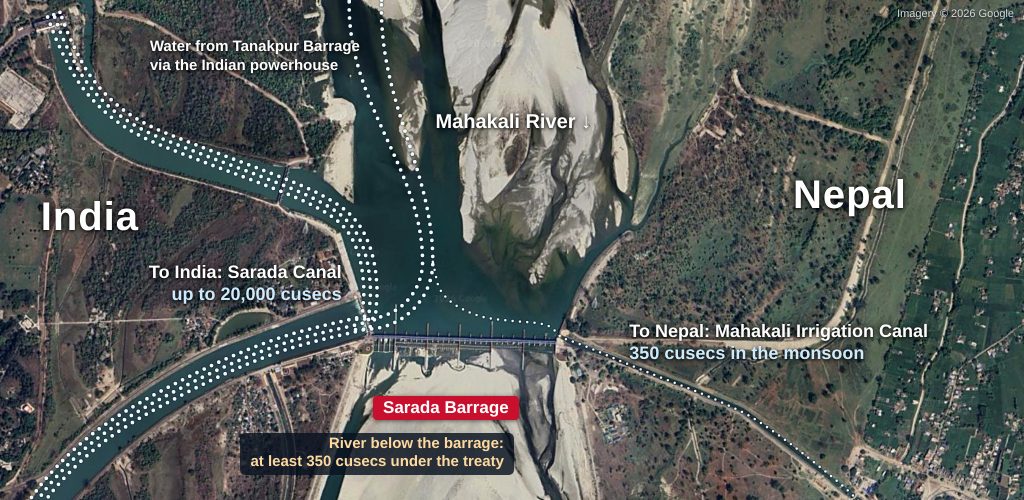
India constructed the Lower Sharada Barrage on its own territory in 1974 and has continued to use its water as it sees fit. India now uses the entire water flow of the Mahakali through the Upper and Lower Sharada barrages, while Nepal receives only 1,136 cusecs of water through the Sharada and Tanakpur arrangements.
The Mahakali may be a shared river, but Nepal’s equal rights appear to extend only to the riverbanks. India, meanwhile, has maintained unilateral control over its waters.
Tanakpur built without consulting Nepal
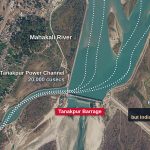
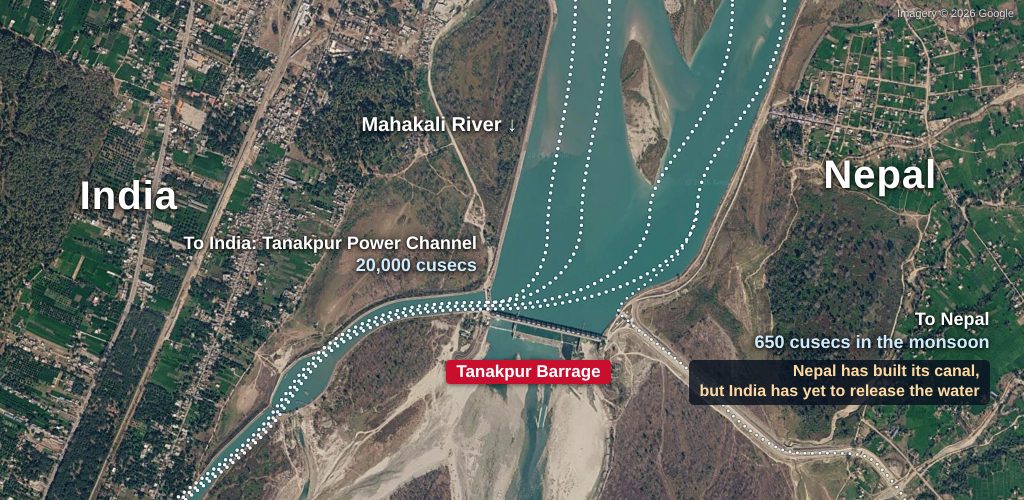
Tanakpur lies about seven kilometres upstream from the Sharada Barrage. In 1988, India began constructing a barrage there without Nepal’s consent.
India built a 475-metre-long barrage on the Mahakali River to generate 120 megawatts of electricity. The water was then diverted and discharged back into the Mahakali a short distance upstream from the Sharada Barrage.
India did not consider it necessary to reach an understanding with Nepal, which had an equal share in the river’s water. Nor did it pay much heed to Nepal’s objections. Since most of the barrage was located on Indian territory, India proceeded with the construction.
However, the eastern embankment of the barrage had to extend into Nepalese territory. India needed 2.9 hectares of land in Jimuwa, Kanchanpur, to complete the project. Only then did it seek Nepal’s consent.
There was considerable dissatisfaction in Nepal over India’s unilateral actions. At the time, Prime Minister Girija Prasad Koirala, who was leading the first elected government following the restoration of democracy, was on a visit to India. Along with other agreements, Koirala signed an arrangement with his Indian counterpart PV Narasimha Rao to provide the 2.9 hectares of land required for Tanakpur.
The agreement triggered widespread protests in Nepal. Koirala, however, maintained that he had signed an understanding, not a treaty. A legal case was also filed over the arrangement.
When Rao visited Nepal in 1992, the understanding was reaffirmed. In 1993, Nepal’s Supreme Court ruled that the agreement was a treaty and therefore required parliamentary ratification.
The Pancheshwar project, meanwhile, had its origins around the time King Mahendra ascended the throne in Nepal. In 1956, India began studying the massive project along the border between Champawat district in India and Pancheshwar in Nepal’s Baitadi district.
The project, which remained largely on paper for decades, proposed constructing a 315-metre-high dam on the Mahakali River. It had three major components.
The first was electricity generation. The main dam was initially planned to generate 6,480 megawatts of electricity for Nepal and India combined. The plan was revised in 2016, with the proposed generation capacity reduced to 5,000 megawatts. An additional 83-metre dam at Rupali Gad was planned to generate 240 megawatts.
The second component was irrigation. The project was expected to provide irrigation to 130,000 hectares of land in Kanchanpur and Kailali in Nepal and 1.6 million hectares in India. The reservoir was also expected to help reduce flood risks.
The multipurpose project ultimately became a key factor in the Mahakali Treaty between Nepal and India.
Manmohan’s ‘package’ proposal in Delhi
After the Supreme Court ruled that the Tanakpur agreement was a treaty, it had to be ratified by a two-thirds majority in Parliament. That appeared unlikely, as UML lawmakers had largely considered the Tanakpur agreement a betrayal of national interests.
However, after forming the government, then prime minister Manmohan Adhikari faced pressure to resolve the Tanakpur dispute. The UML government believed that linking Tanakpur with the proposed Pancheshwar project could help settle the controversy.
Under Pancheshwar, Nepal was expected to receive half the electricity and half the water benefits, a more favourable arrangement than the unequal agreements that had preceded it.
During his visit to India in April 1995, Adhikari and his deputy prime minister and foreign minister Madhav Kumar Nepal proposed a package deal, arguing that the Tanakpur dispute could not be resolved in isolation. The package included the Sharada Barrage, Tanakpur and Pancheshwar. Consequently, Tanakpur was not explicitly mentioned in the joint statement issued following the visit.
Adhikari’s government, however, collapsed within nine months, and the UML moved into opposition.
Sher Bahadur Deuba subsequently became prime minister with the support of the Rastriya Prajatantra Party (RPP). Within four months of taking office, the preliminary document of the integrated Mahakali Treaty was signed. Nepal’s foreign minister Prakash Chandra Lohani and India’s foreign minister Pranab Mukherjee signed the document. Deuba and his Indian counterpart PV Narasimha Rao signed the treaty on February 12.
Following months of debate in Nepal, Parliament ratified the treaty on September 20, 1996, with 220 votes in favour and eight against.
The UML Central Committee had also voted on the treaty earlier that morning. An open vote resulted in a tie, with 17 votes for and 17 against. In a subsequent secret ballot, 17 members voted in favour and 16 against. Following the one-vote margin, the party decided to support ratification and issued a whip.
However, 26 UML lawmakers were absent during the parliamentary vote, while three voted against the treaty.
The controversy surrounding the Mahakali Treaty contributed to the UML’s split in 1998. Bamdev Gautam led the breakaway faction that formed the Communist Party of Nepal (Marxist-Leninist), or CPN-ML.
The project that never materialised despite promises of mutual benefits
The Mahakali Treaty was a major diplomatic victory for India. Under its terms, Nepal accepted the Tanakpur barrage, which India had built unilaterally.
Yet, more than three decades after the treaty, the Pancheshwar Multipurpose Project, which was also supposed to benefit Nepal, has failed to move forward.
The Mahakali Treaty stipulates that the Pancheshwar project should be developed to ensure benefits for both countries. It provides for the equal sharing of benefits from energy generation, irrigation and flood control.
The two countries had agreed to finalise the detailed project report (DPR) within six months of the treaty coming into force. But even after three decades, they have failed to agree on the DPR.
Both countries have conducted their own studies, and a joint draft DPR has also been prepared. However, India has not agreed to Nepal’s proposals on benefit assessment, cost-sharing and the distribution of downstream benefits.
Even the water Nepal is entitled to under the Mahakali Treaty through Tanakpur has not been delivered in the agreed quantities. Nepal was supposed to receive 1,000 cusecs during the monsoon and 150 cusecs in winter, but it has not received those amounts.
According to sources at the Ministry of Energy, when Nepal currently requests water, India insists that the issue must be resolved as part of an overall agreement on the Pancheshwar project.
The treaty also stipulates that India should release an additional 350 cusecs of water from the Sharada Canal for irrigation in the Dodhara-Chandani area. Nepal is supposed to construct a canal after India identifies the point from which the water will be released. However, neither the water-release point has been designated nor the canal constructed, according to ministry sources.
What are the unresolved issues?
The two main issues preventing the Pancheshwar project from moving forward are cost-sharing and water allocation.
The Mahakali Treaty stipulates that the Pancheshwar Multipurpose Project, to be constructed upstream of the Tanakpur Barrage, will be operated as an integrated project. However, the costs are to be borne in proportion to the benefits received by each country.
Nepal maintains that India should bear 70 per cent of the project cost, given the extent to which it already benefits from water utilisation and river regulation through the Sharada and Tanakpur barrages.
Nepal has proposed a 30-70 cost-sharing arrangement, with Nepal paying 30 per cent and India 70 per cent, arguing that India would receive substantially greater irrigation and flood-control benefits, including irrigation for 240,000 hectares.
India, however, has so far appeared willing to bear only 65 per cent of the cost. Officials say the cost-sharing issue could be resolved once the other aspects of the project are agreed upon.
The treaty also allows Nepal to sell electricity generated by Pancheshwar to India. However, the price of the electricity has yet to be determined. Officials say this is not a major sticking point.
Article 3 of the Mahakali Treaty states that both countries are entitled to equal rights over the river’s water, without adversely affecting the existing consumption of either country at the time the treaty was signed.
The current dispute between the two countries centres on how this provision should be interpreted.
When the Mahakali Treaty was signed, India had already built the Sharada and Tanakpur barrages and was using water from both. Nepal is willing to recognise India’s water consumption through these two structures as its existing consumption.
India, however, also insists that its water rights through the Lower Sharada Barrage, located on Indian territory about 163 kilometres downstream from the Sharada Barrage, must be protected. India has been using water through the Lower Sharada Barrage since 1975.
Nepal argues that water flowing through the Lower Sharada Barrage also includes water from the Karnali River, and therefore the entire volume utilised there cannot be considered existing consumption of the Mahakali River.
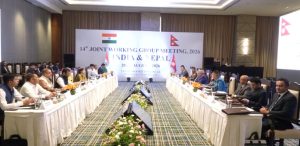
A team of experts led by the secretary of Nepal’s Water and Energy Commission Secretariat and the head of India’s Central Water Commission has been formed to finalise the DPR. The team has held four or five meetings but has yet to reach a conclusion.
“Since sufficient studies and analyses have already been carried out on how the benefits should be divided, the project could move forward quickly if a concrete agreement is reached. This is not something that can be resolved at the bureaucratic level. It requires a political decision,” says Chiranjivi Chautaut, a former energy secretary and former chief executive officer of the Pancheshwar Authority.
Sources say Nepal has again maintained that a broader political consensus is necessary to move the project forward.
Political commitments, but no progress
During Indian Prime Minister Narendra Modi’s visit to Nepal in August 2014, one of the agreements reached with then prime minister Sushil Koirala was to advance the Pancheshwar project. At the time, the two sides committed to finalising the DPR by November 2014.
Addressing Nepal’s Parliament, Modi said the project would begin within a year.
The Pancheshwar Development Authority was established in 2014. In 2016, Indian government consultancy WAPCOS submitted a draft of the integrated DPR. However, the two countries have still not agreed to finalise it.
During then prime minister Sher Bahadur Deuba’s visit to India in September 2017, the two sides again agreed to finalise the DPR within a month. That deadline was also missed.
The project was raised during subsequent high-level visits and discussions, but no concrete decision was made to move it into the construction phase.
During then prime minister Pushpa Kamal Dahal’s visit to India in 2023, the two countries again agreed to complete the DPR within three months. That deadline, too, was missed.
The issue has resurfaced during Prime Minister Balendra Shah’s state visit to India. In a joint document titled A Developed India and a Prosperous Nepal: Reimagining the Partnership, issued during the visit, the two countries agreed to expedite the implementation of the Pancheshwar, Saptakoshi and Sunkoshi Multipurpose Projects, alongside other hydropower and multipurpose projects under construction or in the planning stage.
The document states that the projects will be accelerated to ensure the mutually beneficial use of water resources and minimise the adverse impacts of floods.
Under the energy, water resources and climate resilience component of the agreement, both sides have also committed to strengthening institutional cooperation, promoting mutually beneficial partnerships and advancing sustainable, resilient and inclusive development.
In line with the India-Nepal Joint Vision for Cooperation in the Power Sector, India will encourage additional investment in Nepal’s hydropower and transmission infrastructure. Nepal, in turn, will facilitate such investment by providing appropriate cooperation and an enabling framework for mutually beneficial partnerships.
The two countries will also explore opportunities to expand cross-border electricity trade based on mutual benefits and market demand.
Beyond conventional hydropower, Nepal and India have agreed to cooperate in developing alternative energy sources, including solar and geothermal energy. A pilot project on green hydrogen will also be implemented in Nepal.
The joint document further outlines cooperation in disaster management and climate resilience, with a focus on reducing disaster risks, strengthening early warning systems and supporting post-disaster recovery to protect lives, livelihoods and infrastructure.
Both countries have agreed to institutionalise the real-time, two-way exchange of hydrometeorological data, glacial lake monitoring information and early warnings. Cooperation will also be expanded through joint humanitarian assistance and disaster response exercises, capacity-building programmes, training and humanitarian support involving relevant agencies from both countries.
Similarly, India will facilitate training for young Nepali professionals, officials and experts in environmental fields, including policymaking, regulation, standards, forestry, risk mapping and climate-resilient agriculture.
The two sides have also agreed to exchange expertise on reservoir restoration and the control of groundwater pollution.
At the multilateral level, Nepal and India have pledged to strengthen cooperation through the International Solar Alliance (ISA), the Coalition for Disaster Resilient Infrastructure (CDRI), the International Centre for Integrated Mountain Development (ICIMOD) and the International Big Cat Alliance (IBCA).
However, the latest political commitment does not specify a new deadline for finalising the Pancheshwar project’s detailed project report or indicate whether the longstanding disagreements over cost-sharing and water allocation have been resolved.
Opposition within India
The Pancheshwar project, which proposes a high dam on the Mahakali River, known as the Sharada in India, has faced significant opposition within India.
Environmental activists and regional political parties in Uttarakhand have protested against the project, arguing that a 311-metre-high dam would inundate large areas on both sides of the border, displace more than 30,000 people in Uttarakhand and cause extensive environmental damage.
Protests against the project were held in several cities in Uttarakhand, including Dehradun, particularly in 2010 and 2017.
Sources say the opposition has also made it difficult for India to move the project forward.
“India may be shifting its own difficulties onto Nepal by calling for broader political consensus. There have also been intense political disagreements over the Mahakali Treaty in Nepal since the time it was signed. Since reaching a consensus and moving forward with the project could invite opposition on both sides, there may also be a tendency to avoid dealing with it for now,” a source said.