
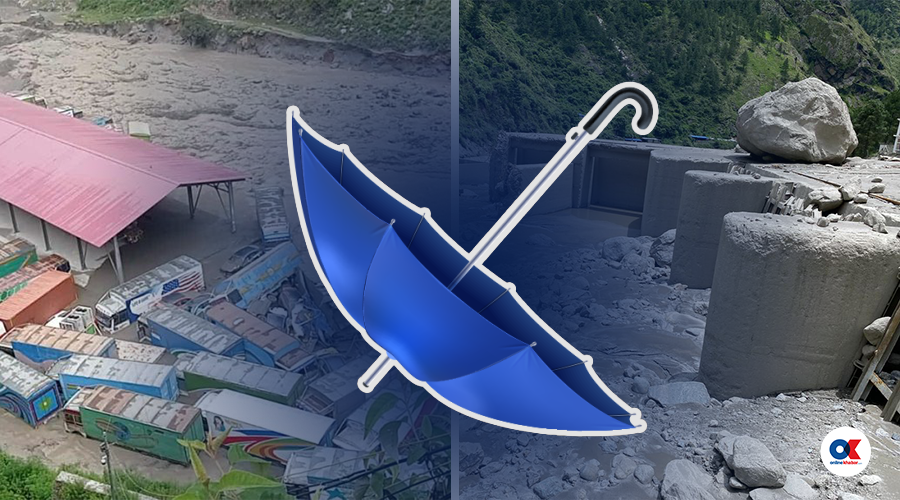
Insured parties are likely to receive advance payments for damage caused by the devastating August 27 flood. Stakeholders have suggested that advance payment is also necessary to help begin reconstruction of the unusual damage caused by the flood.
During the Gen Z movement on September 8-9, insurance companies similarly assessed losses and provided 50% advance payments. At the time, Nepal’s Council of Ministers had directly ordered advance payments, after which domestic reinsurance companies also provided advance payments to insurers, who then paid victims.
Sushil Dev Subedi, Executive Director of the Nepal Insurance Authority, said advance payments were easier at that time specifically because the Council of Ministers had made the decision.
“There will be no problem making advance payments to affected policyholders in the Rasuwa flood either,” Subedi says. “Under Section 10 of the Insurance Claim Payment Guidelines 2081, up to 50% of the estimated liability can be paid in advance; insurance companies can do this accordingly.”
Subedi said the Authority will provide necessary facilitation for advance payments, adding that a Council of Ministers decision would make the process even smoother.
If the government decides to direct the state-invested Nepal Reinsurance Company to act, that company would face similar pressure to make advance payments. Nepali insurance companies are required to reinsure 20% of their business with Nepal Reinsurance, which adds to that company’s responsibility in such situations.
In the case of the Gen Z movement, the Council of Ministers had directly ordered a 50% advance payment of liability, after which reinsurance and insurance companies paid policyholders up to that amount.
Sunil Ballav Panta, Secretary General of the Non-Life Insurers’ Association, said damage from the Rasuwa flood has been seen in hydropower projects, access roads to those projects, vehicles, transit facilities, and other means of transport.
“We still haven’t identified exactly what insured properties have been damaged by the flood,” Panta says. “There’s no information yet on livestock either. Insurance issues extend to bank-financed agricultural and other assets, and accident insurance for workers is also a major component.”
He said that because flood damage assessment follows a fairly standard process, insurance companies and surveyors need to work together going forward. If needed, reinsurers can also assist with assessment, so there shouldn’t be major problems. Panta noted that since human rescue and loss mitigation are currently the priority, property valuation and damage details haven’t yet been compiled.
Whether claims will be paid depends partly on assessing the condition of hydropower project machinery and equipment. Payment will also depend on whether a project was fully or partially destroyed, that is, whether only some equipment was damaged or the loss was total.
Since damage assessment requires mobilising experts, work begins as soon as insurance companies and surveyors reach the flood site. Panta noted that the Rasuwa flood is not the first such disaster Nepali insurers have handled.
“What insurance companies look at is evidence and process,” he says. “There must be evidence, the process must be followed correctly, and we need to make that easier.”
He added that procedural hurdles could cause some delays, and that in some cases, the person entitled to claim may not even be alive, which could further extend timelines.
Another insurer noted that because hydropower projects carry high risk, insurance companies keep their own exposure to such risk relatively low. According to this person, insurers can retain risk up to a maximum of 5% of their net worth and transfer the rest to reinsurance.
Per the “Insurer Reinsurance Directive 2080,” insurers must reinsure at least 20% of the value of policies they issue directly through Nepal Reinsurance Company, with the reinsurer taking its determined share as set by the Authority.
Under the same directive, insurers must reinsure based on their net worth according to policy type. For each policy or risk, a life insurer’s retention within Nepal cannot exceed 0.5% of its net worth, while a non-life insurer’s cannot exceed 5%.
Insurers must also obtain adequate catastrophe reinsurance for the portion of risk they retain under each policy. For catastrophe reinsurance agreements, the directive specifies that a life insurer’s net retention should not exceed NPR 100 million, while a non-life insurer’s should not exceed 10% of net worth.
After ceding the mandatory 20% of their business to the domestic reinsurance company, insurers retain part of the remaining 80% based on their capacity, and cede the rest, beyond what they can bear, to other reinsurers, domestic or foreign. This suggests that a large share of claims for hydropower project damage from the Rasuwa flood will likely come from foreign reinsurance companies.