
Kathmandu, August 31
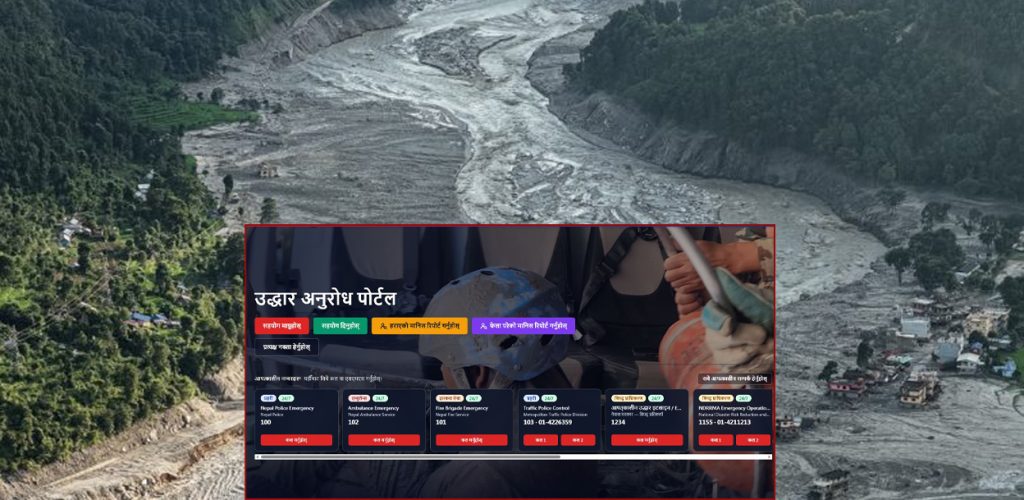
The Nepal government has launched a rescue request portal with a focus on people affected by the Rasuwa floods. Developed in coordination with the Ministry of Physical Infrastructure, the portal is managed by the National Disaster Risk Reduction and Management Authority (NDRRMA). It allows users to submit details of people missing in the floods.
The government introduced the portal to facilitate rescue efforts. It includes contact numbers for Nepal Police, ambulance and fire services, the disaster authority, the Red Cross and other support organisations. Clicking the call button next to a number directly opens the phone dialler for mobile users. Below this is a QR code for the Prime Minister’s Disaster Relief Fund, through which people can send financial assistance.
The portal also displays details of flood victims. However, the data displayed on the government’s rescue portal appears confusing and has created confusion among the public. Posts citing its figures have been circulating on social media, where the numbers have created an alarming impression.
At the time of preparing this report, the portal showed 17,098 reports of missing persons, while 12,819 people were listed as still missing. Many people have been sharing these figures as official statistics.
The figures labelled as reports of missing persons and those listed as people still missing have further added to the confusion. The data shown on the portal does not match the figures officially released by the government through the disaster authority.
Apart from missing persons, the portal also displays reports of people found, the number of people awaiting reunification with their families, and cases marked as resolved. It also shows a figure of 6,637 under “reports in the last 24 hours,” although it is unclear what type of reports this number refers to. It is not immediately clear whether the figure relates to people found, rescued or another category.
The portal also displays figures for missing children and senior citizens. While some people have shared these numbers as official statistics, others have questioned the unusually high figures.
However, a disclaimer below the data warns that the figures may differ from the actual situation.
“The data have been collected based on public complaints and reports. As the same person may be reported more than once in different circumstances, the actual number of individuals may be lower than the number displayed,” the notice states.
Anyone can upload details of a missing person to the portal. Members of the public can also submit information about people who have been found or stranded. This is one reason why the portal may display unusually high figures.
How does it work?
The government’s digital portal, launched to make rescue, search and relief distribution more effective during disasters, has in some cases created duplicate entries and statistical confusion.
According to an official at the Prime Minister’s Secretariat, differences in the figures displayed by the portal are linked to its technical system and the way data are collected.
Anyone who learns that someone is missing can easily upload the information to the disaster portal. If identical details are entered, the possibility of duplication is very low. However, even minor differences in the spelling of a name or other details can result in the same person being entered again as a separate case. If multiple people submit slightly different information about the same individual, the figures can therefore become inflated.
“If people who know the same person upload the details in their own way, multiple entries can be created for that individual. That is why the figures appear high,” the official told Onlinekhabar.
There is another source of information feeding into the portal: various groups operated under the government system. According to the Secretariat official, the government has created four WhatsApp groups involving local representatives and officials from responsible agencies. Members share information about missing people, people who have been found and other developments in these groups.
Information posted in the groups is automatically pulled into and updated on the rescue portal by the system. This also increases the possibility of duplicate data.
“The portal was developed at the initiative of the Ministry of Physical Infrastructure to make work easier during this period and enable faster data collection. Officials from the disaster authority and other agencies have access to its dashboard,” the official added.
Because the portal is based on publicly contributed information, its data are fundamentally different from verified statistics released by official agencies. Its dashboard uses colour indicators to show conditions in affected areas, with locations requiring rescue marked in red and areas needing relief assistance marked in yellow.
However, high numbers displayed on the portal alone do not confirm the actual scale of damage or the situation in a particular area. For example, if three people each report that 30 people are missing from the same location, the system could potentially count those reports separately, making the number appear three times higher.
The official urged the public to understand that the portal was created primarily as an emergency coordination and facilitation tool. The government later filters and verifies the information received through the portal before taking action where necessary.
Therefore, for immediate updates and official, verified statistics, the public should rely only on information released through the mechanisms and official channels of the National Disaster Risk Reduction and Management Authority.
“Rather than relying on the figures displayed here, people should trust the statistics published by the disaster authority. The government created this system to make coordination easier and collect information quickly,” the official said. “The government filters the data before acting on it.”