Kathmandu, April 10
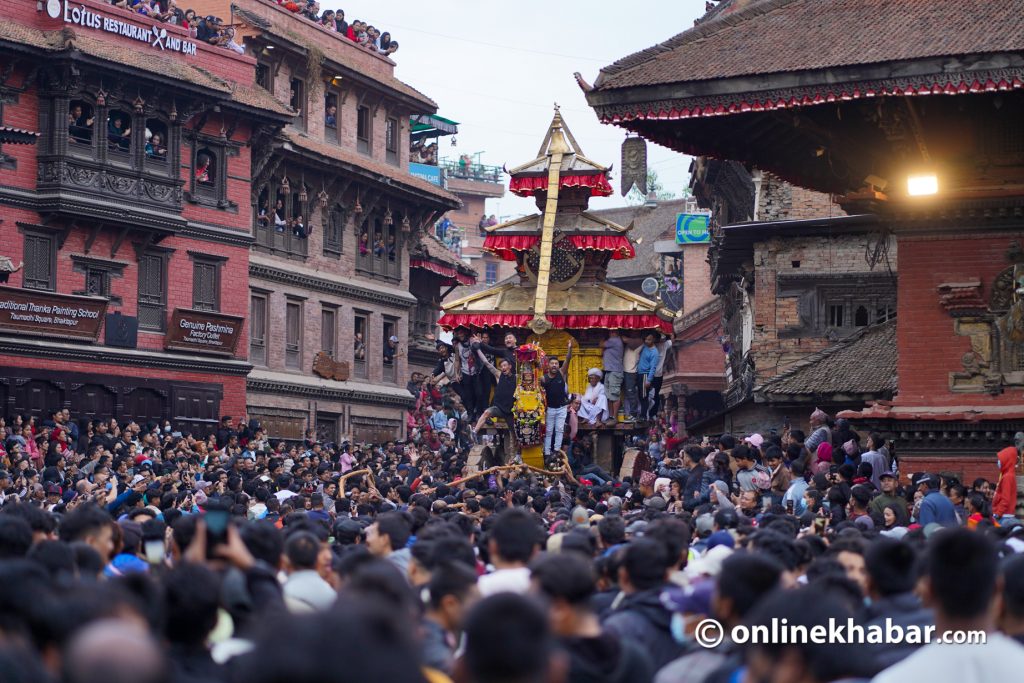
The famous Biska (Bisket) Jatra, celebrated in Bhaktapur for nine days and eight nights, begins today (Friday). The festival starts four days before the Nepali New Year (Baisakh 1) with the pulling of the chariots of Bhairav and Bhadrakali and concludes on Baisakh 5.
This culturally and historically significant festival is believed to date back to the Licchavi period.
The chariots of Bhairav and Bhadrakali are pulled from Taumadhi Square (in front of the five-storied temple), marking the start of the festival. Various rituals and processions take place over the nine days.
Bhaktapur to celebrate for 9 days and 8 nights
The festival continues for nine days and eight nights, with strict security arrangements in place to prevent any untoward incidents.
On the first day, residents of the lower town (Kwone) and upper town (Thane) pull the chariot (Bhailakh) using five ropes in the front and four at the back, attempting to drag it toward their respective localities. This tug-of-war is the main highlight of the festival.
If the Thane side succeeds, the chariot is pulled up to Dattatreya, and later brought back through Tamari to Tekhaphukhu in the Kwone area, before returning it to Ga:hiti, marking the end of the first day’s celebrations.
The traditional route of the chariot procession passes through various localities, including Tamari, Buluncha, Gathkha, Nasamana, Mulakhu, Bansagopal, and Tekhaphukhu in the lower town, and Kwachen, Sakotha, Sukuldhoka, Gomari, Inacho, and Dattatreya in the upper town.
The second day is considered a rest or “zero” day. On the third day, a buffalo is sacrificed to Bhairavnath at Ga:hiti, followed by an official ritual conducted by the Guthi Sansthan. The meat from the sacrifice is distributed as prasad among locals, known as “Syakwatyakwah” in the local language.
On the fourth day, a ceremonial pole (Yosin Dyo) without handles is erected in Kumale Tole at Talako in the morning. In the evening, after tantric rituals, a 55-hand-long pole is raised at Lyasingkhel.
The raising of the Yosin Dyo (lingo) is another major attraction of Biska Jatra, symbolising the farewell to the old year and the arrival of the new one.
Two flags hung on the pole are called Bir Dhwaja and Bishwo Dhwaja. There is a belief that the flags should not be untied midway, as doing so signifies the transition of the year.
The eight ropes used to raise the pole symbolise the Ashta Matrika (eight mother goddesses). After the pole is raised, the Navadurga deities are believed to be present there at night. Special rituals are also performed at the Taleju Temple.
It is believed that witnessing the raising of the pole destroys enemies, which is why the festival is also called the “enemy-destroying festival.” On this day, the chariots of Bhairav and Bhadrakali are taken to Lyasingkhel.
On the fifth day, which marks the Nepali New Year (Baisakh 1), large crowds gather at Chupinghat and Lyasingkhel from early morning. Devotees visit and worship Bhairav, Bhadrakali, Betal, and the Yosin Dyo, dressed in traditional attire and accompanied by musical processions.
A cock is sacrificed to Betal. In the evening, after rituals by Bhairav priests, the ceremonial pole is brought down.
Soon after, the chariots of Bhairav and Bhadrakali are pulled to Ga:hiti and made to collide, marking the “Sangam Jatra,” locally known as “Dyo Lwakigu Jatra.” The chariot festival of Goddess Dumaju at Taleju is also observed.
On the sixth day, processions of Mahakali and Mahalaxmi take place. On the seventh day, Brahmayani and Maheshwari processions are held in Tachapal. The same day also features the Sindoor Jatra of Batuk Bhairav and Jyatha Ganesh at Talako, and the Khatajatra of Pardeshi Bhimsen at Khanla.
On the eighth day, powerful deities of Bhaktapur are brought out from their shrines and placed in courtyards, rest houses, and platforms for worship. Offerings are made in a ritual known as “Dyo Swaga Puja” or “Sagun Jatra,” celebrated throughout the day.
On the final day, the ceremonial lowering of the Yosin Dyo takes place in Kumale Tole at Talako in the morning. In the evening, the Chhuma Ganesh procession is held in Chochhen. The festival concludes with another tug-of-war over the chariot between residents of the upper (Thane) and lower (Kwone) towns, similar to the first day.