
Photos: Bikash Shrestha
For the past several days, an unusual scene has unfolded near Maitighar in the federal capital.
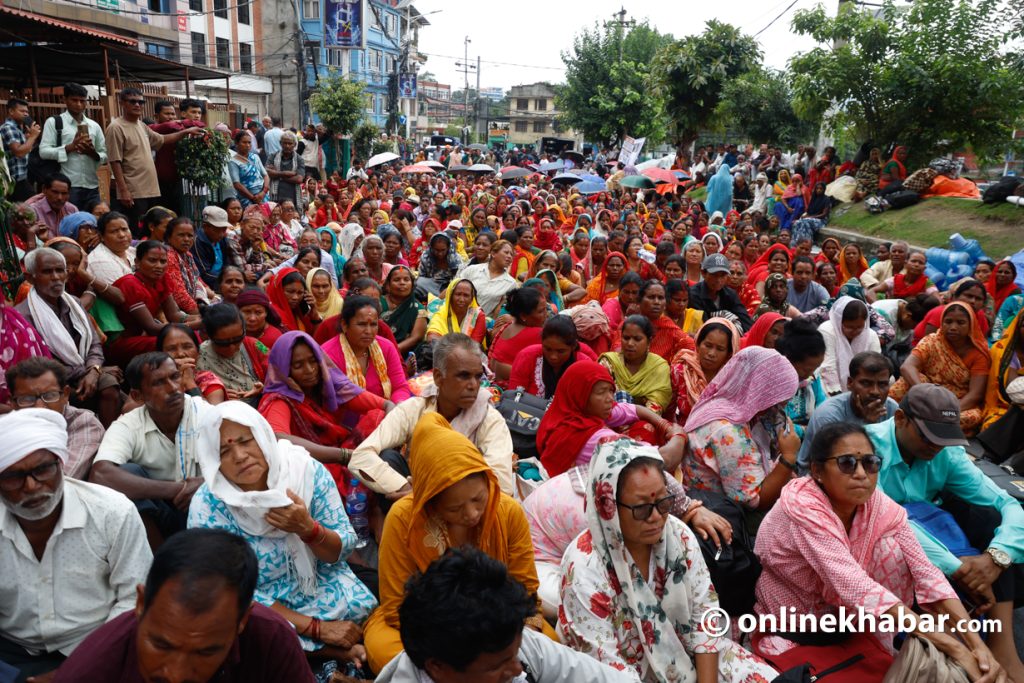
A large crowd of women from Nepal’s Tarai region has gathered along one side of the road. Most are dressed in yellow saris and green blouses, giving passersby the impression that they may be attending a religious event.
But the women have come from various Tarai districts after abandoning their homes and livelihoods, hoping the government—not pedestrians—would understand their suffering and deliver justice.
Even after arriving in Kathmandu, they saw little sign of progress, and they say the government has largely ignored them. Left with no alternative, the women, most of them small-scale farmers from low-income households, began an indefinite hunger strike on Tuesday.
The monsoon has made their protest even more difficult. Whenever it rains, they seek shelter under plastic sheets and tarpaulins. Protesters say security personnel have prevented them from erecting proper shelters, forcing them to cover themselves with plastic during downpours. They cook, eat and sleep on the roadside at Maitighar.
The women, from districts including Siraha, Saptari and Dhanusha, say they were pushed into financial ruin by microfinance institutions and have come to Kathmandu demanding justice.
They say they initially took group-guaranteed loans from microfinance institutions to start or expand small businesses and improve their financial condition. Instead, mounting debt has left many of them landless, forcing them to resort to an indefinite hunger strike as their final option.
One protester said she chose the hunger strike because she would rather fight for justice than take her own life. According to her, around 1,500 victims of microfinance-related debt have died by suicide since 2018.
“Microfinance institutions, which were supposed to improve the lives of the poor, drove us into the hands of loan sharks. The loan sharks made us landless,” she said. “What kind of government cannot even implement a Supreme Court order?”
Many protesters share similar stories.
Shilam Yadav of Bardibas, Mahottari, says she has been dealing with microfinance institutions since 2018 and has now become landless.
A mother of three, Yadav previously ran a cosmetics shop. She says that after borrowing to expand her business, she eventually lost not only her home and farmland but also the shop itself.
She said Divya Microfinance Financial Institution had recently begun operating in Bardibas and was issuing loans based simply on citizenship certificates. After employees told her she qualified, she applied for a loan of Rs 50,000.
“They promised Rs 50,000 and said they would increase the amount if I repaid regularly,” Yadav said. “They never asked about my income, source of earnings or business. They only took a copy of my citizenship certificate and a photograph. A few days later, they called me to the office and handed me Rs 46,000.”
According to Yadav, the institution deducted Rs 4,000 as service and insurance fees but calculated interest on the full Rs 50,000.
Although she invested the money in expanding her shop, business did not improve as expected.
“My monthly sales were only around Rs 5,000 to Rs 10,000, just enough to support my family. Then I had to pay a monthly instalment of Rs 5,000 to the microfinance institution. My income was no longer enough to cover the repayments,” she said.
At the same time, new microfinance institutions continued opening branches and encouraged residents to become members. To repay one loan, she began borrowing from another institution and eventually became a borrower at nearly a dozen microfinance companies.
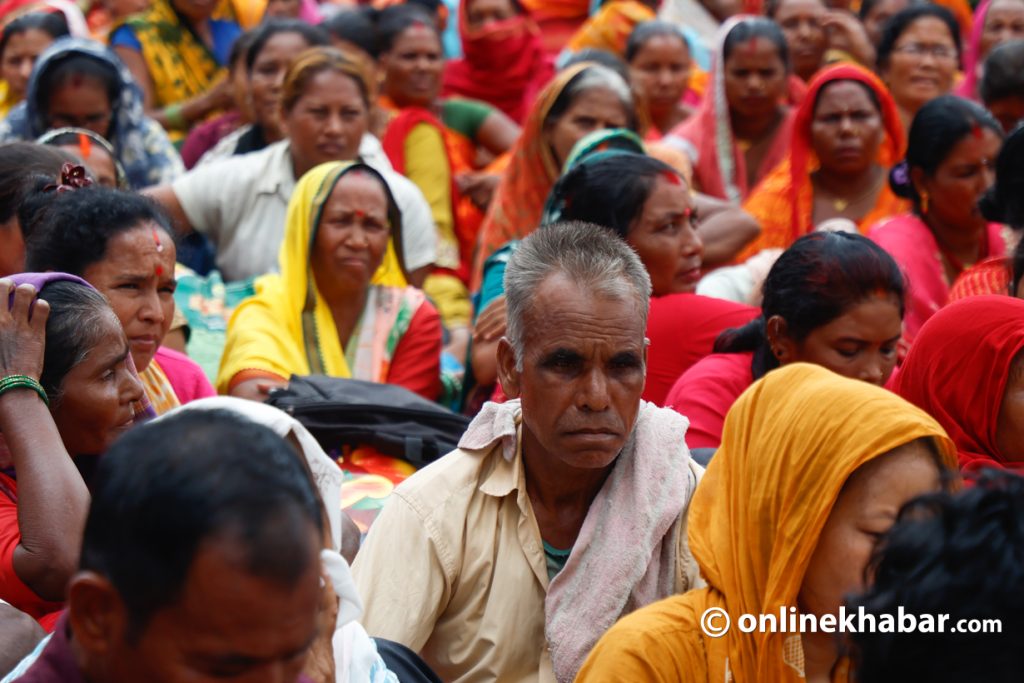
Yadav says borrowers are often accused of deliberately avoiding repayment.
She said the institutions organised borrowers into groups of 10. If one member failed to pay an instalment, the savings of the other nine members were deducted.
When she was unable to make repayments, fellow group members allegedly came to her house and took valuables, including jewellery, a television, cupboards, tables, beds and chairs. Even her livestock was not spared, she said.
“I did borrow money, and I also repaid it,” Yadav said. “But to repay one institution, I had to borrow from another. Eventually I borrowed from eight to ten institutions. In the end, I took loans from loan sharks to settle the accounts. Microfinance institutions created the loan-shark problem. If I borrowed Rs100,000, I had to pay Rs10,000 every week.”
Yadav says she borrowed a total of Rs1.5 to Rs1.6 million. She still owes around Rs1 million. She claims the loan sharks eventually locked her shop.
“My shop remained closed for six months. I also owed Rs 50,000 in rent, and the landlord locked the room,” she said.
She says she lost seven tolas of gold, sold one and a half katthas of land, and now lives in a landless settlement. She also had to sell her shop for just Rs 30,000.
“I have already repaid Rs1.8 million to loan sharks and another Rs700,000 to microfinance institutions, yet I still owe Rs1 million. That is why I joined the protest.”
The experience of Yubraj Rasaili of Mahottari is similar.
He said he borrowed from several institutions, including Asha Microfinance, Forward Microfinance, Mero Microfinance, Bijaya Microfinance, Naya Nepal and Infinity Microfinance, to buy a Tata Sumo vehicle.
Soon after purchasing the vehicle, Nepal entered a COVID-19 lockdown. Rasaili invested his remaining money in vegetable farming, but the lockdown prevented him from operating the vehicle or selling his produce.
“For six months I could not operate the vehicle. I could not take my vegetables to market, and the crops rotted in the fields,” he said.
After the lockdown, he says microfinance institutions stopped issuing new loans and instead pressured borrowers to repay, threatening to seize vehicles, lock homes and even telling them to prepare death certificates.
“I borrowed from loan sharks to keep making repayments,” Rasaili said. He alleges that because of the system, borrowers who take Rs1 million from loan sharks end up repaying as much as Rs10 million through weekly interest payments.
Unable to repay both the loan sharks and the microfinance instalments, he says his house was locked. He eventually sold both his vehicle and his 10 dhur plot of registered land to repay debts.
Tara Pandey of Palpa says she also fell victim to what she describes as deceptive lending practices.
According to her, microfinance institutions prepared loan agreements for Rs100,000 but handed borrowers only Rs80,000 while charging interest on the full amount.
Although the institutions advertised interest rates of around 15 per cent, she says borrowers effectively paid between 36 and 52 per cent.
She initially borrowed Rs100,000 but eventually found herself dealing with 13 different institutions in an effort to repay earlier loans.
Pandey said she sold her residential plot five years ago to clear her debts and has been living in rented accommodation ever since.
“I lost the money I had saved to build a house, and I lost my land as well,” she said.
She had originally borrowed to raise goats. She says loan officers visited her home to issue the loan but returned to collect monthly instalments before a full month had even passed.
According to Pandey, the institutions also used her goat farm as an example while extending loans to others. She believes their main objective was simply to issue as many loans as possible.
Talks between the protesters and the government have been described as positive but ended without a conclusion. The Ministry of Finance said negotiations would resume on Friday, and discussions are continuing.
The protesters say they launched the indefinite hunger strike because the government has failed to implement a Supreme Court mandamus ordering authorities to address the grievances of microfinance victims.
The Supreme Court had directed the government, Nepal Rastra Bank and the Microfinance Bankers’ Association to implement an agreement aimed at resolving the problems faced by borrowers. Protesters say that despite the court’s order and implementation directive, the government has shown little interest, leaving them with no option but to continue their protest despite the rain.