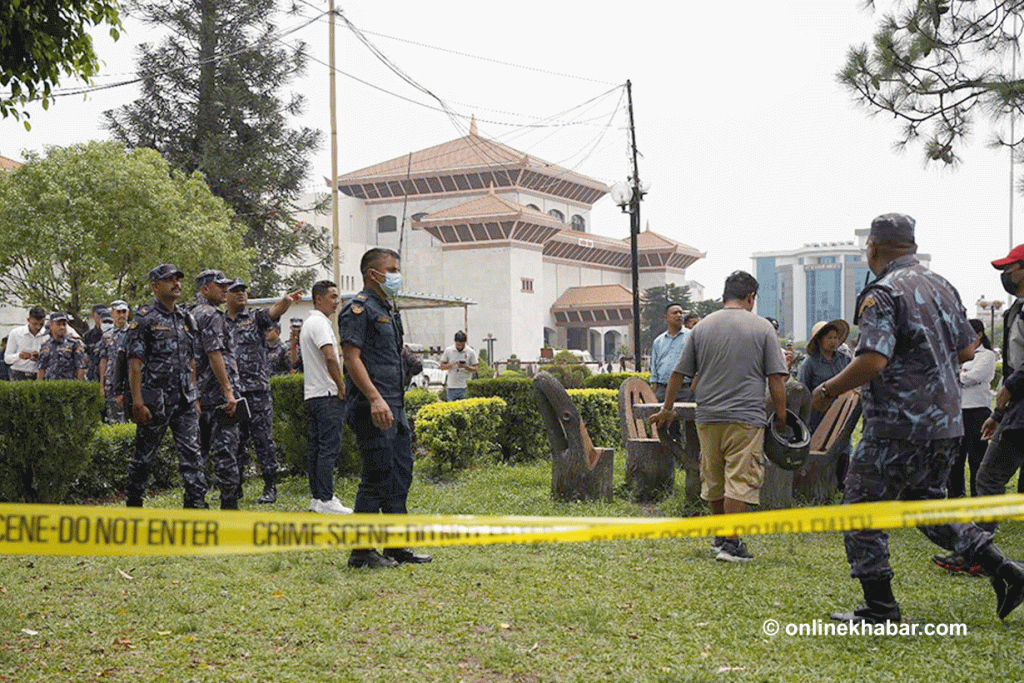


Recently, the country watched Ganesh Nepali die. A 25-year-old ride-hailing driver, carrying debt, supporting a family, preparing for foreign employment, fined Rs 1,000 over a wheel-locked motorcycle. He died at Bir Hospital a day after setting himself on fire outside the passport office. Since then, the argument has been about accountability: the municipal police, the metropolitan city, the Home Ministry. That argument matters and should continue.
But I keep sitting with a different question. How many people reach that same point in this country without a camera nearby? By police count, about 18 a day. Last fiscal year, 6,866 Nepalis died by suicide. The number was down slightly from the year before, and I have seen that reported as good news. Eighteen families a day is not good news.
Here is the statistic I want every policymaker in Singha Durbar to hold. The last time Nepal seriously studied why women of reproductive age die, suicide emerged as the single leading cause. Not childbirth. Not road accidents. Suicide. A fifth of those deaths were girls under 18. That study is from 2008/09, and researchers who have reviewed the evidence since have found no reason to believe the picture has improved. Sit with the second scandal inside the first: the finding is old enough to vote, and we have never repeated the study.
I have spent more than eight years working with women and children in Gandaki, and I can tell you what those numbers look like up close. The girl in our office living with violence at home. The survivor whose legal case will grind on for years while her community whispers. Suicide among Nepali women is rarely a separate problem from the ones we already know about. The research says what our case files say: it travels with domestic violence, with early marriage, with debt, with the particular loneliness of a young wife in a house where she has no allies. Young married women are among those most at risk in this country. That should reorganise how we think about both suicide and marriage.
And yet the official numbers, grim as they are, are almost certainly an undercount. Police data are what we have, and families have every reason not to report. For generations, attempting suicide was treated as a matter of shame and, in practice, punishment. The stigma has outlived the statutes. When a woman dies, communities often find a quieter story to tell. Researchers have been saying for years that the real burden, especially among women, is higher than the record shows.
To be fair, this is not a story of pure government neglect. In December, the Ministry of Health launched the National Mental Health Campaign with UNICEF and WHO, aimed at reducing stigma and helping families know where to seek support. The national suicide prevention helpline, 1166, is free and operational. A national strategy exists on paper. These are real steps, and the people behind them deserve credit.
But I work at the level where policy either arrives or does not, and I want to describe what has actually arrived. Nepal spends less than one per cent of its health budget on mental health. The country has roughly 0.2 psychiatrists per 100,000 people, nearly all of them in cities. More than 90 per cent of people with mental health conditions receive no treatment at all. In most of the municipalities where we work, there is no psychiatrist, no clinical psychologist, and no budget line for the community psychosocial workers who are, in practice, the entire mental health system for a rural woman in distress. When our counsellors visit a ward, we are frequently the first mental health service a woman has ever encountered. That is not a boast. It is an indictment of how thin the safety net is.
So, in the spirit of a government that likes measurable asks, here are three.
First, put the campaign’s money where the districts are. A national campaign that normalises help-seeking is only ethical if help exists when people seek it. Every municipality should have at least one trained, certified psychosocial counsellor with a protected budget line, not a project-funded post that vanishes when the donor cycle ends. We have watched trained counsellors leave the field twice because of funding gaps. Each departure costs exactly the trust that takes years to build.
Second, connect the systems that already touch the same person. The health post treats a woman’s injuries, the police register her complaint, the ward office’s judicial committee handles her case, and none of them screens for suicide risk or refers her to anyone who can help. Ganesh Nepali’s last interactions with the state were enforcement interactions: fines, a wheel lock, an argument. Every frontline official, municipal police included, is a potential first responder to despair, and almost none of them has been given even an hour’s training or a number to call. Judicial committees, one-stop crisis centres, and yes, city enforcement units should have referral protocols to services as standard, not as an NGO’s improvisation.
Third, count better, and count women. A suicide prevention office that relies solely on police mortality data will keep designing policy for a fraction of the problem. Commission a successor to the 2008/09 maternal mortality study. Add community-level surveillance and attempted-suicide data from hospitals. Honest research into why young married women are dying would give the new mental health office something it currently lacks: an accurate map less than two decades old.
Nepal’s young government talks fluently about execution rates and digital dashboards. Good. Then measure this: eighteen a day. The country saw one of those deaths recently and has not stopped talking about it. The other seventeen that day belonged to families who will mostly stay silent. Of all the numbers in this country’s ledgers, this is the one most worth driving down.
If you or someone you know is struggling, the National Suicide Prevention Helpline is 1166. The call is free.