
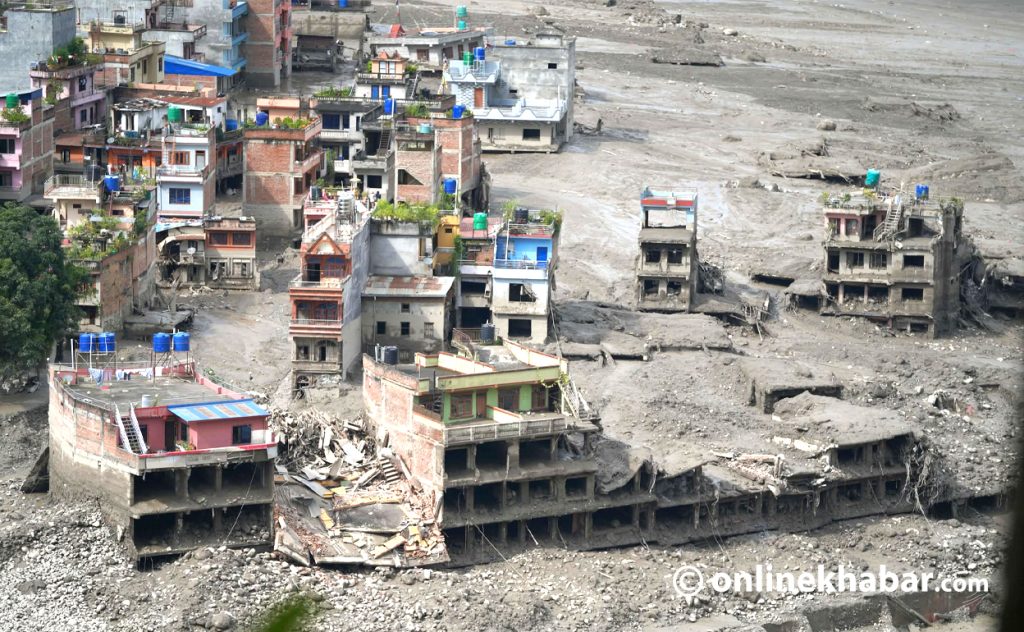
The most expensive consequence of Bhotekoshi was not the flood itself. It was the bill it created.
The government-led Rapid Damage and Needs Assessment placed direct physical damage and economic losses at Rs408.29 billion and estimated Rs723.31 billion for recovery, reconstruction, livelihood restoration, risk reduction and more resilient rebuilding. The second figure is not an invoice already payable by the government. It is an economy-wide estimate. Yet its scale shows how quickly a mountain disaster can become a national public-finance problem.
The comparison with Nepal’s budget makes the burden visible. The Rs723.31 billion recovery estimate is roughly one-third of the federal budget for 2026/27 and more than half of its recurrent expenditure. The Rs408.29 billion disaster impact is close to the entire annual capital budget.
It is also more than three times the revised cost of the Kathmandu–Tarai/Madhesh Fast Track, one of Nepal’s largest national-priority transport projects. Put differently, the estimated recovery requirement could finance more than three expressways at today’s revised project cost, although reconstruction needs and highway costs are not directly interchangeable. The comparison shows opportunity cost, not a claim that the government must immediately pay the full amount.
Reconstruction will arrive through many projects and funding sources over several years, but it can consume fiscal space, administrative attention and development time on that scale. Every rupee redirected to restore a bridge, grid or settlement is a rupee unavailable for a planned school, hospital, irrigation scheme or new road unless revenue, grants or borrowing expand.
The comparison with debt is equally important, but it must be made carefully. Nepal was assessed at low risk of external and overall debt distress before the disaster, with public debt at 48.1 percent of GDP in 2024/25.
Bhotekoshi did not create an automatic debt crisis. The warning is cumulative. Every emergency allocation, revenue interruption, guarantee, distressed public enterprise and delayed development project narrows the room available for the next shock.
The disaster therefore tested whether the state can distinguish private loss from public obligation before political pressure turns one into the other. It also tested whether Nepal can finance reconstruction without repeatedly sacrificing planned development or rebuilding the same exposure.
How physical destruction enters the budget
Every budget tells two stories. One records today’s expenditure. The other hides tomorrow’s liabilities.
Nepal’s bridges, mountain highways and hydropower plants appear in government accounts as completed assets. Increasingly, they should also be understood as contingent fiscal liabilities whose cost becomes visible only when rivers reclaim them.
A destroyed government bridge is a direct public loss. Rescue, temporary shelter and restoration of essential services demand immediate spending. Damage to a state-owned electricity asset can create obligations through ownership, lending or guarantees. A public-private project can return risk to the government through contracts, renegotiation or pressure to maintain an essential service. These costs enter the budget through identifiable channels.
The harder liabilities are implicit. Government may have no prior legal duty to rebuild private homes, rescue uninsured firms or compensate hydropower investors. But support becomes difficult to avoid when households lose shelter, employers cannot restart, banks face impaired loans, electricity supply is disrupted, or local governments cannot restore basic services. A private loss can then migrate onto the public balance sheet through relief, subsidies, credit support, recapitalisation, guarantees or reconstruction grants.
Disasters also weaken the revenue side. Interrupted trade, tourism, transport, power generation and business activity can reduce customs duties, taxes, royalties and local revenue just as public expenditure rises. Government must then draw on reserves, reallocate the budget, mobilise grants and concessional finance, or borrow.
The fiscal cost is therefore not one reconstruction number. It is the combined movement of expenditure, revenue, public assets, guarantees, state enterprises, financing needs and postponed priorities.
Nepal’s missing fiscal architecture

Nepal does not lack climate institutions. It lacks a coherent fiscal architecture that connects them.
Today, disaster funds, the Climate Budget Code, the Climate Change Financing Framework, contingent credit, fiscal-risk reporting and investment appraisal through the National Project Bank largely operate as parallel mechanisms. The next phase of reform is not creating another institution. It is making the existing ones function as one system.
That system should begin with a common view of exposure: what government owns; what federal, provincial and local bodies are responsible for; which guarantees and contracts exist; what support may become politically unavoidable; and which financing instrument responds at each level of loss.
Hazard information must reach project approval, asset registers, annual budgets, debt strategy and the Fiscal Risk Statement. The National Project Bank should then serve as the front door of this architecture. A project that cannot demonstrate its exposure, resilience standard, maintenance plan and lifecycle cost should not enter the budget merely because its construction financing is available.
At the other end, fiscal-risk reporting should show the stock of vulnerable assets and the liabilities attached to them. Between those two points, budget codes and financing frameworks should track whether spending reduces exposure or simply replaces damaged structures.
Otherwise, Nepal will continue identifying physical risk in technical reports while discovering its fiscal meaning only after disaster.
International practice offers bounded lessons. New Zealand links infrastructure risk with investment and asset-management decisions. Japan’s river-basin approach combines prevention, exposure reduction, land use, infrastructure and preparedness rather than treating each damaged structure separately. Fiji uses layered disaster-risk financing, including contingent credit, while recognising that finance cannot substitute for prevention.
Nepal does not need to copy these systems. It needs to connect risk information, investment decisions and pre-arranged finance with equal discipline.
Immediate reforms
First, strengthen fiscal-risk disclosure. The annual Fiscal Risk Statement should include a climate- and disaster-risk annex separating direct public losses, explicit guarantees, contractual obligations, implicit support expectations, revenue effects, public-enterprise and public-private partnership exposure, and provincial and local risks. Scenario ranges would be more credible than a single headline figure and would clarify which losses remain private, which are shared and which may reach the state.
Second, make resilience an investment gate. The National Project Bank already filters and prioritises major public investments; climate-risk screening should become an approval condition rather than an optional technical review. Roads, bridges, energy facilities, irrigation systems and public buildings should not advance to budget approval without documented hazard exposure, resilient design, maintenance responsibility and climate-adjusted lifecycle cost.
Rebuilding the same vulnerability is not reconstruction. It is the creation of another public liability.
Reconstruction creates visible political rewards. Prevention creates invisible success. That is the political economy behind Nepal’s repeated preference for repairing assets after failure rather than financing resilience before it. An investment gate matters because it shifts prevention from ministerial discretion to a condition for receiving public money.
Medium-term reforms
Third, complete layered disaster finance. Frequent, lower-cost shocks should be covered through predictable contingency appropriations and disaster funds. Severe events require pre-arranged concessional credit and rapid grant mobilisation. Insurable assets need carefully designed risk-transfer mechanisms.
The objective is not to socialise every loss, but to decide in advance which instrument responds, at what threshold and who retains the remaining risk.
Fourth, connect intergovernmental responsibility to fiscal capacity and asset ownership. Cost sharing among federal, provincial and local governments should reflect who owns the asset, who controlled its design and maintenance, who can finance recovery and whether resilience standards were followed.
Reliable asset registers and transparent assessments are essential. Without them, fiscal federalism can distribute money after disaster without distributing responsibility before it.
Bhotekoshi did not prove that Nepal is entering a debt crisis. It demonstrated something more useful: physical destruction can move rapidly into expenditure pressure, revenue loss, contingent liabilities and difficult budget choices.
The policy response should therefore extend beyond relief and engineering. Nepal must decide how risk is recorded, priced, financed and prevented across the entire public-investment cycle.
The next river will not ask whether Nepal created another policy. It will ask whether today’s assets were designed to survive tomorrow’s climate.