

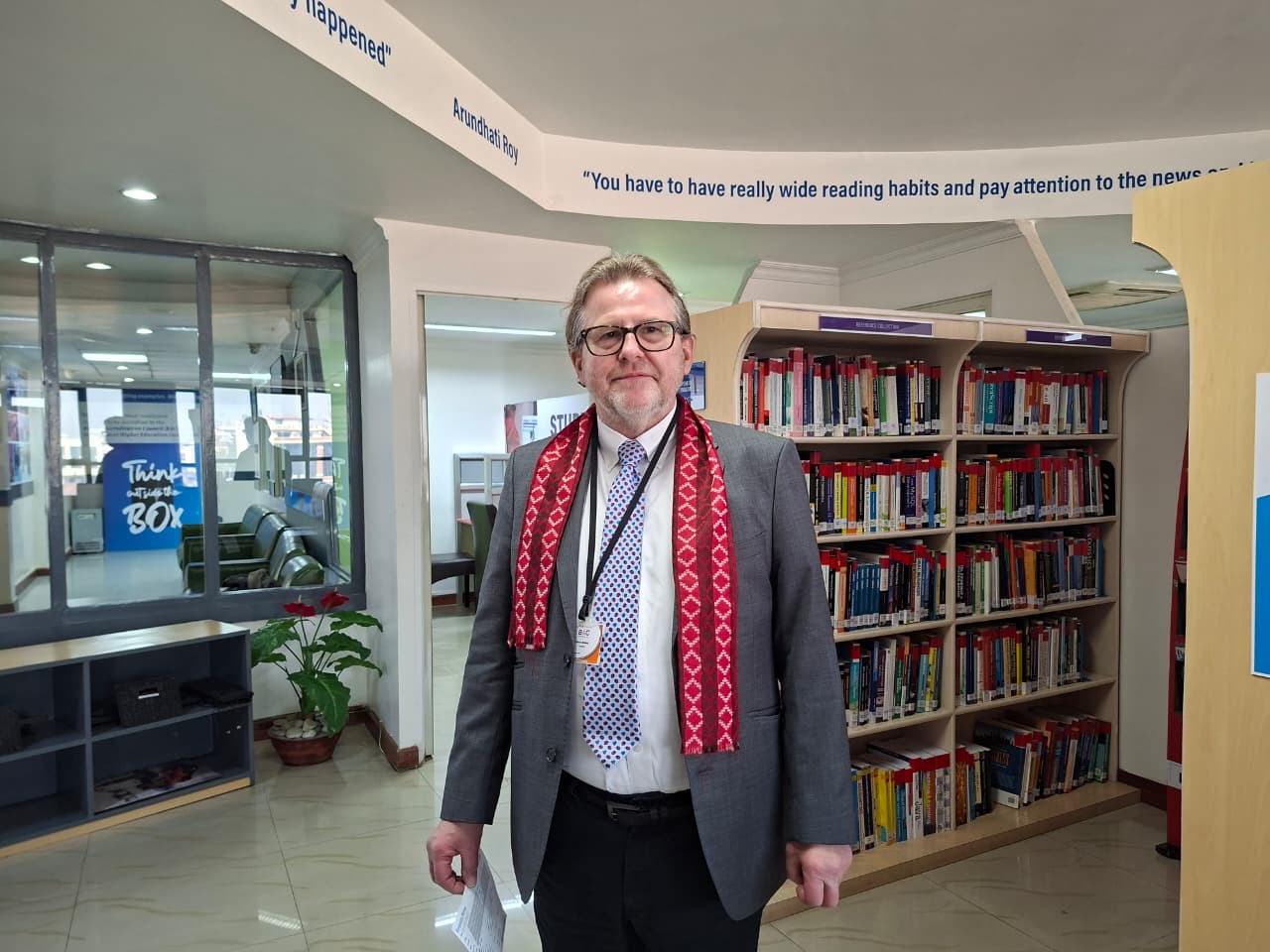
Simon R. Bellamy is a Senior Inspector at the British Accreditation Council (BAC). As part of his role, he inspects a wide range of independent institutions in the UK and internationally. This includes independent colleges of higher education, further education institutions, short-course providers, and online learning providers.
He is currently in Nepal as part of a team, inspecting The British College, Kathmandu. Recently, Onlinekhabar spoke with Simon, where he discussed the roles and responsibilities of a BAC inspector, the challenges posed by AI in the academic sector, and more.
Excerpts:
As an academic inspector, what will you be doing?
Here we will be interviewing the management, students, and staff. We will be looking at the documentation and also the infrastructure of the college.
I inspect the academic aspects of the institutions and all team members will observe teaching and learning as what the students receive is the most important part.
As an education inspector, what are the areas you and your team look after in an academic institution?
We look at several key aspects. We assess the management structure and examine the premises to ensure they are fit for purpose. We evaluate the quality of teaching and learning, along with the quality and availability of resources. Perhaps the most appropriate term to summarize this is the quality of the student experience. We also review the partnerships the institution maintains.
Could you tell us about BAC’s process for preparing the report of an academic institution?
Once we complete the inspection, we prepare the report and send it to BAC’s editor. Then it comes back to the inspected college for a factual check to ensure that details such as student numbers and other information are accurate.
After that, it goes to the accreditation committee, which makes the final decision on accreditation.
The presence of AI is expanding across every sector, and education is no exception. How do you view the challenges that AI poses to the education sector?
Yes, I think a major challenge ahead is the use of AI to produce students’ work and the way it is becoming a research tool. AI can generate essays, but it’s usually easy to spot them because it often invents references when it cannot find real ones. Students may use AI to support their research for assignments, but they should not use it to write the assignments themselves. AI is not good enough for that.
To what extent is AI considered reliable in academic research and writing, and how do educators detect its use?
At the moment, although AI is widely available, it can be used only as part of the research process; it is not yet reliable beyond that. Teachers in the UK can easily identify AI-generated work. They tell students that AI can support their research, but part of using digital research tools involves checking for bias and ensuring information is not fabricated. Students must approach AI-generated content with caution.
Moreover, all university assignments are run through plagiarism-detection software, which can also identify AI-generated content.
We can incorporate AI, but ultimately it will just be another tool. It will be interesting to see how it evolves.
Since you have extensive experience as an education inspector, in your view, what makes an academic institution good?
Just one thing: it should meet the needs of its students. It should address their needs and aspirations, and take responsibility for ensuring that students can succeed to the best of their ability. I think that is what an educational institution is meant to do.