
What happens when women choose to shape themselves? The film Shape of Momo, directed by Tribeny Rai and co- written by Rai and Kisley, presents the tragic reality that, in a society where sons are often valued more than daughters, a capable young woman like Bishnu continues to struggle for recognition and belonging within her community. Ultimately, she is compelled to leave her home and return to the city. Through Bishnu’s journey, the film explores how deeply gender expectations shape women’s identities and how society often resists women who refuse to conform. Women are often expected to fit into roles predefined by society. When they refuse, they may be ignored, judged or compared to men as being ‘like a son’. The Shape of Momo, using the metaphor of ‘like a son’, portrays how society attempts to shape women into socially accepted identities. From childhood, women are taught how to walk, dress, smile, speak, and behave. They are expected to master domestic responsibilities, particularly cooking and caregiving, while remaining within social boundaries. Any woman who dares to move beyond these prescribed limits is often labelled differently, sometimes described as being “like a son,” a phrase that reinforces the belief that strength, leadership, independence and safety belong primarily to men.
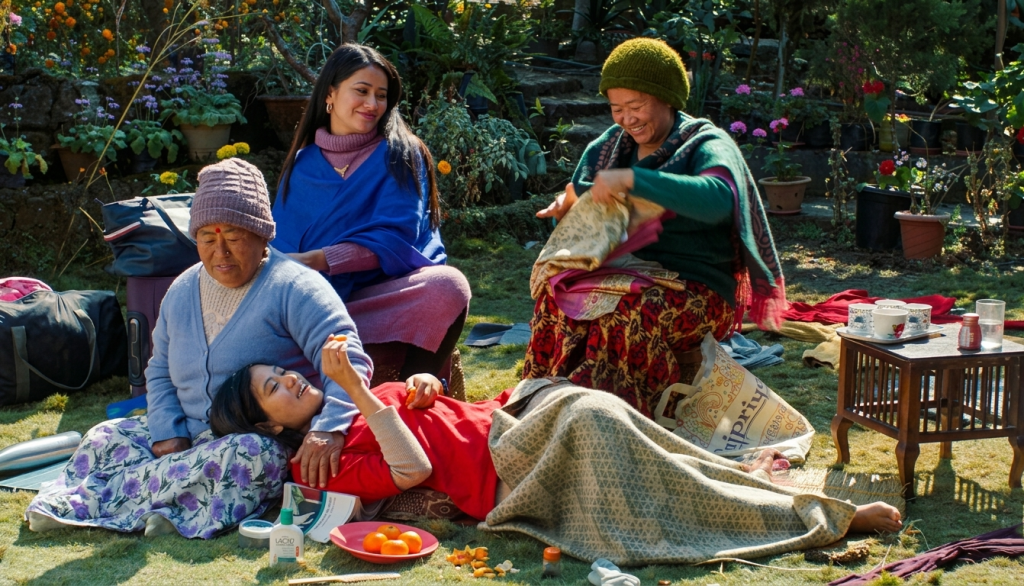
The film’s protagonist, Bishnu, stands as a symbol of resistance against patriarchy. Defying the conventional image of an obedient daughter, she is independent, manages family finances and tries to handle property matters. After returning from Delhi to her hometown, Bishnu lives with her grandmother, mother, and sister in a household where no adult male figure is present. Bishnu negotiates prices, discusses financial matters, concerns herself with land and property issues, visits markets independently, and refuses to limit her ambitions. Yet these qualities, which would be admired in men, become sources of discomfort for those around her. Although the men in her community rarely voice their disapproval openly, their patriarchal gaze, expressions, and interactions reveal an uneasiness with Bishnu’s lifestyle. They expect her to remain within conventional feminine boundaries. Bishnu’s lifestyle is not presented as an act of rebellion; however, her independence and refusal to conform to conventional norms keep her in constant tension between her individuality and the values of her community.
Equally compelling is the portrayal of Bishnu’s mother. Despite carrying the immense responsibility of raising two daughters while caring for her elderly mother-in-law, she remains resilient and emotionally strong. Yet the film shows that the absence of a man in the house continues to be perceived as a vulnerability within the community, particularly by the grandmother, who talks about emerging technologies that could potentially transform a daughter into a son. To project the presence of male protection, the mother hangs men’s clothes outside the house. This seemingly simple act becomes a powerful metaphor for a society where security is imagined through masculinity. The scene reveals how deeply patriarchal assumptions are embedded in everyday life, shaping not only men’s perceptions but also women’s sense of safety and social status.
The filmmaker’s directorial strength lies in her ability to tell an unconventional story through seemingly ordinary events. Rather than presenting dramatic confrontations, she allows everyday conversations, silences, and routine chores. The film reveals how gender discrimination often operates not through violence but through subtle expectations, social judgments, and rooted cultural norms. Cinema often becomes most powerful when it illuminates the ordinary realities hidden within everyday life. In Shape of Momo, the writer-director crafts a subtle yet compelling narrative that explores patriarchy, gender expectations, and the invisible burdens placed upon women in society. Set against the stunning landscape of Sikkim, the film tells a story that resonates deeply with the lived experiences of women across Nepal and the South Asian region. Shape of Momo uses visual metaphors, such as Bishnu’s morning walks and her commitment to her sister’s education, to symbolise the quest for freedom, independence and progress. The woman who remains within the boundaries of her home for daily walks symbolises the social constraints that continue to define and restrict women’s lives. Bishnu later observes the woman from her community stepping out of her home and walking along the road.
One of the film’s most revealing moments occurs when Bishnu negotiates with the family over money and land. A young boy witnesses her bargaining and scolding his parents, something he finds difficult to accept from a girl. He responds by rejecting the fruits she offers later and walking over the broken glass pieces. Through these interactions, the film illustrates how societal expectations are internalised from an early age. Bishnu ultimately fails to satisfy either the expectations attached to both male authority and traditional femininity. Even her boyfriend’s presence is considered more valuable and reassuring than her own. Falling increasingly alienated and unwelcome, she eventually decides to return to Delhi.
The cinematography significantly enhances the narrative. The misty hills, winding roads of Sikkim and domestic spaces create a visual language that mirrors the emotional landscape of the characters. The careful use of light and shadows often occupies the frame alongside the characters, symbolising the invisible pressures of tradition and social surveillance. Natural light enhances the film’s groundedness and creates authenticity, while the changing textures of the landscape reflect the tensions between freedom and social restriction. Nature itself functions as more than a backdrop. The mountains, valleys, and open skies stand in contrast to the restrictive social environment surrounding Bishnu. This visual juxtaposition shows the irony of women living amidst vast natural freedom while remaining constrained by rigid social expectations. The filmmaker’s thoughtful attention to colour, composition, and environmental details enriches the film’s emotional depth and reinforces its thematic impact.
What makes Shape of Momo particularly relevant is its resonance with contemporary Nepali society. Although women in Nepal have achieved significant progress in education, employment, and public spheres, many traditional attitudes remain intact. Women are still judged based on their appearance, behaviour, career choices, and personal freedom. Families often celebrate daughters who shoulder responsibilities yet hesitate to grant them equal authority and autonomy. The phrase “she is like a son” remains common, revealing society’s reluctance to value women’s capabilities on their own terms. Shape of Momo therefore extends beyond the story of one family in Sikkim. It becomes a reflection of broader South Asian realities, where women continuously negotiate between personal aspirations and social expectations.
Through Bishnu’s journey, the film invites viewers to question the cultural norms that define femininity and to reconsider why independence in women is still perceived as exceptional.
Shape of Momo is a quiet but powerful cinematic intervention. It does not shout; instead, it observes, questions, and challenges. Every shot in the film carries meaning. The careful use of wide shots, mid-shots, and close-ups proceeds alongside the characters’ development, gradually drawing the audience into the film’s subtle and deliberate narrative progression. Through performances, thoughtful storytelling, cinematography, and sharp social commentary, the film offers a profound exploration of gender, identity, and belonging. More importantly, it compels audiences to reflect on how societies continue to shape women.
In an era when conversations about gender equality are increasingly visible and vocal, Shape of Momo serves as a timely reminder that true social transformation requires more than policy reforms. It urges society to reconsider the deeply rooted societal expectations that continue to limit and define women’s lives. Shape of Momo reveals how deeply the desire for a son has influenced social attitudes, perceptions of security, and the notion of worth. It invites audiences to question the norms that continue to define women’s identities and to imagine a society where women are valued on their own terms rather than in relation to men.