

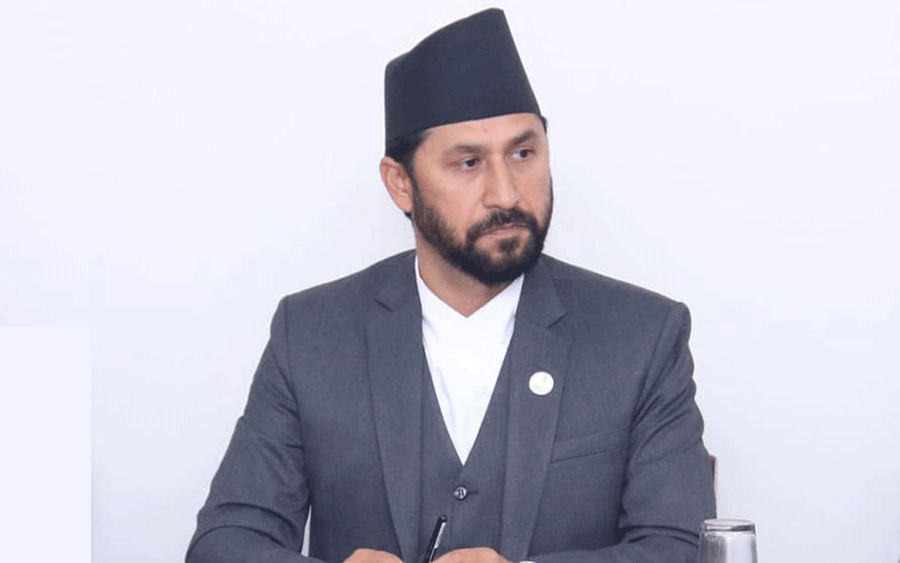
The recent election results shed light on a paradox: while political elites and the institutions they have long controlled portray Rabi Lamichhane as an offender, many ordinary citizens, especially younger generations, view him as a victim.
This paradox made me reflect on my own understanding of law and justice. I recently watched an episode of Inside the Bunker with Gagan Thapa, where he repeatedly emphasised his belief in the “rule of law.” It made me question how many Nepalis and I perceive “law” as something that exists strongly on paper but far less so in practice, often enforced unevenly and unfairly.
In a democratic country like ours, especially in high-profile cases, court decisions and legal proceedings should ideally resolve disputes and establish clarity on guilt and innocence. Instead, they often provoke doubt and scepticism, leaving us with an unsettling feeling that something important has been overlooked. Rather than restoring confidence, they make us question whether justice has been fully and fairly served.
The crisis of trust has existed for as long as I can remember. One recent example that brought this into sharp focus is the public response to Rabi Lamichhane’s legal cases. The scepticism surrounding the case is not merely emotional, biased, or uninformed; rather, it is rooted in long-standing institutional inconsistencies.
Lost trust in the system
People of our generation, Gen Z, did not choose to distrust democratic institutions; we learned it over time. We grew up watching public scandals dominate headlines briefly, only to fade without meaningful resolution. Investigative commissions were often formed, but rarely led to consequences. Over time, we became accustomed to this pattern, with little hope for accountability or clear explanations.
Public perceptions of Lamichhane reflect this history. Despite court proceedings regarding his custody and release, he is not simply seen as an alleged offender; many believe he has been selectively targeted. While this perception is often dismissed as loyalty or populism, it also reflects a broader awareness of how aggressively one individual can be pursued while others are treated with caution.
The concern here should not be whether Lamichhane is guilty or innocent; that is for the courts to determine. The pressing issue is why a growing number of citizens no longer trust legal outcomes to present the full picture of wrongdoing.
The unresolved cooperative crisis
The collapse of Nepal’s cooperative sector lies at the heart of this distrust. For decades, cooperatives were promoted as safe, community-based financial institutions. Their failure wiped out the life savings of many citizens and caused billions of rupees in losses.
This collapse stemmed from widespread irregularities and, in many cases, outright fraud. Yet there has been neither a comprehensive, independent investigation into how this occurred nor sustained scrutiny of regulatory failures, political protection, institutional oversight, or financial flows. Despite the scale of harm, the response has remained fragmented and selective. This absence of accountability has not gone unnoticed.
Shift of focus from systems to individuals
The cooperative crisis was a systemic failure and should have been treated as such. Instead, public attention narrowed to a handful of individuals, most prominently Rabi Lamichhane, a rising political figure challenging the status quo. The institutional mechanisms that enabled the fraud were largely overlooked, as public and media focus centred on his alleged actions.
For Gen Z, constantly navigating a stream of information through headlines, court documents, social media, and YouTube analyses, the issue is not only what is reported but also what is repeatedly ignored. Questions of proportionality arise when systemic losses of billions remain largely unexplained, while the legal battle of a single figure dominates discourse.
The cost of selective accountability
Nepalis are increasingly aware that individuals with greater political and economic influence often avoid scrutiny. We have seen how cooperative operators with strong political connections face little accountability, how regulatory failures go largely unpunished, and how political actors who may have indirectly benefited escape sustained examination.
In such a context, the law begins to appear selective rather than neutral. When those with power repeatedly evade scrutiny while one individual absorbs overwhelming attention, public trust erodes. Selective justice does not inspire confidence.
Even serious allegations can appear politically motivated rather than proportionate when systemic accountability is absent. This does not excuse wrongdoing, but it raises a critical question that courts alone cannot answer: why does accountability seem to apply unevenly?
Although mainstream media has reported extensively on Lamichhane, it has not pursued the broader cooperative crisis with equal rigour. This creates a clear impression: focusing on one controversial figure is easier, while confronting powerful political and economic interests carries significant risk.
Legal decisions and the loss of moral weight
In Nepal, the connection between legal and moral legitimacy has weakened. Citizens have repeatedly observed laws applied rigorously in some cases, but cautiously or not at all in others.
Several high-profile cases, such as the Bhutanese refugee resettlement scam and the Giribandhu Tea Estate controversy, have reinforced this perception, regardless of legal outcomes. At least, this is how many members of the public interpret them.
As a result, people can believe that Lamichhane may have violated the law, while also believing that others responsible for equal or greater harm remain protected. This dual belief reflects accumulated public experience.
Among younger audiences, Lamichhane’s case fits a familiar narrative: a disruptive figure carrying hopes for change becomes entangled in legal battles, while the broader system that enabled wrongdoing remains largely untouched. When mainstream media fails to provide structural context, people turn to alternative sources to fill the gap—sometimes responsibly, sometimes not, but often more convincingly than silence.
A case reflecting a larger breakdown
The erosion of trust in Nepal’s institutions is not ultimately about one individual. Rabi Lamichhane’s case reflects a broader systemic crisis.
If cooperative fraud had been investigated comprehensively, if regulators and political actors had faced appropriate consequences, and if the media had consistently followed systemic issues rather than individuals, his legal troubles might have been perceived as procedural rather than symbolic. They feel symbolic because the system surrounding them remains insufficiently examined.
Accountability as the basis of trust
Rabi Lamichhane’s legal cases will eventually conclude. However, addressing the deeper crisis requires confronting the institutional failures that made such situations possible.
For democracy to function effectively, selective accountability must end. The law must be applied consistently and fairly.
The recent electoral success of the Rastriya Swatantra Party reflects this same crisis of trust. Support for the party, particularly among younger voters, is not merely about one leader, but an expression of broader frustration with traditional political structures that have repeatedly failed to ensure accountability.
The election results signal a demand for reform within existing institutions. For citizens to regain trust, consistency, transparency, and equal application of the law, regardless of political or economic status, is essential.
Until accountability becomes structural rather than selective, verdicts may continue to be delivered, but public belief in them will continue to erode.