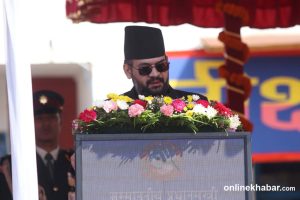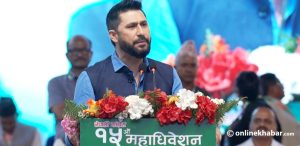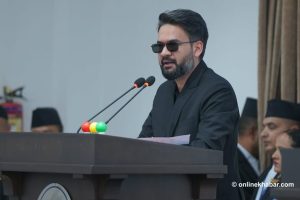

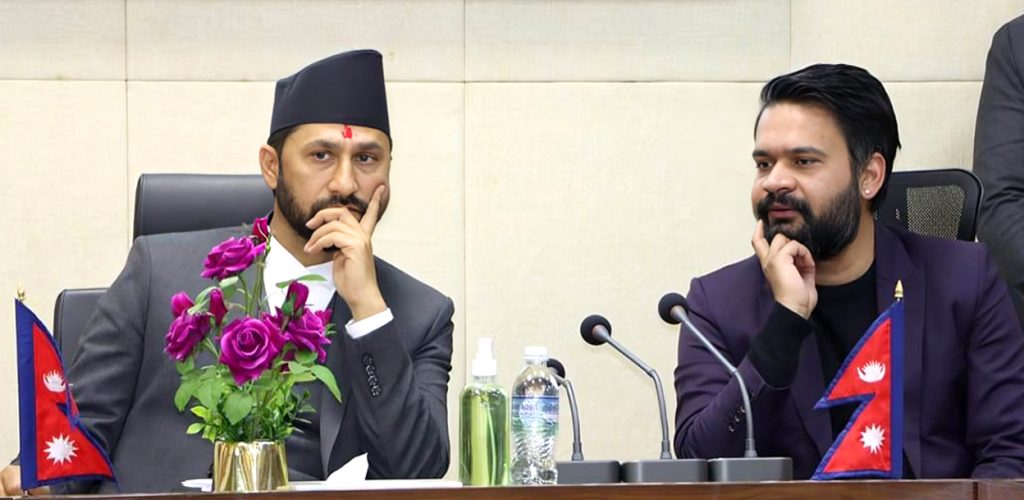
On the early morning of Sunday (December 28), the Rastriya Swatantra Party (RSP) and Kathmandu Mayor Balendra Shah (Balen) signed a seven-point unity agreement. According to the agreement, Rabi Lamichhane will lead the Rastriya Swatantra Party, while Balen will be put forward as the future prime minister.
After RSP Chair Lamichhane was released from custody on December 18, he intensified his political engagements. Immediately after being released from Nakhu Prison, he held various political meetings and party activities. He then met Balen several times, and on December 25, Lamichhane and Balen held one-on-one talks as part of discussions on building an alternative political force.
Now that the two sides have decided to unite, the news has triggered political reverberations across Nepal. The RSP-Balen unity has so far received mixed reviews. Mostly, individuals associated with other parties are criticising their coalition.
With this merger, traditional parties have started feeling challenged.
After the two sides signed the agreement, CPN-UML General Secretary Shankar Pokhrel expressed concern that preparations are underway for a second phase of a conspiracy aimed at pushing Nepal into a geopolitical conflict. Without mentioning RSP and Balen, Pokhrel writes on Facebook, “The events of September 8 and 9 were the first phase of a conspiracy to push Nepal into instability like Ukraine by turning the country into a pawn in a geopolitical conflict. Preparations for the second phase of the same conspiracy have now begun.”
Pokhrel commented that the peaceful protest carried out by youths on September 8 was deliberately turned violent, resulting in the killing of several youths. He further wrote that, under the pretext of the September 8 incident, attacks were launched on September 9 against the fundamental pillars of the state and democracy, to weaken the country’s sovereignty and capacity. “The planners and operators behind these destructive activities are gradually being exposed,” he wrote.
As new political forces move toward unity, UML General Secretary Pokhrel also stressed the need for unity among traditional political forces. “In such a serious situation, patriotic forces committed to the constitution and democracy must remain alert and united. Everyone must play a responsible and active role to prevent Nepal from becoming a pawn in a geopolitical conflict,” Pokhrel wrote.
After reports emerged of alternative forces meeting to discuss political alignment, leaders of major parties also began holding talks on possible future alliances and calls for unity.
A leader close to Oli also acknowledged that the environment for cooperation among the major political forces is gradually becoming more conducive. “We have already been cooperating with the Congress, and now cooperation with Prachanda’s group is also possible to safeguard the constitution,” he said. According to leaders, Deuba and Oli are even considering forming an electoral alliance. However, implementing Deuba’s plan does not appear easy within the Congress.
Similarly, Nepali Congress leader Chandra Bhandari has also called for unity. “The union of Rabi and Balen sends this message: now, others must also be able to take and give responsibility, build trust, and move forward together,” Bhandari writes on Facebook.
The call for unity by leaders of traditional political parties suggests that they are aware that if they do not unite, the new forces could gain an advantage and potentially outperform them in elections or political influence.
Both the RSP and Balen hold significant potential to alter the course of the election. In the parliamentary elections, the RSP won 20 seats, becoming the fourth-largest party. Similarly, during the Local Elections 2022, Balen secured 61,767 votes. These results indicate that both sides command substantial voter support, enough to influence and challenge leaders of traditional parties in the election scheduled for March 5.
Reportedly, although not stated openly, the international community and various organisations appear to be encouraging new political forces at the expense of traditional parties. The current government, led by Sushila Karki, is also advancing the narrative that post-election leadership should be new and youthful.
Following the seven-point agreement between RSP Chairperson Rabi Lamichhane and Kathmandu Metropolitan City Mayor Balen Shah, interim election government spokesperson and Minister for Communication Jagdish Kharel said it marked “a new day, a new beginning.”
“A new day, a new beginning. The dream of a beautiful and prosperous Nepal! The destination is taking shape,” he writes on Facebook.
Political commentators say that the unity of the RSP and Balen will have a significant impact in the upcoming elections, and that traditional parties have already begun feeling threatened. They also note that the traditional parties’ call for unity reflects their awareness of this challenge and their desire to protect their political power.
“There is no doubt that the coalition between RSP and Balen will have a notable influence,” says political analyst Saugat Gautam.
Lately, as preferences toward alternative forces increase, Gautam adds, “Those individuals seeking to vote for alternative forces will most probably vote for the RSP.”
Similarly, he notes that the call for unity by the leaders of traditional parties during elections is something they have always done, but it always fails afterwards. Regarding the alternative forces, Gautam says, “They can be given the benefit of the doubt.”