
For many patients, reaching a hospital emergency department comes with one basic hope: treatment will begin immediately and their lives will be saved.
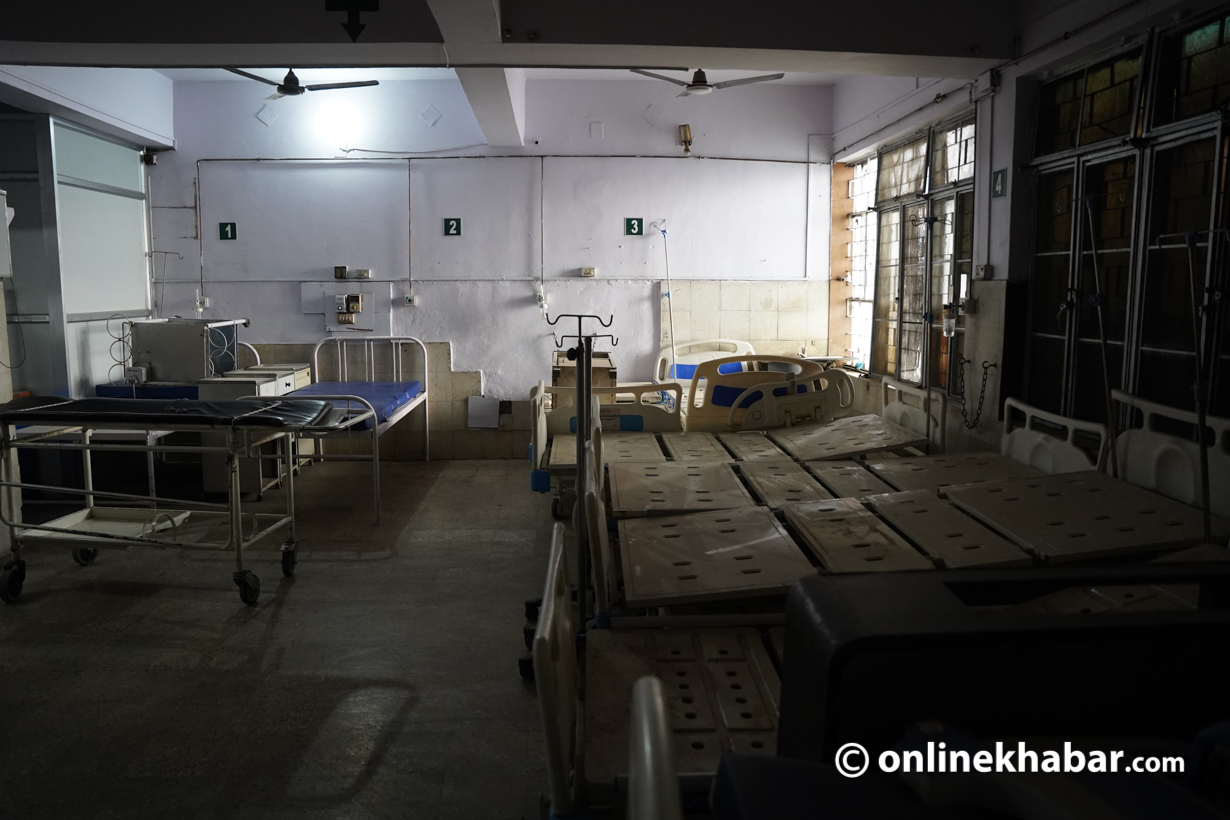
But at some of Kathmandu’s busiest public hospitals, that hope is increasingly being tested by a shortage of beds.
Critically ill patients are being forced to wait for hours or even days in emergency rooms because wards and intensive care units have no space. Some are sent to other hospitals, while others remain stuck in emergency departments.
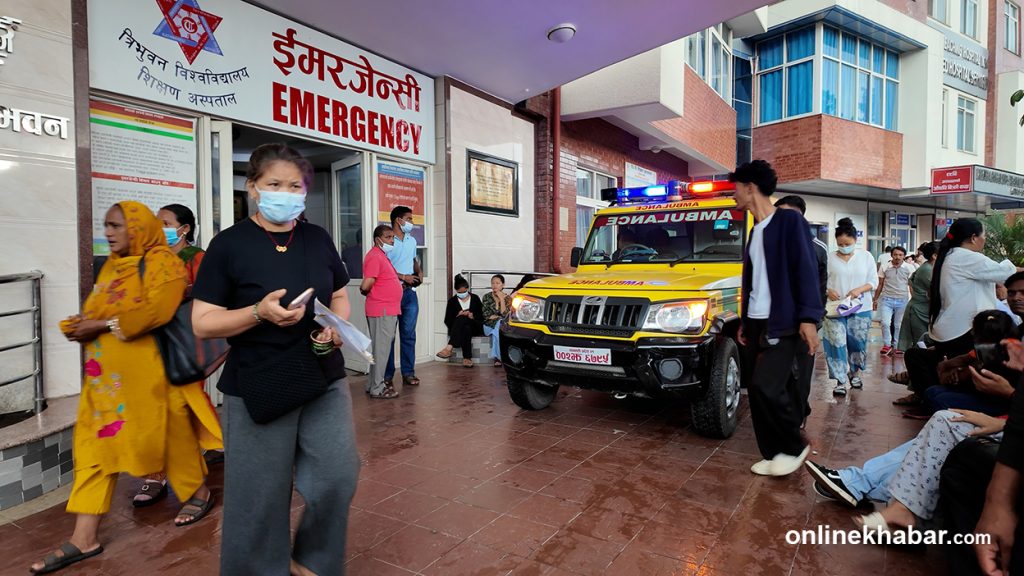
At Tribhuvan University Teaching Hospital (TUTH) in Maharajgunj, 45-year-old Dol Bahadur Thapa of Morang died in an ambulance after arriving for treatment on August 14.
Thapa, who was undergoing dialysis, had suffered a stroke. His family brought him to TUTH from Kathmandu Medical College, hoping the larger hospital would provide better treatment.
When the ambulance arrived outside the emergency department, Thapa was struggling. His relatives rushed inside looking for a bed.
They were told that no bed was available and that they would have to wait.
The family was left unsure whether to wait or take him elsewhere. Thapa’s condition continued to worsen. Around 15–20 minutes later, he died in the ambulance outside the emergency department.
“Had they taken him inside and treated him, I could still call him my father,” his daughter said through tears.
She said her family had pleaded with staff to examine him, but were told not to create a disturbance and were sent outside.
“He was still breathing. If they had taken him inside, perhaps he could have survived,” she said.
Thapa’s death has highlighted a wider problem facing Kathmandu’s major public hospitals: emergency departments are struggling to cope with a growing number of patients while beds, staff and intensive-care capacity remain limited.
Patients packed into emergency rooms
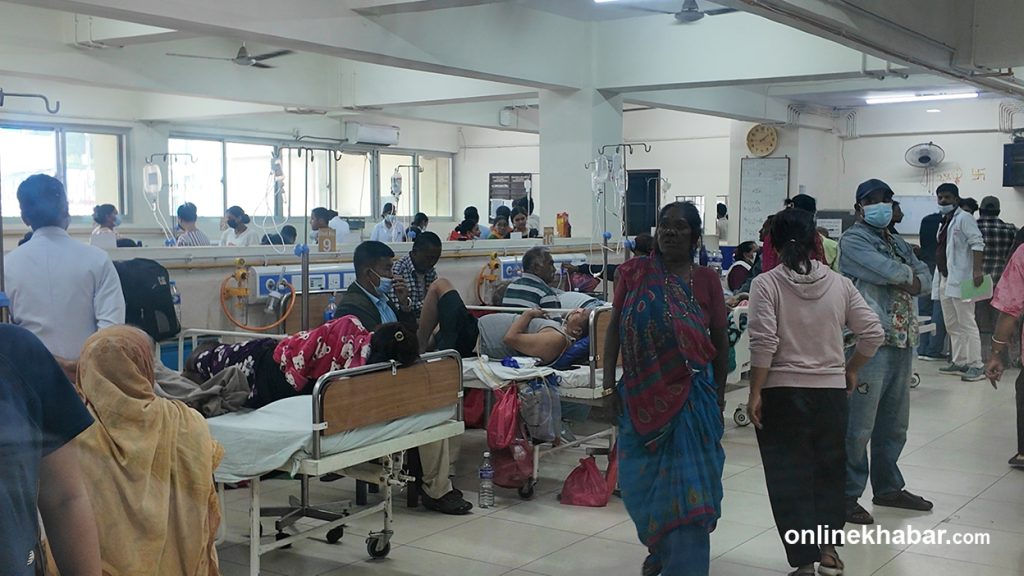
A similar situation can be seen at Bir Hospital, one of Nepal’s oldest and busiest public hospitals.
On August 17, its emergency department was packed with patients. Some were in wheelchairs, while several patients were sharing beds. In some cases, as many as three patients were being kept on a single bed.
Among them was 49-year-old Bal Bahadur Gurung of Gorkha.
Gurung had been waiting for admission for two days. He was suffering from an abdominal problem and said sharing a bed had made it difficult even to sit comfortably.
“I have been waiting for a bed for two days. Two patients have to share one bed. My abdomen is swollen, so it is difficult even to sit,” he said. “I don’t know when I will get a bed.”
Gurung had been told that he needed to be admitted to the medical ward. But with no bed available, he remained in the emergency department.
He is not alone.
According to Dr Suresh Nepal, chief of Bir Hospital’s emergency department, more than 100 new patients arrive there every day. Most require admission.
Patients who can be treated through outpatient services or discharged are managed accordingly. But those who need to be admitted often remain in the emergency department because there are no beds in the wards.
Some end up waiting for several days.
This overcrowding also creates another problem: the risk of infection.
“Keeping four patients on one bed is not good practice. If a patient with an infectious disease is kept together with another patient, there is a risk of transmission,” Dr Nepal said.
“But when beds are not immediately available and patients have nowhere else to go, we are forced into this situation.”
Higher risk for vulnerable patients
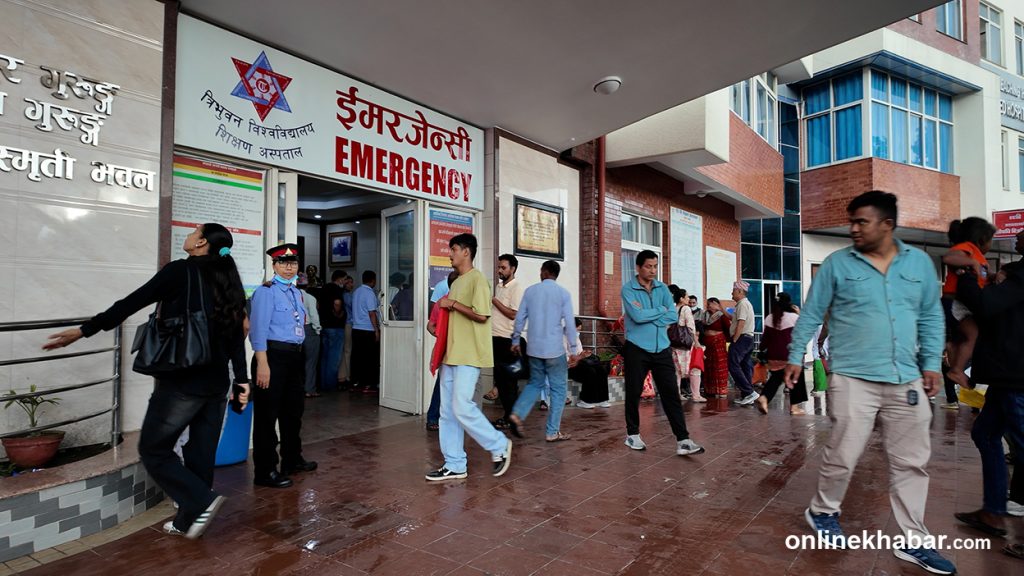
Chandrawati Rai, a kidney patient from Thankot, is particularly vulnerable to infections.
She has been living with kidney failure for seven years and has undergone regular dialysis for around five and a half years.
On August 6, she developed breathing difficulties and went to Bir Hospital. But she had to return home after finding that no bed was available.
Her condition worsened during the night. She became weak, broke into a cold sweat and felt as though she might collapse or lose consciousness.
“I felt like I was going to die. As soon as morning came, I returned to Bir Hospital,” she said.
By the time she reached the hospital, she was struggling to breathe and needed oxygen.
She was eventually placed in a bed shared with two other patients.
“Doctors themselves told me to be careful because infections can spread. But the patient in the next bed has tuberculosis,” Rai said. “I am afraid I may leave the hospital with another disease.”
Doctors say kidney patients and others with weakened immunity need special protection from infections. But overcrowding in emergency departments makes that difficult.
From Humla to Kathmandu, only to wait for a bed
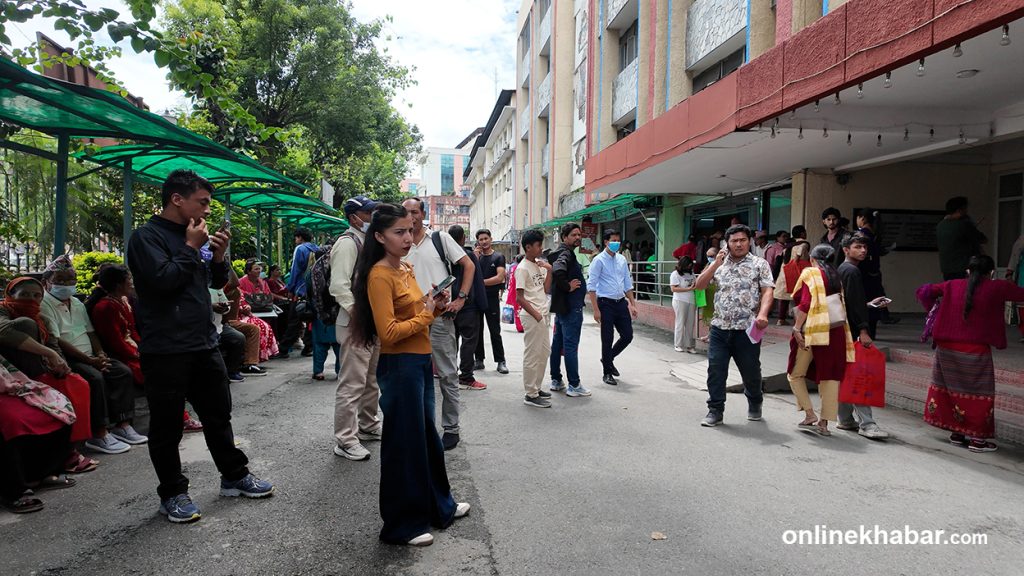
For Padam Pariyar, bringing his 68-year-old mother from Humla to Kathmandu was a long and expensive journey.
His mother, Pansara Damai, developed a heart problem and needed treatment in Kathmandu.
Pariyar travelled with her from Humla to Bajura by road, a journey that took two days. From Bajura, they flew to Nepalgunj and then to Kathmandu.
Nearly a week after arriving in the capital, Pansara was still waiting for admission to the heart ward because no bed was available.
“We came to Kathmandu because we thought there would be better facilities than in a remote place like Humla. But there is no management even in the capital,” Pariyar said.
He had already spent more than Rs 200,000 bringing his mother to Kathmandu and still did not know how long they would have to stay.
“Patients are referred to major hospitals, but there are no beds. The government needs to manage this,” he said.
Too few staff, too many patients
Bir Hospital’s emergency department has 50 beds, but as many as 150 patients may seek emergency care each day.
The number of medical officers has not increased in line with the patient load. Around seven to eight medical officers work in a shift, and the number can fall further when someone is absent.
The situation also falls short of the government’s minimum service standards.
Those standards require one medical officer and one nurse for every two emergency beds. At Bir Hospital, however, one nurse and one medical officer may currently have to look after six beds.
The emergency department has only five consultant doctors.
According to Dr Nepal, consultants are present in the emergency department during the morning and evening, up to 8 pm. After that, specialist doctors remain on call until 9 am.
“Even the staffing level does not meet the required standard. We are providing services to so many patients with such limited staff,” he said.
Teaching Hospital faces the same problem
TUTH has taken steps to reduce overcrowding by introducing a “one bed, one patient” policy in its emergency department.
The department has 75 beds: eight in the red zone, 30 in the yellow zones, 15 in the green zone and 22 in observation.
The policy has reduced the practice of putting several patients on one bed and is intended to improve patient safety and reduce the risk of infection.
But it has also exposed another problem: what happens when there is no bed for the next patient?
According to hospital data, more than 30 patients a day have to leave in ambulances for private hospitals because no emergency bed is available.
Some patients wait. Others remain in the emergency department for days.
Dr Ram Prasad Neupane, who works in TUTH’s emergency department, said some patients have remained there for up to five days.
“The biggest challenge is balancing quality service with access to treatment,” he said.
He said simply expanding emergency departments would not solve the problem.
Patients need to be moved from emergency care to wards or intensive care units, or transferred to other hospitals, as soon as their condition is assessed and initial treatment is provided.
Weak referral system adds to the problem
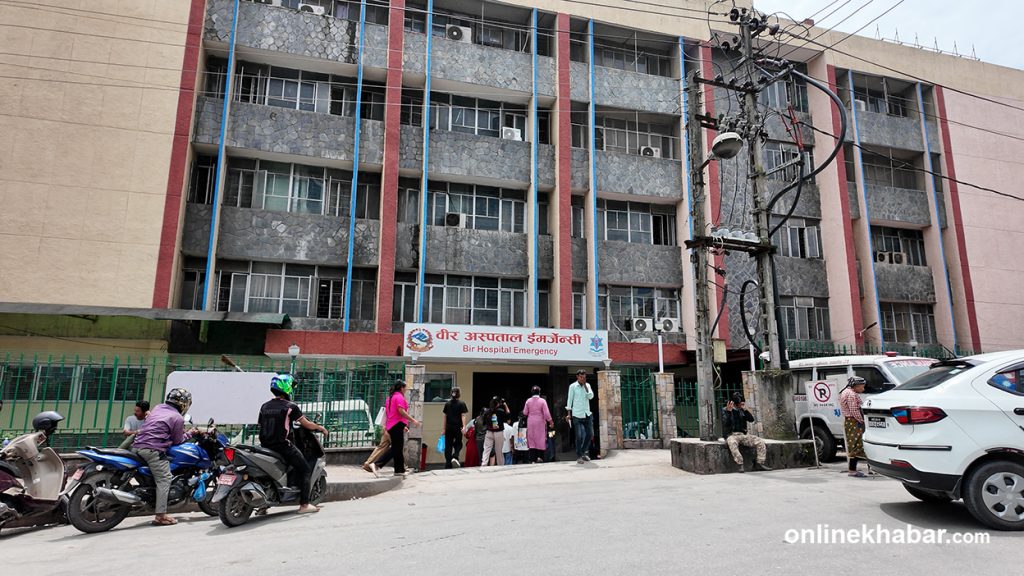
Doctors say the problem is not limited to individual hospitals.
Patients referred to Kathmandu’s major hospitals often end up at the same facilities because there is no effective system showing where beds are available.
In other health systems, Dr Neupane said, patients can be transferred to another hospital immediately after triage if no bed is available.
Nepal does not yet have such an effective system.
Public health expert Dr Sharad Onta said the difficulty patients face in accessing emergency treatment reflects weaknesses in the management of the health system.
“Emergency services involve life and death. But they have not been managed efficiently,” Onta said.
He said government hospitals should be able to coordinate with one another when beds are unavailable.
“If there is no bed at TUTH, there should be a system to call Bir Hospital or another government hospital and arrange a bed,” he said.
Without such coordination, many patients are eventually forced to seek treatment at private hospitals.
A constitutional right under pressure
Nepal’s Constitution guarantees every citizen the right to basic health services and states that no one should be deprived of emergency health services.
Yet patients arriving at the emergency departments of major public hospitals are sometimes unable to receive treatment simply because there is no bed available.
For patients from remote districts, the problem is even more difficult. They travel long distances and spend large amounts of money to reach Kathmandu, only to find themselves waiting in an emergency department.
Those who cannot afford private treatment have little choice but to remain there.
The death of Dol Bahadur Thapa outside TUTH shows how serious the consequences can be.
Onta said the government cannot consider its responsibility fulfilled simply by guaranteeing healthcare rights on paper.
“Not being able to provide the health services guaranteed by the Constitution is injustice against citizens by the state,” he said.