Kathmandu, September 23
Nepal’s public debt has reached nearly Rs 3 trillion, even as the government’s total debt burden declined slightly in the first two months of the current fiscal year.
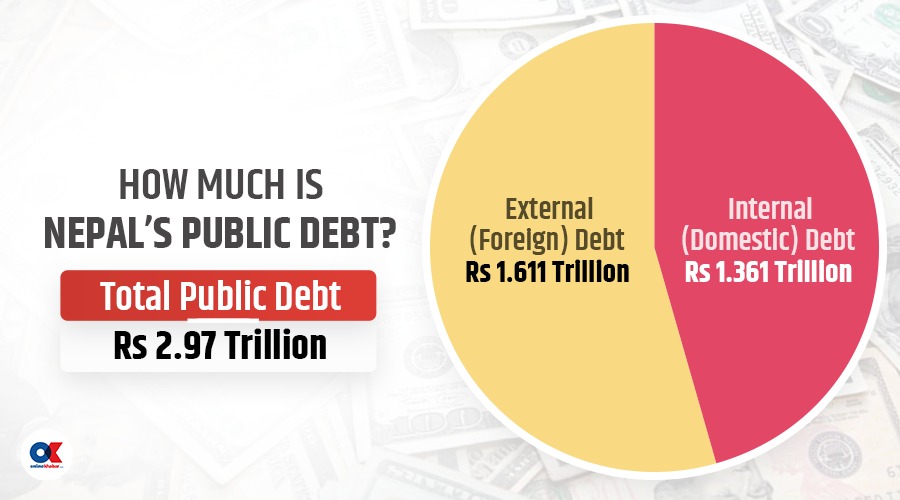
According to the Public Debt Management Office, Nepal owed Rs 2.973 trillion by the end of Bhadra, the second month of the fiscal year 2026/27. The figure is slightly lower than the Rs 2.981 trillion recorded at the end of the previous fiscal year.
The decline came because the government repaid more debt than it borrowed during the period.
By the end of Bhadra, the government had borrowed Rs 61.05 billion while repaying Rs 70.13 billion in principal, excluding interest. A loss arising from exchange-rate movements, however, added Rs 436.3 million to the debt burden.
Of the total debt, Rs 1.361 trillion was domestic debt and Rs 1.611 trillion was external debt. They represented 20.63 percent and 24.41 percent of gross domestic product respectively, putting total public debt at 45.05 percent of GDP.
The Public Debt Management Office publishes monthly government debt statistics, including reports through Bhadra 2083.
Government plans to borrow Rs 658 billion
Despite the slight decline in the first two months, the government plans to raise Rs 658.28 billion in public debt during the current fiscal year.
By the end of Bhadra, it had raised Rs 61.05 billion, or 9.28 percent of the annual target.
The government plans to raise Rs 400 billion through domestic borrowing this fiscal year. It had already raised Rs 50 billion by the end of Bhadra, equivalent to 12.20 percent of the annual target.
It has set a target of raising Rs 248.28 billion in external loans, of which Rs 11.05 billion had been received by the end of Bhadra, or 4.45 percent of the annual target.
Domestic borrowing accounted for 81.89 percent of total borrowing during the first two months, while external borrowing accounted for 18.11 percent.
The government raised Rs 20 billion in domestic debt in Shrawan and increased borrowing to Rs 30 billion in Bhadra. External borrowing rose from Rs 3.84 billion in Shrawan to Rs 7.21 billion in Bhadra.
More money going to debt than development
The figures become more striking when government expenditure is examined alongside debt servicing.
By the end of Bhadra, the government had spent Rs 85.01 billion on servicing public debt, including principal and interest. Capital expenditure during the same period stood at just Rs 7.66 billion.
The government has allocated Rs 417.88 billion for public debt servicing in the current fiscal year. By the end of Bhadra, it had already spent 20.34 percent of that allocation, equivalent to 1.29 percent of GDP.
During the period, the government repaid Rs 63.54 billion in domestic principal and Rs 13.25 billion in domestic interest.
For external debt, it repaid Rs 6.59 billion in principal and Rs 1.61 billion in interest.
In total, principal repayments amounted to Rs 70.13 billion, while interest payments stood at Rs 14.87 billion.
The pattern raises a broader question about how much of Nepal’s borrowing is contributing to new capital formation and how much is being absorbed by existing liabilities.
The Office of the Auditor General has also raised concerns about the use of public debt and whether borrowed funds are being directed towards productive capital formation. Its 63rd annual report is the latest annual audit report published by the office.
Public debt has nearly doubled in seven years
Nepal’s debt burden has increased sharply over the past seven years.
According to government figures, public debt stood at Rs 1.43 trillion in fiscal year 2019/20. It has since increased to nearly Rs 3 trillion.
As a share of GDP, public debt has risen from 38.05 percent in 2019/20 to around 45 percent now.
The increase has come amid rising government expenditure, declining foreign grants and weaker-than-expected revenue mobilisation.
Economists generally distinguish between borrowing used to create productive assets and borrowing used to finance recurrent expenditure. Debt can generate future economic capacity when it is invested in projects that increase production, employment, income or infrastructure.
The concern arises when borrowing does not generate sufficient returns to meet future repayment obligations.
A high-level Economic Reform Recommendation Commission formed by the government in 2024 also warned about this issue.
Its report noted that GDP and revenue mobilisation had not increased in line with the growth in public debt, increasing the burden of principal and interest payments.
The commission warned that if public debt is not properly utilised and fails to generate returns, the risk of the country falling into a debt trap could increase.
It also noted that rising debt-servicing obligations can leave fewer resources available for essential government functions such as education, health and security.
Commission calls for tighter rules on domestic borrowing
The National Natural Resources and Fiscal Commission has recommended that domestic borrowing should not be used to finance recurrent and administrative expenditure.
While setting the ceiling for domestic borrowing by the federal, provincial and local governments for fiscal year 2083/84, the commission recommended that domestic borrowing be directed towards projects capable of creating employment, generating long-term benefits and contributing to capital formation.
The commission has set the federal government’s domestic borrowing ceiling at no more than 5.5 percent of GDP, consistent with its annual recommendations.
It has specifically recommended that domestic borrowing be strictly prohibited for recurrent and administrative expenditure.
According to the commission, net domestic borrowing in fiscal year 2081/82 amounted to only 1.41 percent of GDP. Much of the domestic borrowing, it said, was effectively absorbed by repayment of existing debt because debt-servicing costs have been rising.
The commission has therefore called for domestic borrowing to be concentrated on projects that can increase production, employment and income, develop infrastructure and create capital.
It has also recommended conducting cost-benefit analysis, net present value calculations and internal rate of return analysis before directing domestic borrowing towards projects.
For projects financed through borrowing, the government should ensure that future returns will be sufficient to repay both principal and interest, according to the commission.
It has further called for an integrated electronic information, accounting and reporting system covering domestic borrowing and overall public debt across all three levels of government.
Auditor General raises concerns over use of borrowed money
The Auditor General has also questioned whether public debt is being used sufficiently for capital formation.
Its 63rd annual report says borrowed funds have also been used for recurrent purposes, including employee expenses, services and consultancy and office operations.
The report also points to foreign-exchange risks associated with external debt and recommends that borrowing be directed towards productive sectors while considering financial instruments that can help manage currency risk.
The Auditor General has additionally noted pressure on domestic resources as total revenue collection remains below the government’s target.
With debt-servicing obligations increasing, the government faces a growing need to borrow to finance other expenditures, creating a cycle that could further increase the debt burden.
The Auditor General has recommended keeping recurrent expenditure within desirable limits and directing borrowed funds towards projects capable of generating returns.
The bigger question is not simply how much Nepal owes
Nepal’s public debt has not yet reached Rs 3 trillion, but it has moved close enough to that mark to highlight a larger fiscal question.
The government borrowed Rs 61.05 billion during the first two months of this fiscal year while repaying Rs 70.13 billion in principal. Yet it spent Rs 85.01 billion on debt servicing during the same period, compared with only Rs 7.66 billion in capital expenditure.
The numbers underline the growing weight of past borrowing on the government’s current budget.
The central question for Nepal, therefore, is not simply how much more debt the government can raise.
It is whether the money borrowed today can create enough economic activity, revenue and productive assets to repay that debt tomorrow.