Kathmandu, September 22
For leaders who have attended CPN-UML Central Committee meetings for years, Monday’s meeting was unlike anything they had seen before.
Traditionally, the party’s general secretary would open Central Committee meetings, invite the chair to preside over them and then hand over the floor to the chair for his opening remarks. Once the chair had spoken, the meeting would proceed according to the rules agreed for the session.
On Monday, however, KP Sharma Oli changed the script.
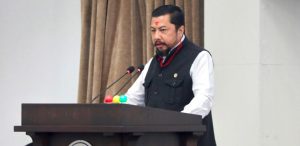
The UML chair opened the meeting himself, delivered the opening remarks, laid down detailed instructions on how members would be allowed to participate and then read out his own political report. He subsequently ended the meeting and left.
In the past, the general secretary would conduct the meeting, while Oli would have another leader present his report. This time, there was little room for that kind of arrangement.
The change in style became apparent when leader Krishna Gopal Shrestha challenged the procedure from inside the meeting. Referring to the party’s established practice, Shrestha argued that the general secretary should be conducting the meeting. Oli did not allow him to continue.
Instead, he told Shrestha to “speak after looking at the statute”. According to leaders present at the meeting, Shrestha subsequently left the meeting.
There was no attempt to soften the atmosphere.
Oli also laid down strict instructions on how Central Committee members would speak. Members would have to seek the chair’s attention before speaking and would be given three minutes. The chair could interrupt a speaker if he felt it necessary, while the speaking time could also be changed in special circumstances.
From the following day, members were told they would have to leave their mobile phones outside. Phones could not be kept in recording mode. Members would need the chair’s permission before leaving their seats. Oli also instructed volunteers to maintain complete neutrality.
They were not to make any gesture, sign or signal. Even if, as political beings, they had feelings about what was being discussed, he said, those feelings should not be reflected on their faces.
The instructions were striking enough for one Central Committee member to describe the situation as something they had never witnessed before.
The change in procedure, however, was not simply about how one meeting was conducted. It reflected the much bigger fight now unfolding inside the UML over Oli’s leadership.
Oli is under pressure from within the party to step aside and allow the UML to be reorganised. But he has shown no willingness to do so.
Instead, Monday’s meeting suggested that he intends to hold his ground.
The Central Committee is a larger body than the party’s office-bearers, and Oli has comparatively greater support among its members. In that setting, he appeared determined to keep control of the proceedings rather than allow the discussion to be shaped by other senior leaders.
That may help explain why he chose to conduct the meeting himself rather than allow the general secretary and other office-bearers to take the lead.
Oli has a formal basis for doing so.
The party’s statute convention last year strengthened the authority of the chair, including giving the chair the authority to conduct meetings. On Monday, Oli exercised that power directly.
The result was a meeting in which other office-bearers, including the general secretary, remained largely on the sidelines.
One leader summed up the significance of the change by pointing to the decision at the statute convention to concentrate authority in the chair.
Monday, that leader said, showed the consequence of that decision.
No sign of retreat
Oli’s political report made his position even clearer.
He has received a report prepared by a task force led by Ram Bahadur Thapa after demands for a change in leadership grew inside the party. But he did not present that report at Monday’s meeting.
Instead, the meeting will focus on the political report presented by Oli himself. And that report leaves little indication that he intends to surrender the leadership question.
In the opening session, Oli accused what he described as fascist forces of attacking him and the UML, while also accusing people within the party of attempting to weaken the chair.
His anger was also evident in the way he addressed the demand for party reorganisation.
Oli questioned whether replacing the leadership should itself be considered reorganisation.
He pointed to previous episodes of reorganisation in the communist movement, from the period involving Keshar Jung Rayamajhi and the Jhapa movement to the reorganisation of the party in 2018, and argued that the present situation was fundamentally different.
Party reorganisation, he argued, should not be a matter of desire or impulse.
For Oli, the answer is not to remove the old leadership but to transform how the party works.
He described transformation as changing working methods, changing the language used to communicate with the public, making decision-making more efficient and turning party committees from formal meeting structures into centres for solving people’s problems.
He also rejected the idea that leadership transfer should mean simply vacating a position.
Instead, he argued for a planned transfer of responsibility, knowledge, experience, institutional understanding, political culture and decision-making capacity.
His argument on generational transition followed the same line.
Youth alone, he said, should not be treated as qualification, just as age alone should not be treated as disqualification. What is needed is a combination of energy and experience.
To reinforce the point, Oli turned to the image of a tree. A new shoot, he argued, does not require cutting the roots.
“The history of UML is the root, and the new generation is the new shoot,” he wrote in his report.
The metaphor neatly captures the position Oli is taking in the current dispute. The pressure inside the party is for change. Oli’s response is that change does not require changing him. And Monday’s meeting showed that, at least for now, he intends to make that argument from the chair — and on his own terms.
From Tuesday, Central Committee members will be allowed to speak on his political report, with three minutes allocated to each speaker.
The debate will therefore move from Oli’s presentation to the wider Central Committee. But the first day has already established the tone.
Oli is not preparing to step aside. He is preparing to defend his position — with the authority of the chair, control over the proceedings and a political argument that says the party can transform without replacing its roots.