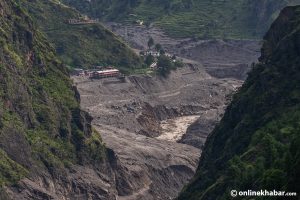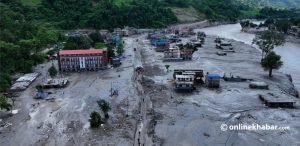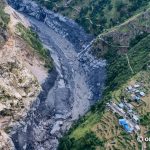

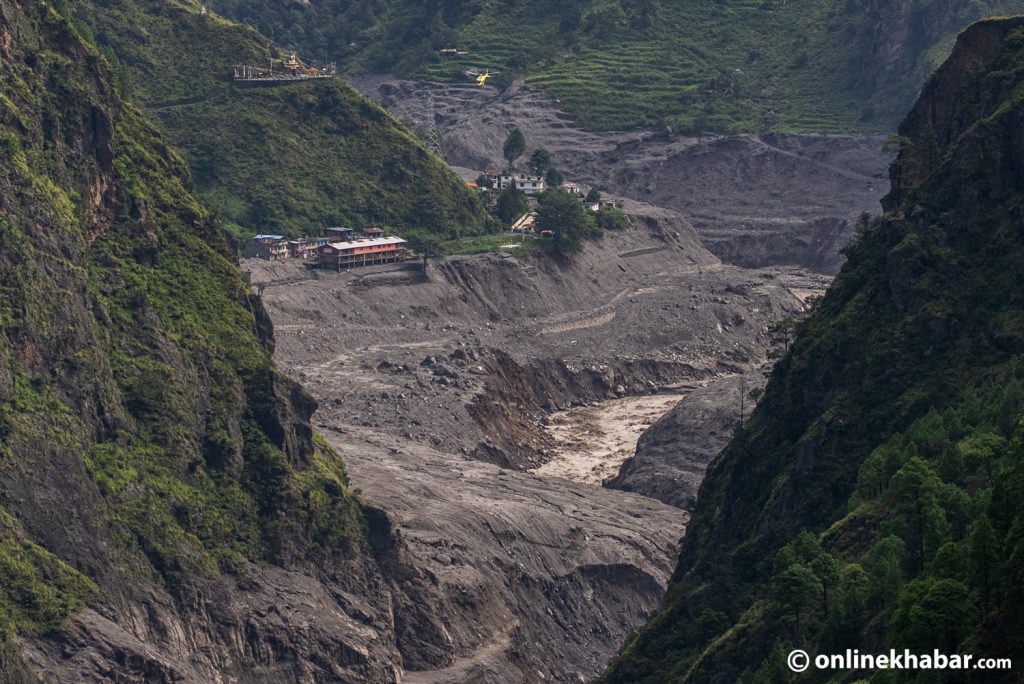
On 26 August 2026, when a colossal wedge of bedrock and glacial ice broke free from the northern flank of Mount Langtang Lirung at precisely 28.288°N, 85.528°E into Lhende Khola, it triggered devastating floods across Nepal, destroying villages, fertile land, bridges, roads, and 13 hydropower projects with a combined capacity of around 759 MW. Initial government reports recorded over 1,399 bodies recovered and more than 5,170 people missing. However, the full human and economic cost is still being assessed, although the overall recovery could run to NPR 723.31 billion, roughly a tenth of Nepal’s yearly GDP.
As the floodwaters receded, a single question echoed across Nepal and beyond: “Nepal emits almost no greenhouse gas, yet feels devastating climate risks. Who will pay for it?” That question was repeated by survivors, officials, activists, researchers and citizens. It is the question this article seeks to answer.
The science behind the flood
The avalanche from Mount Langtang Lirung plummeted 1,200 vertical meters straight down into the valley floor, travelling a horizontal distance of 14 kilometres in just 7 minutes before striking Nepalese border infrastructure. Driven by immense gravitational forces, the initial rock-ice avalanche and the flash flood it triggered swept down the upper reaches of the Lhende Khola valley at an average velocity of 193 kilometres per hour (120 mph). This devastating torrent then cascaded through the Upper Trishuli Watershed, destroying the critical Rasuwagadhi border crossing and multiple major downstream hydropower corridors.
Avalanches and ice falls are natural mountain processes that have occurred for centuries. However, climate change is making the Himalayas increasingly unstable.
The Bhotekoshi catastrophe illustrates how fossil fuel combustion, such as coal, petrol, diesel, and natural gas, drives global warming. Global temperatures have risen by approximately 1.2°C above pre-industrial levels, with the Himalayas warming faster than the global average. This accelerates the thawing of permafrost, the frozen ground that helps hold mountain slopes together.
The injustice: Who emits, who suffers
According to the Global Carbon Project, IEA, and Our World in Data, the United States, China and India are the world’s three largest annual CO₂ emitters, collectively accounting for over half of global emissions. The United States emits 13.83 tonnes, China 9.24 tonnes, and India 2.19 tonnes, compared with the global average of 4.67 tonnes per capita.
Nepal emits just 0.54 tonnes per person, contributing approximately 0.05% of global annual emissions and 0.01% of cumulative historical emissions since industrialisation.
The loss and damage fund: Promises, pleas and responsibility
Established at COP27 in 2022, the Fund for Responding to Loss and Damage (FRLD) helps vulnerable developing countries address climate-related losses beyond adaptation. However, it is not a compensation mechanism: the Paris Agreement’s Decision 1/CP.21, Paragraph 51, explicitly excludes liability or compensation. Funding is provided through grants, while contributions remain voluntary.
By mid-2026, the Fund had received about $822 million in pledges, with $631 million transferred, while 119 developing countries had submitted requests totalling $2.8 billion. Rapid-response projects are currently capped at $5–20 million, and no funds had yet been disbursed; first allocation decisions were deferred to December 2026.
Government of Nepal submitted an urgent request on 1 September 2026 for $20 million, the maximum rapid-response amount, following the 26 August Bhotekoshi disaster. This represents only a fraction of its estimated $4-5 billion reconstruction needs. FRLD has warned that without substantially greater contributions, the Fund’s resources could be exhausted by the end of 2027.
This raises a central question of climate justice: when countries that have contributed little to historical emissions face disproportionate losses, should reconstruction finance remain voluntary assistance or become a stronger international obligation? The principle of Common but Differentiated Responsibilities (CBDR) holds that countries with greater historical responsibility and capacity should contribute more towards climate finance.=
Yet international law remains limited. The gap between differentiated responsibility and voluntary climate finance therefore remains.
The path forward
To prevent such disasters again, the priority must be to drastically reduce global carbon emissions. The transition to a green economy, green infrastructure, and green energy must begin now, not tomorrow. Even if this transition may take 20, 30, 40 years or more, delaying it will only increase future risks. Nepal’s commitment at COP26 to become carbon neutral by 2045 must therefore be treated as a long-term national priority.
Nepal should work with other mountain nations, such as Bhutan, Kyrgyzstan, Tajikistan and Peru; Small Island Developing States, including Tuvalu, Vanuatu, Fiji and the Maldives; and other highly climate-vulnerable countries, such as Bangladesh, Pakistan, India and Ethiopia, to form a climate justice coalition and jointly advocate for stronger adaptation finance, loss-and-damage support, technology transfer and climate accountability.
Additionally, loss-and-damage finance should move beyond voluntary pledges toward predictable and stronger international financial obligations, particularly for countries with greater historical emissions and greater financial capacity.
Glaciers, permafrost, glacial lakes, avalanches and river systems across Nepal, Tibet and the wider at-risk regions must be tracked continuously.
High-risk glacial lakes, specifically the 25 critical transboundary danger lakes in China (Tibet), the 21 internal high-risk lakes in Nepal, and the broader networks of 52 hazardous lakes in Pakistan and 65 in Bhutan must be identified and monitored using satellites, sensors, drones and remote-sensing technology, with shared data and early-warning systems.
Nepal should also expand automated weather and multi-hazard monitoring systems, particularly in high-risk mountain areas. Water-level, rainfall, temperature, seismic and avalanche sensors can provide real-time warnings. Automated systems should also be deployed in rivers and as well as in mountains which are above 5,000 meters, where timely human monitoring is difficult, to detect hazards and alert communities before avalanches, floods or GLOFs occur.
Schools, communities, local governments and infrastructure operators should receive regular disaster preparedness and climate-risk awareness training, including evacuation routes, emergency communication, first aid and response drills. Dedicated disaster management centres with trained personnel and technical expertise should also be established in high-risk areas.
Nepal must shift from reactive reconstruction to risk-informed development, ensuring infrastructure is built away from flood channels, unstable slopes and other hazard-prone areas. Hydropower and tunnel projects must undergo proper geological, hydrological, glacial-lake and climate-risk assessments before construction.
Development must be region-specific: mountain areas need GLOF and avalanche protection, hills require slope stabilisation and controlled road-cutting, and the Terai needs flood-resistant infrastructure, better drainage and flood-risk zoning. Every new development project should incorporate climate projections, disaster-risk assessments, resilient design, renewable energy and nature-based solutions. Safety and resilience must guide development, and Nepal’s model must shift from simply rebuilding after disasters to preventing avoidable losses before they occur.
Climate disasters cannot be addressed through relief alone. The burden must be shared more fairly: countries with greater historical emissions and financial capacity should contribute more to the recovery of vulnerable countries like Nepal through stronger and more predictable loss-and-damage finance.
At the same time, Nepal must reduce future risks by decarbonising, building climate-resilient infrastructure and strengthening early-warning systems.