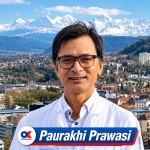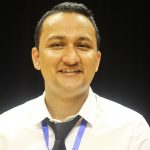

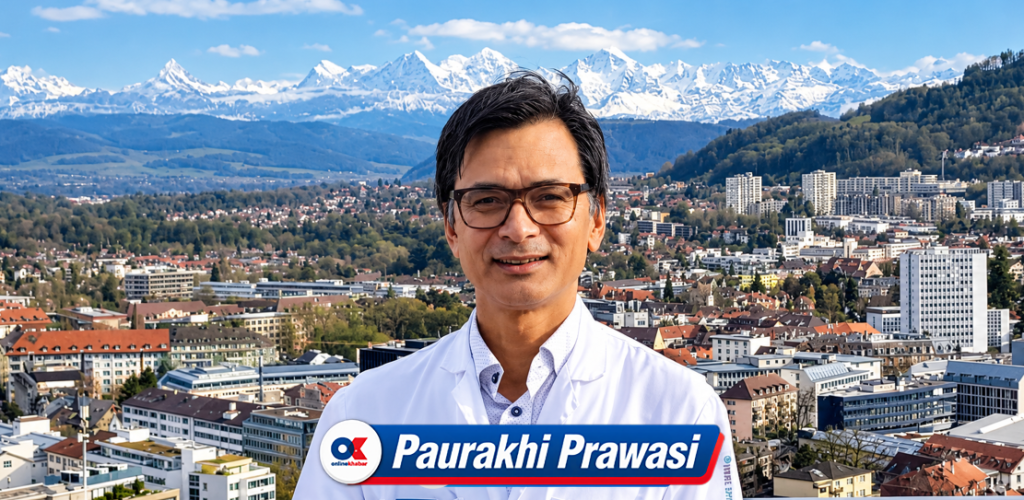
In a radiation oncology department at a university hospital in Bern, Switzerland, a Nepali doctor spends his days treating cancer patients with some of the most advanced technology available. But Dr Binay Kumar Shrestha’s mind often travels thousands of kilometres away, to Nepal.
For nearly two decades, Shrestha has worked in high-level cancer care in Europe. Since 2018, he has been a senior consultant at a university hospital in Bern, treating cancer patients, conducting research and training younger doctors.
Yet his ambition extends beyond his work in Switzerland as he yearns to build a modern cancer hospital in Nepal.
In Dhikurpokhari, Kaski, preparations are already under way. Land has been secured, a design is being developed with Dutch architect Prof Feenstra, and an agreement has been signed with the Cancer Centre at University Hospital Bern for knowledge transfer and training.
The project is expected to cost billions of rupees. Around Rs 50 million has already been invested by Shrestha’s team.
For Shrestha, however, the project is about more than constructing a hospital.
“Many people think that what we learn abroad should simply be shared,” he says. “But I am trying to do something with a bigger dream. This hospital will not just be a building. It will be a strong bridge between Nepal and Switzerland in healthcare.”
A childhood decision
Shrestha was born in 1973 in Mangalpur, Chitwan. His father, Chamunarayan Shrestha, was a teacher, and his mother was a homemaker.
Education was central to the family. Literature and learning were part of everyday life, and the family would often recite Muna Madan together.
But it was an illness in the family that first made Shrestha think about medicine.
When he was in Grade 4, his grandmother became seriously ill.
Even as a child, he began to understand what it meant to have the ability to protect someone’s health.
That experience eventually convinced him that he wanted to become a doctor.
He passed his SLC examination in first division from Balkumari Secondary School in Narayangadh and completed his ISc in first division from Nepal Science Campus in Ramshah Path, Kathmandu.
He later received a scholarship to study MBBS at the College of Medical Sciences in Bharatpur.
That opportunity would eventually take him far beyond Nepal.
The journey to Switzerland
After completing his internship at United Mission Hospital in Tansen in 2002, Shrestha initially focused on orthopaedic surgery. He began working as a resident doctor at HRDC Hospital in Banepa.
Around the same time, he applied for a position at a hospital in Switzerland. There was one problem. He needed to know German.
“I realised that without German, you couldn’t even move a leaf here,” he recalls.
The initial opportunity slipped away.
Instead of giving up, Shrestha used his time in Austria and Switzerland to pursue fellowships and training in orthopaedics and surgery while learning German.
He later worked in family medicine in rural Switzerland for two years, gaining experience by working closely with local communities.
During this period, he also completed a master’s degree in biomedical engineering from the University of Bern, adding another dimension to his medical and research background.
Then, in 2008, his career took an unexpected turn.
From surgery to cancer care
Shrestha had resigned from his previous position with the intention of pursuing orthopaedic surgery. But he was uncertain about what should come next.
He applied for an internal medicine residency at University Hospital Zurich, initially intending to improve his language skills before returning to surgery.
Instead, he encountered radiation oncology.
Working in internal medicine brought him into close contact with cancer patients and the radiation oncology department.
The experience changed his thinking.
“I realised that you don’t have to save lives only through surgery,” he says.
After about a year and a half of working closely with the field, Shrestha made a decision he had never originally imagined. He would specialise in radiation oncology.
At University Hospital Zurich, he gained experience in research, teaching and leadership within radiation oncology.
Although he later took some time away from Zurich for family reasons, his professional journey continued in Switzerland.
Since 2018, he has worked as a senior consultant at a university hospital in Bern, where he treats cancer patients using advanced technology while training and mentoring younger doctors.
A hospital for Nepal
For years, Shrestha had heard that doctors trained abroad should share their knowledge with Nepal.
But he felt that conferences and panel discussions alone were not enough.
That thinking eventually led to the Swiss-Nepal Cancer Hospital Project.
The plan to build the hospital in Dhikurpokhari, Kaski, has been developing for around five years.
“I have lived and worked in Switzerland for 20 years,” Shrestha says. “That experience has made me feel a responsibility. At this stage, my family and I feel that doing something for cancer patients in Nepal is more important than profit.”
He also sees the project as a way of giving back to the country where he received his medical education.
“If I had not received my basic education and skills from Nepal, this journey would not have been possible,” he says. “My responsibility is therefore not only to treat patients in Switzerland, but also to contribute to my homeland.”
His team has already invested around Rs 50 million in the project.
Over the past five years, work has continued on both sides of the Nepal-Switzerland relationship, including registering the organisation, building the team, purchasing land and reaching the final stages of leasing additional land.
The team includes businesspeople, technical professionals and doctors working in Nepal and Switzerland.
In October 2023, Dutch architect Prof Feenstra visited the proposed hospital site.
Shrestha and his team also invited Feenstra to Switzerland to study the cancer department at University Hospital Bern, including everything from patient facilities to equipment arrangements.
The initial cost estimate for the project was around Rs 2 billion, although Shrestha expects the final cost to be higher.
The plan is to develop the hospital in three phases, with an investment of around Rs 1 billion in each phase.
The project is currently being developed through private investment.
“We were worried that making the project public too early could affect the vision,” Shrestha says. “But this is not simply a private investment project. It is driven by a service-oriented vision.”
Two Swiss cancer specialists have also invested in the project, although they have described their contributions as donations. Shrestha says sending smaller amounts of foreign investment to Nepal has been difficult because of the country’s foreign direct investment rules.
Building a bridge between Switzerland and Nepal
The project has already moved beyond plans for a building.
On February 14, 2024, Shrestha’s team signed an agreement in Switzerland with the Cancer Centre at University Hospital Bern for knowledge transfer and training required to establish and operate the Swiss-Nepal Cancer Hospital.
The agreement is intended to give Nepali doctors and technical staff the opportunity to observe, learn and train in the operation of an advanced hospital in Switzerland.
“We can understand directly what the design should look like and what kinds of machines are effective,” Shrestha says.
Doctors, nurses and technicians from Nepal will be able to receive training in Switzerland, while Swiss doctors are also expected to travel to Nepal and participate directly in treatment once the project moves forward.
Shrestha says the partnership will also provide access to important cancer-treatment documents and expertise available at Swiss cancer centres.
His team is preparing to bring the head of the cancer centre, along with Swiss doctors who have invested in the project, to Nepal when the work there progresses.
For Shrestha, that exchange is at the heart of the hospital’s purpose.
It is intended to bring Swiss experience directly into Nepal rather than simply replicate a building.
Bringing health professionals together
While working on the cancer hospital, Shrestha has also been trying to connect Nepali healthcare professionals across Europe.
Last year, he took leadership of the Society of Nepali Healthcare Professionals in Europe.
The organisation aims to create a platform where Nepali healthcare workers can exchange experiences about different registration systems, examinations and professional challenges across European countries.
The organisation has also made information about registration and examination procedures available through its website.
“The idea is that healthcare professionals who have already gone through these processes can help those who are coming after them,” Shrestha says.
At the first annual convention in Amsterdam, Nepali doctors from across Europe discussed emerging trends, challenges and possible solutions in healthcare.
The conference also saw the Nepali Health Professional of the Year 2025 award presented to Prof Dr Ganesh Acharya.
Shrestha says the organisation plans to regularly recognise healthcare workers not only in Europe but also those working in remote areas of Nepal.
A long connection with Nepal
Shrestha’s connection with Nepal did not begin with the cancer hospital project.
He was also involved with the Swiss-Nepal Society, which was established by Swiss people who had worked in Nepal during the 1960s and 1970s.
He worked with the organisation from 2006 to 2015, an experience he says taught him a great deal.
He later became actively involved in the NRN movement in Switzerland, serving twice as president of NRN Switzerland and one term as an ICC member.
Those experiences helped him build connections among Nepalis living across Europe.
Today, those networks have become part of a much larger ambition.
A hospital in Nepal.
A professional network across Europe.
And a system through which knowledge can move in both directions.
A dream bigger than a building
For Shrestha, the cancer hospital is not simply another professional achievement.
It is an attempt to turn nearly two decades of experience in European healthcare into something that can serve patients in Nepal.
“My dream is not just a building,” he says. “It is about saving lives, giving hope and maintaining an unbroken connection with my homeland. Where there is determination, a plan and a commitment to service, nothing is impossible.”
He is proud to have specialised in both radiation oncology and general medicine.
But his ambitions have moved beyond his own career.
“I don’t want to simply be proud of what I have achieved,” he says. “I want to use it to do something for the country.”
For now, the hospital remains a work in progress.
The land is being prepared. The design is taking shape. Partnerships have been signed. Money has already been invested.
And thousands of kilometres away from Nepal, inside a cancer department in Bern, a Nepali doctor continues to treat patients—while working towards the day when the expertise he has spent decades acquiring can be put to work in his homeland.