
Modern authoritarianism does not always announce itself through the suspension of elections, the dissolution of Parliament or the arrival of soldiers on the streets. It can grow inside formally democratic systems, through the gradual redefinition of who is entitled to democratic rights.
Its politics is apocalyptic. Society is repeatedly told that it faces an exceptional danger: anti-nationals, urban extremists, infiltrators, foreign agents, disorderly students, politically motivated activists or people supposedly obstructing the state’s work. The identity of the enemy may change, but the political requirement remains constant. Power needs an internal adversary against whom extraordinary conduct can be presented as necessary governance.
The cases of Indian activist Umar Khalid and Nepali activist Majid Ansari are not identical in scale, duration or legal circumstances. Khalid has spent years incarcerated under India’s Unlawful Activities (Prevention) Act in the alleged conspiracy case concerning the 2020 Delhi violence. Ansari’s detention at the Kirtipur Holding Centre is a recent and still-developing incident involving disputed accounts of police conduct. To equate the two cases completely would be analytically careless.
But comparison does not require equivalence. It requires identifying a common political method: first diminish the dissident’s standing, then treat the demand for rights as evidence of guilt.
Manufacturing the public enemy
Long before a court determines criminal responsibility, political communication can produce a social verdict.
Umar Khalid experienced this process after the 2016 JNU controversy. In 2018, following an alleged attempt to shoot him outside New Delhi’s Constitution Club, he described a sustained campaign in which ruling-party spokespersons, television anchors and online trolls had branded him “anti-national.” At that stage, he argued, public condemnation had preceded formal legal proof: allegations were repeated as settled facts, debate was displaced by trolling, and political disagreement was converted into threats against his life.
This was not merely Khalid’s subjective description of hostile coverage. In 2022, India’s News Broadcasting and Digital Standards Authority found that several television broadcasts had crossed the line between reporting allegations and presenting an accused person as already guilty. The authority objected to sensationalist headlines portraying Khalid as the mastermind of the Delhi riots and ordered the relevant channels to remove the broadcasts, finding violations of impartiality, objectivity and neutrality.
The political function of labels such as “anti-national” is therefore larger than insult. They reduce a citizen’s legal and cultural standing. Once a person is placed outside the imagined national community, constitutional safeguards begin to look like undeserved privileges. Arrest becomes accountability. Prolonged imprisonment becomes prevention. Violence becomes a response to provocation rather than an abuse requiring investigation.
In Kirtipur, the language was different, but the method was recognisable.
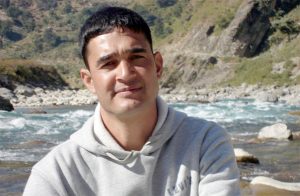
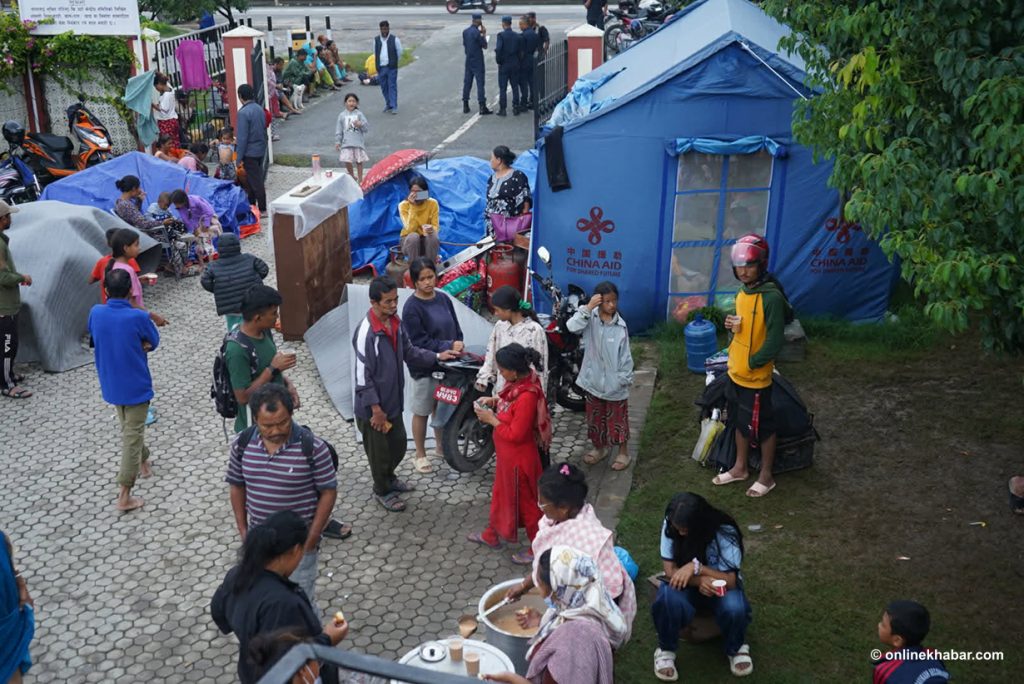
According to reports, Majid Ansari and other activists had gone to a holding centre where families displaced by squatter evictions were living amid serious flooding and waterlogging. Police said the activists obstructed rescue work and refused instructions to leave. Eyewitnesses disputed that account, alleging political favouritism and excessive force. Photographs subsequently showed injuries on Ansari’s face, while police maintained that only the minimum force necessary to manage resistance had been used.
A video circulated from the incident shows Ansari asking, “Give me an arrest warrant.” The response was not a clear explanation of the legal basis for his detention. Instead, a police officer reportedly addressed him through the language of hierarchy and infantilisation: “Your father sent you to study, and you are doing politics? He was then told, “Do not do politics.”
This language matters. It converts a citizen into a disobedient child and a political question into a disciplinary problem. Ansari was not answered as someone invoking legal rights. He was lectured as a student who had supposedly crossed the boundaries assigned to him.
The message was not simply “you may have committed an offence.” It was: politics is not your domain.
Due process is most meaningful when the person invoking it is unpopular, disruptive or accused of wrongdoing. A right that exists only for respectable citizens is not a right. It is social approval disguised as law.
In Khalid’s case, the media environment frequently blurred accusation and conviction. The current legal position must nevertheless be described carefully. Courts have treated the prosecution’s allegations as prima facie sufficient to trigger the restrictive UAPA bail standard. In rejecting bail, the court expressly clarified that its observations were limited to the bail inquiry and should not influence the trial on its merits. A prima facie determination at the bail stage is not a conviction after trial.
That distinction disappears in a media trial. The public does not hear “an accusation has met the preliminary threshold governing bail.” It hears “terrorist,” “mastermind” or “enemy.” The legal presumption of innocence survives on paper while political communication administers punishment in advance.
In Majid Ansari’s case, the constitutional question is similarly broader than whether a physical warrant existed. Nepal’s Constitution prohibits detention without informing the person of the grounds for arrest. It guarantees access to a legal practitioner from the moment of arrest and requires production before the relevant authority within 24 hours, excluding travel time. It also prohibits physical or mental torture and cruel, inhuman or degrading treatment.
Nepal’s criminal procedure law permits different forms of arrest depending on the offence and circumstances. It also requires that, before an arrest under the relevant provisions, the person be informed of the cause necessitating arrest. Therefore, the decisive issue is not merely whether police displayed a particular piece of paper. It is whether Ansari was told the legal grounds for depriving him of liberty and whether the force used against him was lawful, necessary and proportionate.
Ansari later alleged from hospital that he had been dragged and beaten, had not been informed of the reason for his arrest and had not been shown a warrant. These remain allegations requiring an independent and credible investigation. The police account must also be examined rather than dismissed in advance. But constitutional government requires more than competing statements. When an injured detainee alleges abuse, the state carries a duty to explain, document and investigate its own use of force.
A government cannot answer a demand for legality with “do not do politics.” Asking why one is being arrested is not insolence. It is citizenship.
Who belongs to the democratic universe?
The religious identity of Umar Khalid has been central to the political imagination constructed around him. Opposition to the Citizenship Amendment Act was frequently represented not as a constitutional disagreement but as a Muslim conspiracy against the nation. Peaceful assembly could consequently be described through the vocabulary of jihad, communal mobilisation or civilisational threat.
This is how minorities are expelled from what may be called the democratic universe: the shared political space in which citizens are presumed entitled to speak, organise, disagree and demand accountability. A majority-community activist may be portrayed as idealistic, misguided or passionate. A Muslim activist expressing the same dissent is more readily interpreted as sectarian, radical or disloyal.
Majid Ansari is also a young Muslim activist. But intellectual honesty requires an important qualification: the publicly available reporting on the Kirtipur incident does not yet establish that the police explicitly targeted him because he was Muslim. The strongest documented evidence concerns his political activity, the police’s disciplinary language, disputed allegations of obstruction and force, and his claim that he was not informed of the legal basis of his detention.
The comparison with Khalid should therefore not depend upon asserting an unproven motive. Its value lies in showing how existing social identities can deepen vulnerability once a dissident is marked as troublesome. A Muslim name does not prove religious targeting. But neither can a society ignore the wider environment in which Muslim political participation is often viewed with greater suspicion.
The question is not only whether an officer uttered a communal slur. It is whether public institutions and political audiences find it easier to suspend empathy when the dissident belongs to a minority already associated with danger.
The crowd as an auxiliary institution
The state’s coercive power does not operate through police and prosecution alone. It is reinforced by television studios, anonymous accounts, partisan influencers and ordinary spectators trained to see suffering as entertainment.
Dehumanisation reaches its most dangerous point when a bruised face provokes ridicule instead of concern. The “Haha” reaction made by Home Minister Sudan Gurung on a post about Majid Ansari’s arrest transforms what might otherwise seem like a trivial social-media gesture into an alarming political message. When the minister responsible for the country’s security apparatus appears to mock the suffering of an injured citizen, that person is no longer treated as a rights-bearing human being, but as someone whose humiliation and pain are considered acceptable. It is not merely laughter directed at Majid; it is a public display of state indifference and a signal to supporters that his rights need not be defended and his suffering may be mocked.
This is why the “public enemy” must be manufactured before force is used. Without prior vilification, an image of a bleeding student might create outrage. After vilification, the same image is treated as proof that the troublemaker received what he deserved.
In this environment, even demands for due process are manipulated. Asking for a warrant becomes arrogance. Seeking legal counsel becomes obstruction. Questioning police conduct becomes hostility to law enforcement. Refusing to obey an unexplained command becomes proof of dangerous radicalism.
The term “efficient governance” then acquires a sinister meaning. Institutions are praised for acting quickly precisely because they have avoided the delays associated with evidence, hearings, explanations and review. The inconvenience of constitutional procedure is presented as weakness; the spectacle of immediate punishment is marketed as strength.
This is the logic of rule by force: the belief that order can be created by disregarding the law. Its appeal lies in its simplicity. It tells the public that complex social problems do not require careful governance, accountable institutions, or respect for due process. All that is needed is a powerful authority and a convenient enemy against whom that power can be displayed.
The price paid by everyone
A society may convince itself that the suspension of rights will remain confined to controversial figures. It never does.
The machinery created for the “anti-national” can be used against the journalist. The powers normalised against the minority activist can be used against the opposition worker. The contempt shown toward a student asking for the grounds of arrest can later be directed at a labourer, a displaced family, a comedian or an ordinary citizen recording police misconduct.
The ultimate danger is not that every dissident will become Umar Khalid or that every detention will reproduce the Kirtipur incident. It is that the public will lose the capacity to recognise a constitutional violation when it occurs.
Democracy is not tested when the state respects citizens it admires. It is tested when an accused, unpopular or confrontational person invokes the law and the state restrains itself.
On a hospital bed lies Majid, his eye injured. Inside a Delhi prison, the label “anti-national” remains attached to Umar’s name. Between them stands a citizen’s question: “What is the legal basis for my arrest?” surrounded by the words “Rohingya,” “serves him right,” and the digital echo of HaHa React. The promise of equal protection still remains written on the pages of the Constitution.
The danger does not begin only when rights are erased; it begins the moment society hears a citizen’s name and stops believing that person deserves those rights.