
It has been a year since Nepal’s Gen Z uprising. In the meantime, much like the blind men and the elephant in the popular folk tale, there have been different attempts to interpret what happened.
Was it an internal economic and political explosion, or was it the result of geopolitical manoeuvring from outside? What were the real forces beneath the surface? What direction could Nepal’s politics take in the future? And what are the major challenges ahead?
Nepal today truly stands at a crossroads of enormous possibilities and equally serious challenges.
A brief chronology
On September 8, 2025, a group of Gen Z youths spontaneously held a peaceful demonstration from Maitighar to the Federal Parliament building in New Baneshwor, Kathmandu. Their main demand was that the government lift its ban on several social media platforms. Corruption, nepotism and other issues were also raised.
On the surface, these were familiar issues in Nepali politics. But unexpectedly, the crowd grew in front of the Parliament building. A fierce confrontation followed. The youth tried to get into the Parliament building. To stop them, the state used force indiscriminately, killing 19 people. The situation soon went out of control.
The following day, a highly violent movement spread across the country.
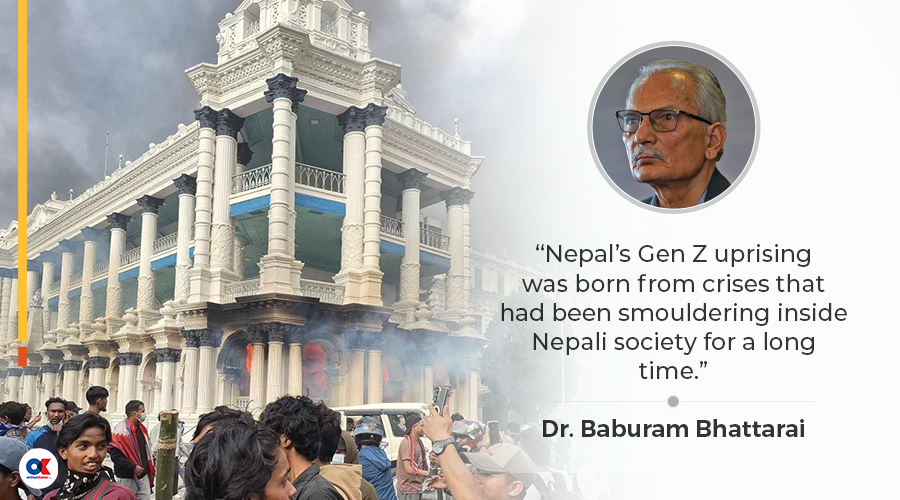
In Kathmandu, symbolic state structures including the Parliament building, Singha Durbar, the Supreme Court and the President’s Office were set on fire. With only a few exceptions, virtually no police office or post was left untouched. Many prisoners escaped from jails. The private residences and rented houses of major political leaders were also not spared from arson.
A total of 76 people were killed across the country. The economic damage ran into billions of rupees.
Throughout the entire episode, the Nepal Army remained a silent spectator.
The prime minister resigned on September 9 itself. For three days, the country appeared to be without a central government. Rumours of various kinds became the subject of national and international discussion.
Finally, on September 12, an interim government comprising independent figures was formed under former Chief Justice Sushila Karki. On its recommendation, the House of Representatives was dissolved. New general elections were announced for March 5, 2026.
The Constitution, which had reached the edge of a cliff, was narrowly saved.
In the general election, the Rastriya Swatantra Party (RSP), formed only three years earlier, won nearly two-thirds of the seats with 48 percent of the vote. All the established old parties suffered a dramatic collapse.
At 36, young leader Balendra Shah assumed the post of prime minister. Nepali politics entered another new phase.
Meanwhile, an investigation commission led by former High Court judge Gauri Bahadur Karki had been formed by the interim government on September 22 to investigate the events of September 8 and 9 and submits a report with recommendations.
The commission submitted its report to the government on March 8. However, the report has not yet been officially made public.
An unofficial version of the commission’s 907-page report circulated through digital media. It provides a detailed account of the events of September 8 and recommends action against those found responsible.
Regarding the events of September 9, however, it provides only a general account and says further investigation is needed.
The report also briefly mentions the role of Discord in the violent protests. It refers to the technical aspects of preparations allegedly made by some individuals for violent activities in the days leading up to the protests.
Who are Gen Z?
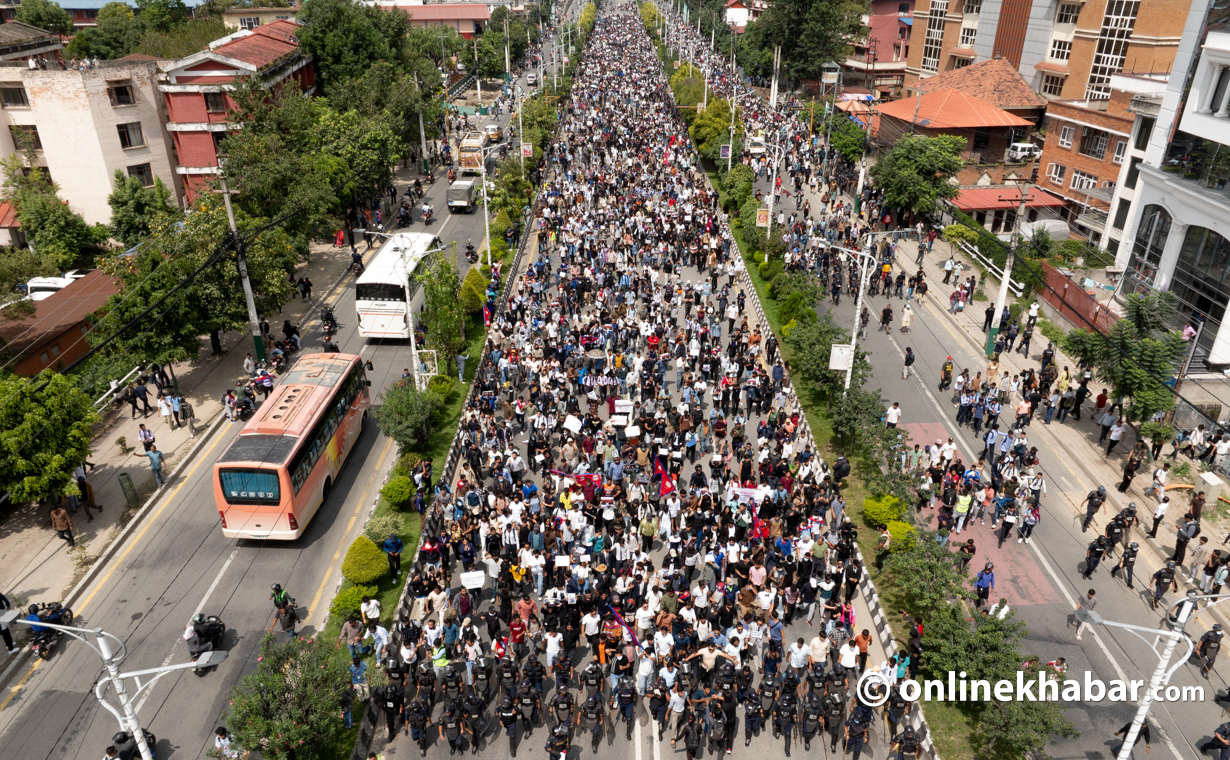
There are now attempts to portray Gen Z youths as either heroes or villains. The term ‘Gen Z’ itself has become part of everyday political vocabulary.
But what exactly is Gen Z? Who are the Gen Z youths?
Generally, those born between 1997 and 2013 are described as Generation Z, or ‘Zoomers’. Since this is the generation that was born and raised alongside digital technology, the internet, social media and artificial intelligence, they are also described as ‘digital natives’.
Generational classifications are generally based on the period in which people are born. But there is no scientific standard for determining the ideological, cultural, political, economic or scientific character of an entire generation.
Nor is this something formally decided or declared by any official global institution. Such generational labels have emerged because terms used by journalists, writers, cultural figures and others gradually entered popular usage.
Thus, the generations following the Second World War came to be known as Boomers, followed by Generation X and Generation Y, or Millennials, and then Generation Z. The generation that follows is increasingly referred to as Generation Alpha.
Whatever the terminology, the scientific theory of evolution tells us that humanity itself has evolved over time. It is therefore natural for groups of people to develop certain distinctive ways of thinking, lifestyles, cultures and behaviours depending on their place and time.
Just as previous generations carried the distinctive imprint of their era, Gen Z is naturally influenced by developments in information and communication technology, science and knowledge, the global economy, politics and culture following the Fourth Industrial Revolution.
As a result, some of the common positive characteristics of the Gen Z generation include networking across the world through the internet and social media, including Discord; accessing knowledge from virtually every field instantly through tools such as AI; increasing their capabilities; developing broader, more inclusive and tolerant worldviews; and becoming more politically aware and active.
However, Gen Z youths living in nation-states at different stages of economic and social development cannot possibly possess identical qualities, tendencies and capacities.
The personal, social and national concerns of Gen Z in the so-called ‘Global North’, which has reached the peak of modernisation and is facing crises of that very model, can be—and often are—very different from those of Gen Z in the so-called ‘Global South’, which is only beginning its journey towards modernisation.
Even within the same nation-state, issues can differ along class, ethnic, gender and cultural lines.
Yes, during the uprising, there appear to have been attempts by certain anti-social elements and regressive forces opposed to the Constitution of the democratic republic to infiltrate the movement.
But that is a secondary factor.
Those who seek to ‘fish in troubled waters’ are active to some extent in almost every spontaneous uprising.
The diversity of recent movements in Bangladesh, Nepal, Indonesia, Mauritius, India and elsewhere also confirms this.
It is in this context that it is relevant to examine the underlying forces behind Nepal’s Gen Z movement and its possible future direction.
The underlying factors

Karl Marx wrote in his famous work The Eighteenth Brumaire of Louis Bonaparte:
“Men make their own history, but they do not make it as they please; they do not make it under self-selected circumstances, but under circumstances existing already, given and transmitted from the past.”
Nepal’s Gen Z uprising, too, was neither the result of a carefully designed plan by Gen Z themselves nor, as some conspiracy theorists have claimed, the product of a web woven by foreign powers.
It was driven by crises that had been smouldering inside Nepali society for a long time, certain undercurrents of rapidly changing geopolitics, and some conscious efforts by young people who are highly skilled in the latest information technologies.
The political factor
In the concluding paragraph of my doctoral dissertation, which was more than 900 pages long and which I presented at Jawaharlal Nehru University in 1985 before it was later published as a book titled The Nature of Underdevelopment and Regional Structure of Nepal, I wrote:
“On the basis of this research, it can be concluded that Nepal’s problem of development/underdevelopment is essentially a problem of transforming a pre-capitalist society that has become a hybrid of a backward internal social structure and external capitalist/imperialist interests. … Therefore, unless society is radically restructured in a way that defeats these tendencies and the forces supporting them, there is little possibility of resolving the social and geographical problems of development/underdevelopment.”
In other words, my considered conclusion was that Nepal could not achieve economic development without ending the autocratic feudal state system rooted in the country for centuries and its externally dependent relationship with Indian and other foreign monopoly capitalism.
It is worth remembering that I was 31 years old at the time.
It was with the aim of achieving that goal that the Maoist armed conflict continued for a decade. The 2006/07 People’s Movement was built on its foundation. The Madhesh, Janajati and Tharuhat movements followed as complementary struggles.
Collectively, these movements resulted in Nepal’s sovereign people receiving, for the first time in the country’s history, a Constitution of a federal democratic republic through the Constituent Assembly on September 20, 2015.
But the younger generation, connected to contemporary global consciousness, saw no future for itself in such distorted and corrupt politics.
That is why a movement that began with the relatively simple demand to lift restrictions on social media turned into a massive uprising.
This is the principal political dimension of the Gen Z uprising.
In this sense, the political struggle for modern democracy that had begun around 1951 had essentially been completed in Nepal.
Looking back at world history, Nepal’s revolution in the 21st century can be seen as a later chapter in the modern democratic revolutions that began in Europe and America in the 18th and 19th centuries, particularly in countries that underwent modernisation relatively late.
Why have I repeated this long and perhaps tedious history here?
Because it is directly connected to the Gen Z uprising.
There are other dimensions to the uprising, which I will discuss later. Here, I am referring only to its political dimension.
Throughout world history, particularly in countries that underwent modernisation late, when the promises of ‘liberty, equality and fraternity’ made by political revolutions do not quickly translate into reality, people who participated in, witnessed or were born immediately after those revolutions eventually rise in revolt in different forms.
Philosophers including Friedrich Nietzsche and Hannah Arendt have developed interesting theories around this phenomenon.
The French term ressentiment is particularly well known in this context. In the absence of a precise Nepali equivalent, it refers to a deep psychological state in which, broadly speaking, everyone becomes angry with everyone else.
More recently, writer Pankaj Mishra discussed this tendency in his 2017 book Age of Anger, examining episodes of revolt from history to the present.
Something broadly similar happened in Nepal on September 8 and 9.
Everyone vented their resentment against everyone else.
Why did Gen Z youths and ordinary Nepalis become so angry with the old political parties and their leaders?
A serious self-review is essential.
The central problem was that after political change, the state and society should have undergone rapid transformation across all sectors so that ordinary people could experience meaningful improvements in their lives.
That did not happen.
A political revolution only opens the door to broader economic, social and cultural revolutions.
Instead, a large section of the parties and leaders who had led Nepal’s political revolution became absorbed in the politics of power after the revolutionary transformation.
In the decade following the promulgation of the Constitution, the three major parties and their three top leaders occupied the country’s political ‘musical chair’ eight times, taking turns in power.
Corruption, irregularities and cronyism knew no limits.
Although the parties called themselves Congress and communist, there was little difference in their policies and behaviour.
There was no significant improvement in public service delivery from top to bottom.
There were no serious efforts to fundamentally reform the administration, judiciary, security agencies or constitutional bodies.
Instead, all these institutions became increasingly politicised and corrupted.
Naturally, the younger generation connected to contemporary global consciousness saw no future in such distorted and corrupt politics.
That is why a movement that began with the demand to lift restrictions on social media turned into a massive uprising.
This is the principal political dimension of the Gen Z uprising.
Again, some anti-social elements and regressive forces opposed to the Constitution of the democratic republic appear to have infiltrated the uprising.
But this remains a secondary factor.
Those who seek to ‘fish in troubled waters’ are active to some extent in every spontaneous uprising.
The economic factor
Everyone must recognise that the country’s severe economic crisis lies at the heart of the Gen Z uprising.
All major and recognised macroeconomic and microeconomic indicators confirm that the Nepali economy has remained near the bottom of the global rankings for decades.
With growth proceeding at a tortoise’s pace, imagining that this situation will change quickly is little more than wishful thinking.
How can a young person carrying a smartphone and simultaneously connected to Silicon Valley, London, Tokyo, Dubai, Seoul and Sydney dream of finding decent employment within Nepal, living comfortably and building a secure future under such circumstances?
A young person may be unable to support a family through traditional subsistence agriculture in a village and therefore move to the city.
If there are not enough income-generating jobs in the city and the young person is forced to seek employment abroad, what else can they do but revolt against the state?
Nepal’s Constitution declares education and health to be fundamental rights and provides for free basic education and healthcare for all citizens.
But if the government, under various pretexts, creates a situation where people cannot easily access education and healthcare, why would those young people not join a revolt?
Historically, one of the biggest crises and contradictions of Nepal’s economy has been its entrapment in a cycle of exporting labour while importing goods and services—an inherently unequal and dependent economic structure.
Even after the political revolution, this cycle has not been broken. It has instead tightened further.
When young people see that they cannot secure decent employment in their own country, either for themselves or for their children, why would they not choose the path of revolt?
Is it surprising, then, that young people preparing to leave the country for foreign employment were among those at the forefront of supporting the Gen Z uprising and shaping public opinion against the old parties?
All these indicators clearly show that the fundamental cause of Nepal’s Gen Z uprising lies in the country’s economic condition.
As a student of political economy, I anticipated this and have been advocating alternative politics for the past decade under the slogan, ‘The way forward is economic development.’
The impact of digital technology

Over the past decade, the rapid expansion and reach of digital technologies, including the internet, social media and AI, have brought major changes in the thinking, skills, values, political inclinations and culture of Nepal’s younger generation.
I believe the role of the ‘digital native’ generation has become decisive in the Gen Z uprising and the politics that followed.
Traditional Nepali politics has generally operated through a mechanical hierarchy:
Party → Leader → Cadre → People
But the politics of the new generation, including Gen Z, is increasingly becoming network-based:
Individual → Smartphone → Network → Collective action
This represents a fundamental change in the arena of political power and struggle.
It has created a situation in which people who are not affiliated with any party or organisation can directly network with one another and potentially outperform traditional political parties and politicians in areas such as protest, organisation, elections and fundraising.
The decisive role played by Discord, particularly on September 9, during the Gen Z uprising has now become a matter of history.
No one can ignore it anymore.
The geopolitical factor
In today’s globalised and multipolar world, it is increasingly becoming an ‘open secret’ that different forms of ‘colour’ and ‘Gen Z’ uprisings can be influenced by centres of power according to their own strategic interests.
In that sense, there is still no basis for determining with certainty how much the major power centres influenced Nepal’s Gen Z uprising, or how much they attempted to influence it.
It is reasonable to assume that the visible and invisible manoeuvring of Nepal’s two major neighbours, both of which have declared or undeclared strategic interests in Nepal, as well as the global superpower United States, continues.
Among them, China, the northern neighbour, has traditionally worked by maintaining trust with established political forces. Therefore, there is no rational basis to conclude that China supported the Gen Z uprising.
India, the southern neighbour, has been visibly and invisibly involved in Nepal’s domestic politics since 1951. There may be some assumptions and suspicions about what role India played in the Gen Z uprising, but no concrete evidence has emerged.
There is widespread suspicion that the United States, the distant global superpower, may have played a direct or indirect role in the Gen Z uprising as it seeks to compete with its principal rival, China, in the future and establish its own foothold in Nepal beyond its engagement through India.
Other powers may also have played a greater or lesser role, but no concrete evidence has been found.
Whatever the case, there can be no doubt that the Gen Z uprising’s main roots lie within Nepal itself.
If there are secondary roots elsewhere, they should be investigated seriously.
All patriotic forces must remain extremely vigilant about this.
At the crossroads of great possibilities and serious challenges
From last year’s Gen Z uprising and the subsequent general election to this year’s devastating Himalayan disaster on August 26, the country now appears to stand at a crossroads of enormous possibilities and equally enormous challenges.
According to the laws of nature and social science, opportunities and risks—or possibilities and challenges—are inherently interconnected.
With favourable circumstances and the right leadership, risks and challenges can be transformed into opportunities and possibilities.
Otherwise, opportunities and possibilities can themselves turn into risks and challenges.
Let us look at some of these areas.
First: The political sector
The emergence of new political parties and a younger generation of leaders following the Gen Z uprising and the subsequent general election is historically significant for Nepali politics.
At the same time, it has created a positive environment for new political forces suited to the times to emerge as alternatives to traditional liberal democracy represented by the Congress and state-socialist democracy represented by the communist parties.
It has also created an opportunity for leadership to pass from the old and exhausted gerontocracy to a new generation.
The devastating Himalayan disaster on Bhadra 10 has also made climate change and the unimaginable crises it can bring not a distant issue but an immediate and urgent national concern.
For a new government that has not yet firmly established itself, managing this crisis will be a major litmus test.
But this is also where a major risk lies.
There remain numerous questions and uncertainties surrounding the political force and leadership that have suddenly come to power.
What are its concrete ideological and political commitments?
How strong is its commitment to the four major pillars of Nepal’s Constitution—republicanism, federalism, secularism and inclusive democracy?
How can we be confident that a force and individuals driven primarily by immediate issues and practical concerns, without clear and open ideological commitments, will not fall into right-wing or left-wing populism?
How sustainable will the internal unity of a party formed so suddenly by people from different backgrounds be?
These are only some of the questions.
On the one hand, there is a positive possibility that a force made up of different ideological currents, tendencies and capabilities could eventually evolve into an alternative political force reflecting Nepal’s diversity, like a rainbow.
On the other hand, there is a serious risk that it could fail to contain its internal contradictions, fall apart and push the country into another cycle of political instability.
Second: The economic sector
The country’s foremost challenge today is rapid economic and social transformation.
For this, Nepal must urgently create an average of 800,000 new jobs annually—500,000 new entrants and 300,000 returning from abroad.
It must transform an economy trapped in the cycle of exporting labour and importing goods into one that imports capital and technology while exporting goods and services.
It must achieve double-digit economic growth continuously for two decades.
It must provide quality education, healthcare and social security to everyone.
It must escape the growing trap of trade deficits and foreign debt.
And at the very least, it must become self-sufficient in food and energy security.
These tasks must be undertaken with a sense of urgency.
It is natural for people, particularly young people forced to leave the country, to have high expectations of the new political force and its leadership.
The examples of Singapore, China, South Korea and Malaysia before us show that, with a clear vision and strong political will, dramatic economic transformation can be achieved within a single generation.
Is our new leadership prepared for this?
Can it replace the development policy that has crawled like a snake for years with a take-off policy that flies like a plane?
As an economic philosophy, can Nepal—a country at our level of underdevelopment—move away from both ‘market fundamentalism’ and ‘state fundamentalism’ and adopt a model in which the state, market and community play balanced roles?
And instead of pursuing a one-dimensional policy focused solely on ‘growth’ or ‘distribution’, can it adopt a critical-modernist approach that incorporates four dimensions—growth, distribution, sustainability and happiness?
Can it also break free from the trap of external dependence that has continuously deepened since the Sugauli Treaty and move towards an interdependent economy?
These are the major possibilities and challenges facing the country’s economy today.
The ultimate test of the new political force and government that emerged from the foundation laid by the Gen Z uprising will be measured against these questions.
Third: Geopolitics
Another major opportunity and challenge for the new party and government that came to power after the Gen Z uprising will be managing growing geopolitical tensions.
In this projected ‘Asian Century’, Nepal will find itself at the centre of strategic tensions between its two major neighbours and the Western powers led primarily by the United States.
If we can manage this intelligently, Nepal can establish itself in the world as an independent and prosperous country.
If we fail to manage it, knowingly or unknowingly, we could become trapped in a prolonged cycle of conflict, potentially putting our national independence itself at risk.
It should be remembered that geopolitical interest and tension in Nepal have increased sharply, both visibly and invisibly, since the Gen Z uprising.
Whether in relation to the proposed seminar on Tibet, the search for the Dalai Lama’s successor or the recent Himalayan disaster, the signs are becoming increasingly clear.
The new government must remain alert.
It should remain firmly committed to a non-aligned foreign policy based on the principles of Panchsheel.
It should remain committed to the concept of making Nepal a ‘dynamic bridge’ between its two major neighbours.
Ultimately, it must move cautiously and skilfully towards the goal of making Nepal a ‘peace nation’.
Fourth: Climate change
Following the devastating Himalayan disaster on August 26, the question of climate change and the unimaginable crises it can bring is no longer a distant concern for Nepal.
It has become an immediate and serious issue.
For a new government that has not yet firmly established itself, managing this crisis has become a major litmus test.
Alongside immediate rescue, relief, rehabilitation and reconstruction, the government now has the responsibility of effectively internationalising the issue of the climate crisis in the Himalayan region and demanding fair compensation for the damage Nepal has already suffered and could suffer in the future.
At the same time, it must take responsibility for systematically promoting a model of ‘green development’ in Nepal and mitigating the impending climate crisis.
In conclusion
Nepal’s politics has entered a new era following the Gen Z uprising.
Let us all recognise the objective reality that the country will—and must—move forward amid a combination of diverse possibilities and challenges.
The alternative to democracy is better democracy.
The alternative to a new political force is an even newer political force.
The continuous cycle of history moves forward through its many turns, disasters and catastrophes. It does not move backwards.
Let us all remain confident. Let us remain unwavering on the path of truth.