


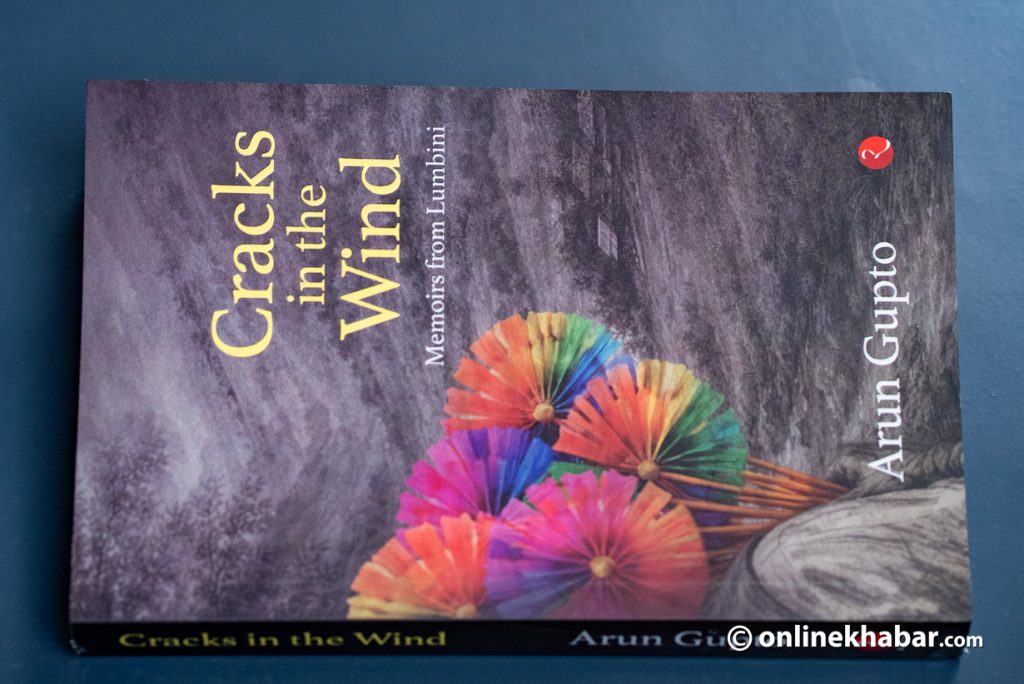
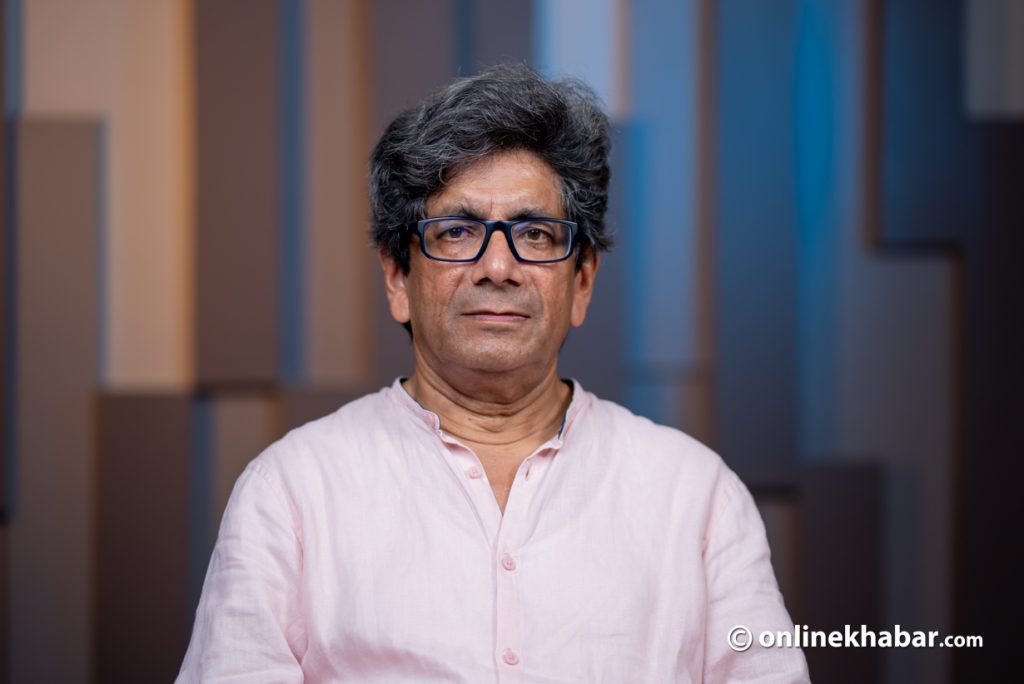
Arun Gupto, a professor of English literature and cultural studies, has long been a revered intellectual figure. Known for his heavyweight academic publications with prestigious international publishing houses like Routledge and Rupa, Gupto is a scholar who commands deep respect in academic circles. However, his latest literary endeavour reveals a profoundly different side of him.
His recently released book, Cracks in the Wind: Memoirs from Lumbini (published by Rupa Publications), steps away from rigid academic jargon to immerse the reader in the vivid, tapestry-like reality of his childhood, adolescence, and the multicultural landscape of a border town in Kapilvastu, Nepal.
Blurring the lines between fact and fiction, the memoir captures the changing societal tides of the Terai region through a cast of eccentric, poignant, and forgotten characters. Onlinekhabar spoke to Professor Gupto to discuss his shift to creative writing, the magic realism underlying the plains of Lumbini, and why a good novel demands the luxury of time.
Your new book, Cracks in the Wind: Memoirs from Lumbini, has just hit the shelves. As an academic, how do you personally define this genre?
This book isn’t a conventional autobiography; in literary terms, it is a memoir. To me, there is a distinct line between the two. While an autobiography relies strictly on documented, chronological facts, a memoir permits a degree of fictionalisation and creative reimagining.
This book is a narrative of my childhood and adolescence spent in Bahadurganj, Kapilvastu, near the sacred site of Lumbini. But it isn’t just my story. It is the story of a changing, multicultural society on the Indo-Nepal border, a melting pot where Awadhi, Bhojpuri, and hilly communities coexist, and where Hindi and Nepali languages seamlessly blend. It’s a story of that unique space and its people.
When writing Cracks in the Wind, infusing real-life events with fiction, were you ever worried that the truth would get lost, or that readers might find the stories unbelievable?
I worried about that immensely. However, because these stories are anchored in Bahadurganj, Kapilvastu, the land of the Buddha,I wanted to evoke an aura of purity and non-political innocence without directly writing about the historical Buddha. To achieve that, I leaned into magical realism. If you want to recreate an essence of ‘Buddha-hood,’ you have to step into fiction.
For instance, the historical Buddha had a female disciple named Khema. In the book, I created a character named Khema, who is left behind at our village high school by an Indian monk travelling on a pilgrimage. She grew up as my classmate but became deeply disillusioned by the patriarchal society that barred her female friends from studying or playing sports. She eventually retreats into the jungle. To elevate her character to a Buddha-like image, I had to resort to fiction and magic.
Historically, your writing has been academic, focused on literary criticism, theory, art, and archaeology. Why choose this moment in your life to look inward and reflect on your past?
There are two reasons. First, I was surrounded by these phenomenal village characters, and I felt a strong creative urge to immortalise them through a fictionalised lens. Second, my Professor Shreedhar Lohani made a wonderful observation about this shift. He said, “Arun, you have taught theory your entire life, but in this book, you have finally given ‘flesh’ to theory.”
Writing academic theory doesn’t stifle creativity; rather, the challenge lies in how you manifest that theory into a living, breathing form. When I first pitched this book in the Indian market, publishers were sceptical. They said, “You are a man of theory; your previous books are deeply ideological. How did you write something akin to a novel?” But once they read the manuscript, they accepted and published it within three to four months.
Twelve years is a long time for a single book. Why did it take so long?
I always tell aspiring novelists that creative writing demands time. Kiran Desai took nearly a decade to write The Inheritance of Loss. If you rush, character development suffers. I can churn out an academic book in a year or two; in fact, while writing this memoir, I published three theoretical books with Routledge and Rupa.
But a memoir like this requires patience. Spending time allows a writer to dive into a character’s “interior monologue”, to understand what they are thinking from within. In The Old Man and the Sea, Hemingway doesn’t just narrate; he enters the interiority of the character. To capture what a character is truly thinking, rather than what the author wants them to think, takes years. Taking my time with this book was highly rewarding.
Are you someone who can only write one book at a time, or do you juggle multiple projects simultaneously?
I am reminded of a quote by Rabindranath Tagore, “A change of profession is relaxing.” Sometimes, writing in the same genre becomes exhausting, so I step away for a month or two.
Returning after a break allows me to spot my own mistakes with a critical eye. Juggling between a novel and a theoretical book actually sharpens my editing skills. Writing across two or three different genres simultaneously works well for me; they feed into each other.
It seems you are constantly seeking truth in the intersection of fact and fiction.
Yes, that is where I thrive. I am not a traditionally religious man who visits temples every day, but I have a profound fascination with the deities and myths of Kathmandu. This valley houses fifteen to twenty different goddesses dedicated specifically to knowledge and performance.
If we look at these ancient deities solely through the lens of religious rules and historical data, without embracing their mythical and fictionalised dimensions, we fail to comprehend the true imagination of this thousand-year-old valley. Fact and fiction must coexist. Fiction does not exist to tell lies; rather, it serves to glorify and illuminate the truth. I simply attempt to bridge the two.
What is your next book going to be about?
I am currently working on two books. One is non-fiction. When I visited Florence, Italy, I noticed striking similarities between Florence and Kathmandu; both are monumental cities of art and culture. I am co-authoring a book with my daughter titled Dimensions of Art: From Florence to Kathmandu.
The other project stems from the immense grief I’ve felt over the conflict and loss of life in Palestine. I am writing a magic-realist fiction featuring a Palestinian sister and brother as the protagonists. Stylistically, it will be heavily inspired by Gabriel García Márquez’s brand of magical realism.