

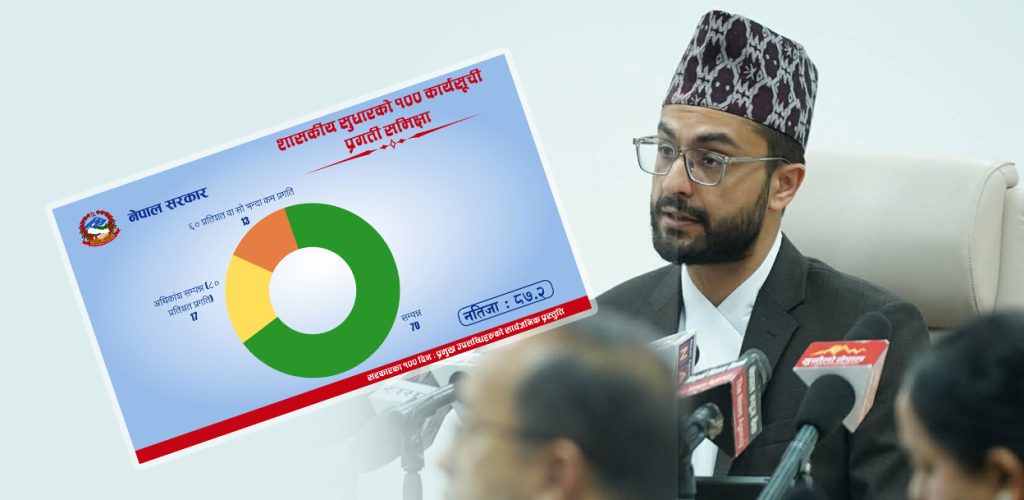
The government led by Prime Minister Balendra Shah (Balen) has released its hundred-day report card.
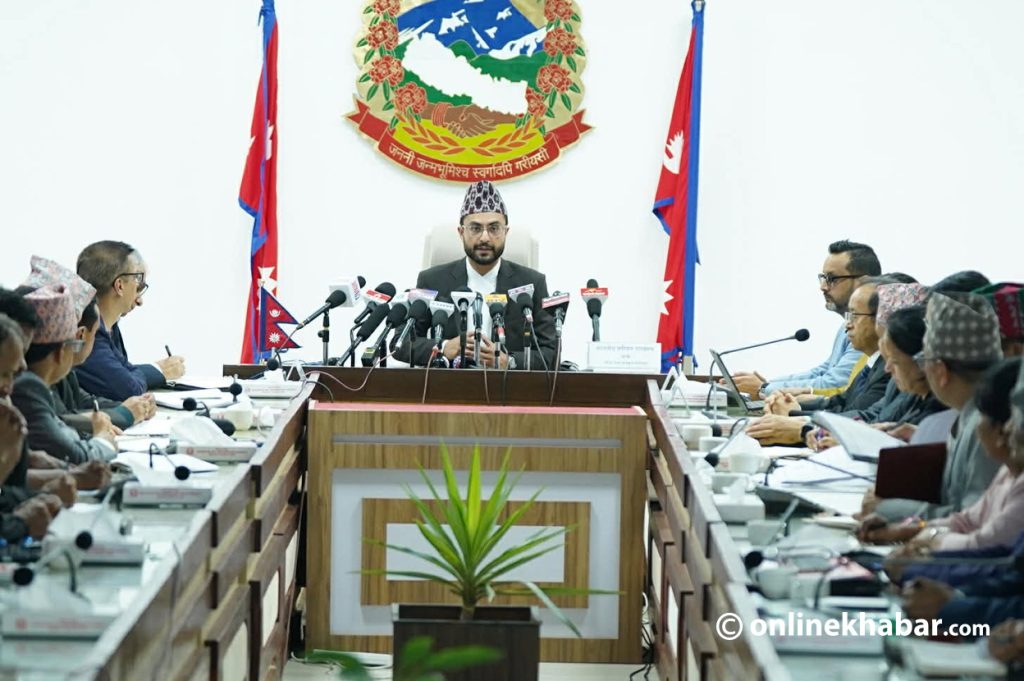
Government spokesperson and Minister for Education and Sports Sasmit Pokharel held a press conference on Saturday to announce the government’s key achievements from its first hundred days.
The government had earlier published a hundred-point agenda for governance reform. It now claims that most of the tasks it committed to completing within the hundred days have been finished. Citing that 70 percent of the work is fully complete, 13 percent is more than 60 percent complete, and 17 percent is more than 80 percent complete, the government has given itself an overall score of 87.2 percent.
At Saturday afternoon’s press conference, spokesperson Pokharel said the government had designated its first year as the foundation year for governance reform, aimed at building the base for long-term governmental transformation.
He said reform programs were being pursued vigorously in priority areas including administrative reform, public service delivery, digital governance, good governance, financial discipline, project management, infrastructure development, and the social sector.
Under the hundred-point governance reform agenda, each activity had been detailed with timelines, responsible ministries and agencies, and performance indicators, with regular monitoring, coordination, and facilitation arranged through the Office of the Prime Minister and Council of Ministers.
The document released to mark the completion of the government’s first hundred days covers the major work carried out by ministries and agencies as per the agenda, along with achievements and preliminary results.
Pokharel said the document also includes significant work completed by various ministries during the hundred days that fell outside the formal governance reform agenda.
He said the government remained committed to making its governance reform efforts more institutionalised, refined, and results-oriented going forward, so that citizens could directly feel the effects of good governance.
The hundred-point governance reform agenda was approved and put into implementation at the first Cabinet meeting held on March 27, after the government was formed under the leadership of the Rastriya Swatantra Party (RSP).
Spokesperson Pokharel said the government had taken strict steps against corruption as part of efforts to improve governance, control corruption, and reform public services.
“To end the corruption, asset concealment, and impunity prevalent in the country, an asset investigation commission has been formed under the Commission of Inquiry Act, 2026,” he said.
According to the document, the commission formed by Cabinet decision will investigate the assets of political office-holders and senior government officials who held public positions from 2062/63 to 2082/83 BS, and will recommend action to the government under prevailing law against anyone found to have illegally acquired assets.
The government stated that the commission has built its administrative and institutional structure and has so far collected more than 11,000 asset declarations and complaints, which are now being recorded, categorised, and undergoing preliminary analysis.
Under the good governance, anti-corruption, and public service reform agenda, the Cabinet has decided to implement the report of the high-level inquiry commission on the Nepal Children’s Organisation and Bal Mandir.
“As part of implementing that decision, Nepal Police’s Central Investigation Bureau (CIB) is investigating matters including fraud-related offences connected to Bal Mandir, illegal renting out of Nepal Children’s Organisation and Bal Mandir land leading to misuse of government property, and children being unlawfully sent abroad through unauthorised adoption,” the document states.
The document also notes progress on implementing the report of the high-level inquiry committee on the Ncell share purchase-sale and ownership transfer dispute.
“As part of implementing that report, the CIB is continuing its investigation into offences related to fraud, criminal activity, and breach of trust,” it states.
The Cabinet has also decided to implement inquiry reports from various commissions or committees formed over political and criminal incidents. Spokesperson Pokharel said the Office of the Prime Minister and Council of Ministers has directed all concerned ministries to implement such reports accordingly.
Another item on the government’s hundred-point agenda was financial crime and money laundering. Pokharel said the Department of Money Laundering Investigation has brought individuals involved in the misappropriation of state funds and improper policy-level dealings within the scope of the law on charges of financial crime and money laundering.
She said that under a zero-tolerance policy on corruption, the department has filed seven cases naming 101 individuals and legal entities as defendants, with claims totalling 118 billion rupees in damages.
The government continues to pursue investigations through the CIB against individuals implicated in offences under the Securities Board Act, 2063 BS, and has similarly brought individuals involved in banking offences within the legal net.
To make anti-corruption efforts more systematic, the government says it has begun the process of establishing an integrated digital asset-tracking system covering bank accounts, digital wallets, share investments, and other financial activities.
“This system’s development and operational modality is being prepared in coordination with the Ministry of Finance, the Inland Revenue Department, and Nepal Rastra Bank,” Pokharel said. He added that, following the decision to shut down betting apps and related websites within 24 hours, more than 200,000 domain links have been blocked across various service providers.
The government also reported that, for crime control and public safety, police have brought under control 495 middlemen involved in mutual transactions with various government bodies during the hundred days. “Cases have been filed against 170 of them,” the document states, adding that 13,696 people involved in attacks on private property and looting have been brought under control, with 6,195 cases filed.
For industrial and business security, a rapid-response mechanism has been set up in all 77 districts, with 15,439 armed police personnel kept on standby. The government claims that by deploying traffic police alongside Nepal Police and the Armed Police Force, and coordinating with relevant agencies on road obstructions, strikes, or blockades at 1,469 locations across the 77 districts, it has ensured citizens’ right to safe movement.
The hundred-day achievements also include the installation of CCTV cameras for citizen safety in public vehicles and monitoring of SOS buttons in ride-sharing apps. “4,259 CCTV cameras have been installed in key areas nationwide with peace and security risks,” the document states, adding that the Armed Police Force Nepal has established a rapid-contact system with industries, banks, and security agencies.
The government has mobilised police personnel for highway security and formed 77 Viber/WhatsApp groups across the 77 districts, linking up 995 organisations. It says surveillance has been intensified through Armed Police Force patrols in industries, business centres, transport routes, and other key areas.
The document also notes that budget has been released to make Nepal Police’s Central Investigation Bureau more technologically equipped, with the procurement process for forensic software and forensic workstations underway.
Spokesperson Pokharel said legal action had been taken against conflicts of interest within the first hundred days of the government’s formation. She said the government had issued the long-demanded National Integrity Policy, which covers promoting integrity, developing and enforcing a code of conduct, and controlling conflicts of interest.
The government expects that implementing the Cabinet-approved policy will institutionalise transparency and accountability across the government, private, and non-government sectors, laying the groundwork for a more disciplined society.
Pokharel said the Ministries of Home Affairs, Finance, Culture, Land, Women, Youth, and Labour, among others, have issued the Employee Code of Conduct, 2083 BS, and begun strict implementation and monitoring.
“The government is closely monitoring undesirable activities carried out outside official propriety for personal gain, and has expanded the legal scope to discourage those involved in such activities,” he said.