
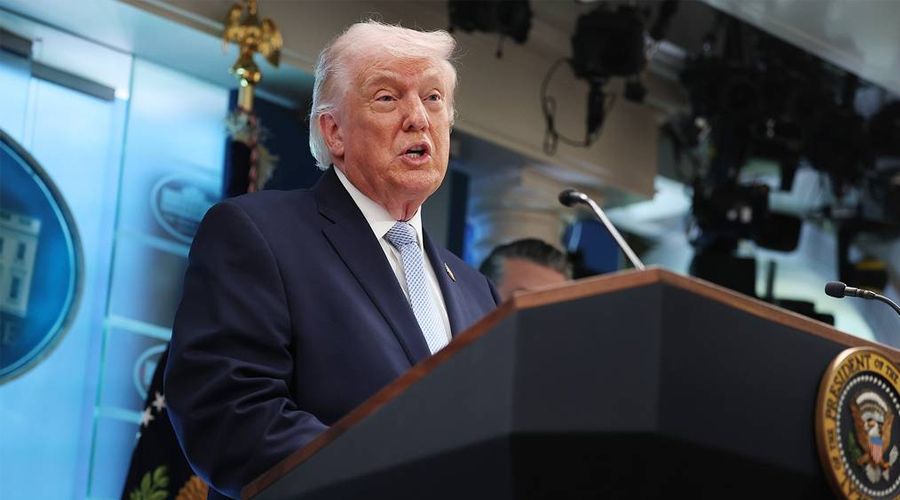
The recent visit of US President Donald Trump to China and his bilateral talks with President Xi Jinping have once again drawn the focus of global politics. During the intensive dialogue lasting over two hours at Beijing’s Great Hall of the People, Chinese President Xi raised a profound historical concept of international relations, the “Thucydides Trap,” asking how the United States and China could escape it.
Connecting the historical context where misunderstandings between an established superpower and a rising power often trigger war due to third-party actions or external factors, Xi emphasised that in the changing dynamics of the new era, both nations must sketch a framework for fresh strategic stability to avert confrontation.
This visit, on one hand, attempted to shield the relationship between the world’s two largest economies and superpowers from a more complex turn, while on the other, it sparked a fresh debate regarding the future of the global order.
This historic summit offered a crucial opportunity to establish direct communication at the leadership level, rising above the Cold War mentality. President Trump’s visit marks the first by a US president to China in nearly a decade, described by both sides as “historic and a milestone.”
At a time when Trump champions the Make America Great Again (MAGA) agenda, and Xi targets the rejuvenation of the Chinese nation, competition between the two nations appears natural; yet, high-level political and diplomatic etiquette was fully utilised to prevent it from turning into war.
The primary focus of the talks was managing the existing global friction and drafting a new roadmap for the benefit of both peoples and humanity at large, which has provided an immediate sigh of relief to global markets and international politics.
Historical background of the Thucydides Trap
The “Thucydides Trap” is a famous political theory named after the ancient Greek historian Thucydides. Analysing the “Peloponnese War” between Sparta (the established power of the time) and Athens (the rising power), he noted that when a rising power threatens to displace an established power, it creates fear and insecurity in the established state, which ultimately leads to war. Professor Graham Allison of Harvard University revived this concept in the modern context of US-China relations.
Historical studies show that over the past 500 years, there have been 16 major instances where a rising power challenged an established one. Out of those 16 cases, 12 ended in devastating wars, such as World War I and World War II. In only 4 instances did diplomatic ingenuity and nuclear balance avert war, with the Cold War between the United States and the Soviet Union serving as the prime example.
This trap becomes active when two nations engage in intense competition across trade, technology, and military spheres. In such a scenario, even if the heads of state are prudent, a minor miscalculation by a third party or an external factor can drag both superpowers into the vortex of war against their will. The established power adopts aggressive policies out of fear of losing its hegemony, while the rising power feels mistrustful when it perceives its natural expansion and respect are being denied.
Xi Jinping pointed to this historical destiny during his talks with Trump, advocating for a new type of “Great Power Relations” to avoid such a suicidal war in the current technological era. By showcasing this mirror of history, China aimed to make the US understand that if both sides do not control their ambitions in time, the manoeuvres of an external third party could lead them into a suicidal military showdown, the price of which would be paid by human civilisation itself.
Changing global context and possibilities
The context of history and present times is entirely different, so the Thucydides Trap cannot be considered an inevitable or immutable destiny. Past wars focused primarily on territorial capture and conventional military prowess.
However, in the 21st century, the economies and technologies of the US and China are so deeply intertwined that the collapse of one would inevitably ruin the other. Due to “globalisation” and “economic interdependence,” both countries are bound by a strong commercial chain.
Deals involving Boeing aircraft purchases, agricultural trade, and semiconductor chip supplies make it clear to both sides how expensive the economic cost of war would be. Another primary reason is the presence of nuclear weapons. Just like the US and the Soviet Union during the Cold War, both the US and China possess nuclear capabilities that can destroy each other (MAD – Mutually Assured Destruction). This makes direct military confrontation highly unlikely, as there would be no winner in such a war.
Both countries also need each other’s cooperation to tackle shared global challenges like technological governance and climate change. Therefore, if both nations respect each other’s strategic “Red Lines” and resolve misunderstandings through high-level mechanisms, this historical trap can be easily averted. As today’s world moves toward multi-polarity, the role of small and medium-sized nations has also become equally significant.
Hence, to avoid a clash between China and the US, it is necessary to abandon old alliance politics and encourage multilateral dialogue. The trap of history is merely a warning, not a decree of fate. If Washington and Beijing view their national interests in alignment with global stability, it is entirely possible to alter the path of war shown by Thucydides and establish a new, modern model of peaceful coexistence and healthy economic competition.
Official agreements in the joint statement
In the official statements and joint briefings released after the conclusion of the talks, both leaders agreed on a new approach of “Constructive Strategic Stability.” This agreement aims to provide a positive direction for the bilateral relationship over the next few years. Commitments were officially made to stabilise economic and trade ties, expand practical cooperation in various fields, and address each other’s core concerns.
The resumption of military-to-military communication and diplomatic channels was also announced, ensuring that any potential accident or misunderstanding could be intercepted immediately. On the economic front, major commercial agreements took shape, with Trump mentioning to the media China’s plans to purchase a substantial number of Boeing aircraft. Additionally, an environment was created for the US to sell billions of dollars’ worth of agricultural goods to China.
Discussions were also held on forming a joint board to monitor investments in non-sensitive sectors. Another crucial official agreement occurred in the field of Artificial Intelligence (AI), where both nations agreed to establish a new protocol or framework to prevent dangerous AI models from falling into the hands of non-state actors. This confirms that both sides share a common interest in preventing the misuse of technology.
Although climate change agendas saw a slowdown, clauses to maintain technical subcommittees on green energy technology exchange and carbon emission reduction were included in the joint statements. Looking at it this way, the official agreements primarily served as a “fencing” or protective wall to prevent immediate deterioration of economic and technological relations, offering a positive and steady morale to the global market.
Secret agreements and unfulfilled expectations
During the visit, diplomatic trade-offs and certain tacit understandings that did not directly appear in the joint statement also garnered significant attention. Particularly regarding the Middle East crisis and Iran, as Trump claimed, China gave verbal assurances that it would not supply military hardware to Iran and would use its influence to keep strategic waterways open. In return, the US gave the green light for certain Chinese tech firms to purchase powerful semiconductor chips.
This is expected to provide substantial relief for China’s domestic technology development and AI research. It is evident that a “give-and-take” occurred behind the scenes on technological and geopolitical issues, which both sides chose to keep discreet due to strategic confidentiality. However, this visit failed to produce a concrete breakthrough on the most sensitive bilateral issue: Taiwan.
President Xi issued a stern warning that Taiwan’s independence is entirely unacceptable to China and crossing this “Red Line” could trigger an outright war. Trump did not give a definitive answer regarding US military actions to defend Taiwan and kept his decision reserved on the arms sale package. China’s expectations of reducing trade tariffs and completely lifting technology restrictions, as well as US expectations of halting Beijing’s military expansion in the South China Sea, remained unfulfilled.
For this reason, several analysts have labelled this summit a “status quo agreement,” keeping big differences intact. Neither country abandoned its strategic stance; rather, they merely displayed diplomatic shrewdness by shelving current tensions temporarily for immediate commercial interests.
In summary, US President Donald Trump’s visit to Beijing played a vital role in cooling down the immediate friction in US-China relations and providing the world some relief from the dread of the Thucydides Trap. Although Thucydides’ historical trap remains a genuine challenge, war is not inevitable due to the complex architecture of the modern world, nuclear deterrence, and economic interdependence.
The personal chemistry and dialogue between the top leaders minimised the risk of a strategic accident. Even though severe differences over Taiwan and technology persist, both nations have opted for the path of “constructive strategic stability,” managing the conflict within a specific boundary.
This diplomatic understanding inspires a strong hope that the upcoming days will guide global politics and economy toward multipolarity, establishing a new dimension of peaceful competition and averting history’s suicidal trap through diplomacy.