
Nepal is projected to receive below-average rainfall and above-average heat during this year’s monsoon season.
The weakening of this year’s monsoon is attributed to changes in the El Niño pattern developing in the Pacific Ocean and shifts in the Indian Ocean Dipole (IOD) in the Indian Ocean. However, some parts of Nepal may still experience heavier-than-normal rainfall in isolated areas.
The monsoon season in Nepal is considered to span from June to September, during which approximately 80% of the country’s annual rainfall occurs. The monsoon directly affects agriculture and the national economy, and public interest in it is high because floods and landslides during this period often cause significant loss of life and property.
The South Asian Climate Outlook Forum (SASCOF), in which Nepal participates, publishes seasonal weather forecasts for South Asian countries every year. Based on the forum’s findings, Nepal’s Department of Hydrology and Meteorology also provides information on the expected monsoon situation annually. The department has scheduled a meeting this coming Friday to brief all stakeholders on this year’s monsoon conditions.
What SASCOF report state?
A SASCOF meeting was recently held in Malé, Maldives, attended by meteorologists from nine South Asian countries: Afghanistan, Bangladesh, Bhutan, India, Maldives, Myanmar, Nepal, Pakistan, and Sri Lanka.
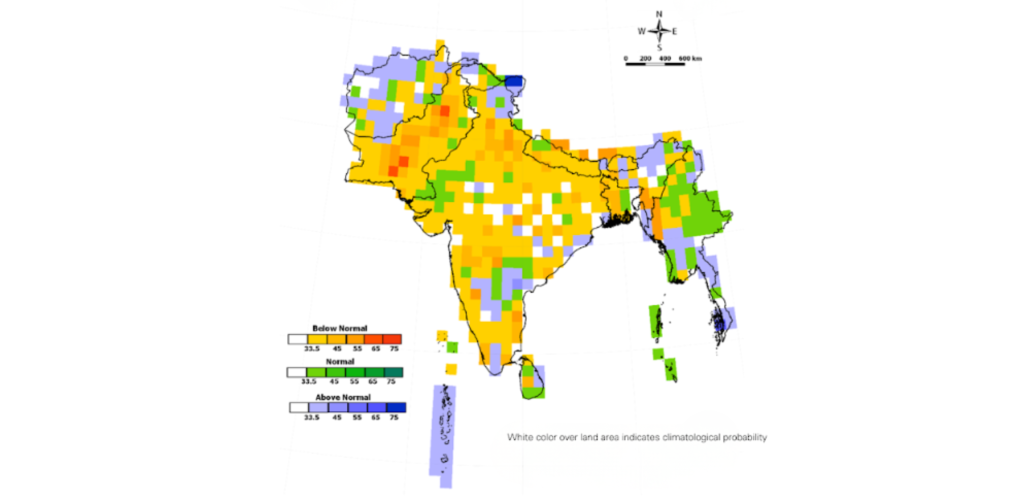
The meeting published a report projecting that during the May–September monsoon period this year, some parts of South Asia’s northwestern, northeastern, and southern regions will receive normal or above-normal rainfall, while the central region is expected to receive below-normal rainfall.
Nepal’s eastern parts lie close to the northeastern region projected to receive “normal or above-normal rainfall.” However, the larger portion of Nepal falls within the central region projected to receive “below-normal rainfall.”
Therefore, while some localised areas of Nepal may get heavy rain, the overall expectation is for below-average rainfall nationwide.
Dr Binod Pokharel, Associate Professor in the Department of Hydrology and Meteorology at Tribhuvan University, also states that the monsoon is likely to be weak during its early phase and that most parts of the country are likely to receive below-average rainfall. According to him, the period from June to July is likely to be dry.
This uncertainty in the monsoon is expected to have a direct impact on the country’s agriculture and hydropower sectors. Meteorologist Pokharel estimates that if the first half of the monsoon is dry, only 30 to 40 percent of normal rice planting may be possible this year.
Why is monsoon weakening?
According to meteorologists, two main weather systems appear to be responsible for this year’s weak monsoon: the El Niño effect and the Indian Ocean Dipole (IOD).
El Niño refers to the condition where Pacific Ocean temperatures are higher than average. This weakens the South Asian monsoon. Although this condition is currently moving toward neutral, its lingering effects and atmospheric changes are expected to slow down cloud formation processes in June and July.
Similarly, Indian Ocean temperatures (the IOD) play a major role in Nepal’s monsoon. According to various international models, the Indian Ocean conditions in June–July this year are not expected to be favourable for the monsoon. This could create an obstacle for moisture-laden winds to reach Nepal.
Agriculture, considered the backbone of Nepal’s economy, depends on monsoon rainfall for 75 to 90 percent of its needs. If rainfall decreases, paddy farming and other monsoon-dependent crops could be affected, raising the risk of food insecurity. Additionally, since most of Nepal’s hydropower projects are run-of-river type (dependent on river flow), a shortage of rainfall could revive fears of load-shedding or energy shortages in the coming winter.
What does the DHM Say?
It is projected that during this year’s monsoon season, not only will rainfall be below average, but daytime and nighttime temperatures (maximum and minimum) will also be higher than average. Experts warn this could have adverse effects on public health, particularly in the Terai region, where it may impact agricultural productivity and daily life.
However, Department spokesperson Vibhuti Pokharel cautions that many other factors influence Nepal’s monsoon, making it difficult to state anything definitively at this point.
“El Niño conditions exist, but there are many other factors that also affect Nepal’s monsoon. It is not yet possible to say with certainty what this year’s monsoon will be like,” says Pokharel. “Since the monsoon forecast is updated periodically, it is necessary to monitor the situation closely.”
In recent years, the effects of climate change have caused widespread shifts in weather patterns. Even during the rainy season, some areas experience extreme rainfall while others receive almost none.
Experts therefore recommend selecting alternative crops that require less water, storing water for drinking and irrigation, and implementing temperature control and other