
Supporters walking ahead of and behind candidates shake their mobile phones to produce a sound of a ringing bell, loud enough to reach voters in villages and neighbourhoods. These scenes, now viral on social media, are closely associated with the Rastriya Swatantra Party (RSP).
The trend, which began a few weeks ago, has been gaining momentum. At its centre is a website called ghanti.website.
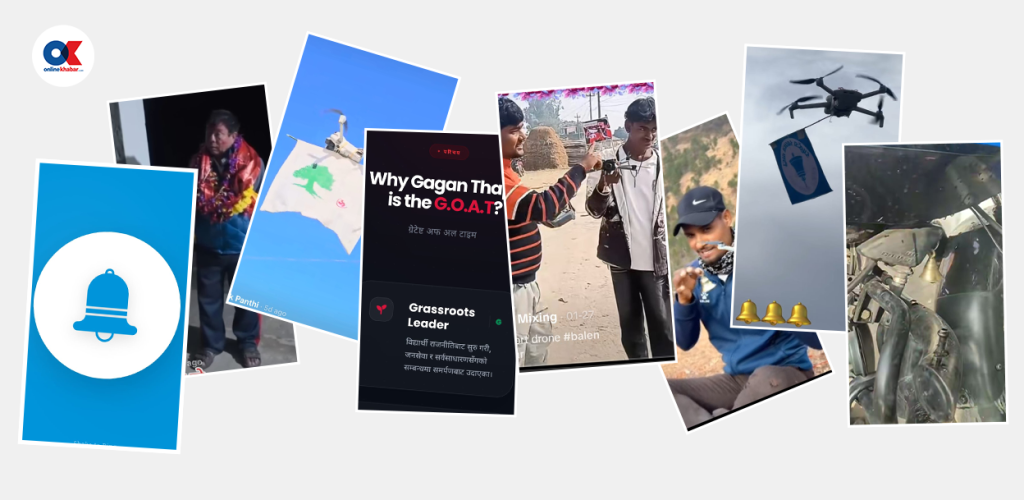
The site, created by an RSP supporter, appears to have been registered on January 23 for a one-year term. When opened, it displays a bell inside a white circle against a blue background. Touching the blue bell triggers a sound. When the phone is shaken from side to side, it rings ting, ting, ting.
The sound closely mimics that of a real bell. RSP members, whose election symbol is a bell, are using it to solicit votes. Videos circulating on social media show candidates walking through neighbourhoods as supporters ring the digital bell on their phones. Wherever RSP leaders and supporters visit, the ringing follows, made easier by the Ghanti. website.
As political parties take their campaigns from digital spaces into voters’ homes, accusations and counteraccusations have also intensified. One of the most frequently used jabs in recent weeks has targeted Nepali Congress leader Gagan Thapa, who has been labelled bakhra (goat).
Opponents have seized on a rumour circulating on social media alleging that Thapa misused subsidies meant for goat farming. As the nickname “Bakra” or “Muttonkaji” spread widely online. Thapa’s repeated clarifications failed to stem the tide. With the election campaign in full swing, the label only gained traction.
In response, Thapa’s supporters appear to have decided to turn the mockery into what they call “political capital.” On January 16, they registered a domain, mutton.world, for one year, later updating it on January 21. The site initially asked, “Why vote for Muttonkaji?” and listed Thapa’s agendas. In English, it urged voters to support the “GOAT,” highlighting his record and plans.
The site has since been redesigned. Earlier content has been removed, and it now opens with the slogan “Gagan Thapa for a New Nepal,” alongside his personal profile. While new material has been added, one section remains unchanged: “Why Gagan Thapa is the GOAT”, this time clarifying the acronym as “Greatest of All Time.”
Even the website’s tab title reads: “GOAT of Nepal, Gagan Thapa,” signalling an effort by his supporters to reclaim and satirically reframe the goat nickname as a badge of pride.
Among candidates adopting distinctive approaches is Sachin Timilsena, widely seen as close to Thapa and running in Kathmandu–4. While his broader campaign resembles those of others, his recent initiative, Sachin Sanga Sambad (Dialogue with Sachin), stands out.
Under the program, Timilsena holds phone conversations every evening with voters from his constituency. He listens to grievances, answers questions, and takes notes in a diary, promising to address the issues raised. From Kathmandu–5, RSP candidate Sasmita Pokharel has also drawn attention with his creative campaigning, particularly his vlogs.
In the vlog, Pokharel speaks casually about his ideas. Often, the person asking him questions is his wife, Sushmita Adhikari. In one video, she asks him from inside a moving car, “What will you do differently from other lawmakers?”
Pokharel replies, “I will work with a strong legal team on every bill that enters Parliament, examine each clause, study loopholes, and show what the role and dignity of a lawmaker should look like.”
The couple records these conversations inside the car and posts them on social media, a format that appears to have resonated with voters and online audiences alike.
Another candidate frequently cited for his unconventional style is Mahabir Pun, an independent candidate from Myagdi. He does not ask voters directly for their ballots. Instead, he tells them, “Vote if you feel like it. If someone better than me deserves it, vote for them.” Often, he ends up selling copies of his autobiography during door-to-door visits.
Pun has openly said, “When I come asking for votes, you can also buy my book.”
His approach has drawn attention on social media. Visiting villages with simple scarves and garlands, Pun tells voters plainly, “I don’t make promises. But I do what I can. I have never worked for personal gain.”
When voters attempt to compare him with others, he asks them not to.
As candidates emphasise distinctive styles, the use of technology has also expanded. Drones have become campaign tools. Five days ago, Shalik Panthi posted a video showing a Nepali Congress flag tied to a drone and flown through the air. The white flag bearing the party’s tree symbol has since circulated widely on social media.
RSP supporters have followed suit, even tying bells to drones and flying them alongside party flags. Some have gone further, hanging bells from their motorcycles, images that have spread rapidly online.
In another video posted by a TikTok account called Shiva Video Mixing, a drone carries a photograph of Kathmandu Mayor Balen Shah, draped in a flag and offering a namaste.
The video bears the caption: “This time, Balen government.”
From drones to reels, websites to online groups, leaders and activists are deeply engaged in digital campaigning. As younger voters gravitate toward these methods, Nepali Congress leader Shekhar Koirala has adopted a different approach.
Koirala wrote personal letters to leaders, party workers, and voters in his constituency, nearly 6,500 people, including active party members. In the letters, he thanked them for past support and apologised for failing to do justice to their expectations.
“If, after being sent to national responsibility with such selfless support, I have failed to serve my dear brothers and sisters of this constituency, I sincerely ask for forgiveness,” he wrote.
Alongside the apology, Koirala asked voters to elect him once again. His old-school, personal approach has also been widely appreciated.
As election day approaches, Nepal’s political leaders appear determined to seek votes in every way they can, each striving to stand out with a style of their own.